The traditional real estate market often rewards patience, but in 2026, speed is the ultimate premium service. While many sellers believe a fast exit requires a massive sacrifice in equity, the most sophisticated property owners realize that certainty is a financial asset. You’re likely facing holding costs like taxes and insurance that drain your potential profit while you search for reputable companies that buy houses for cash. It’s frustrating to watch your equity vanish while waiting for a financed buyer who might back out at the last minute.
This guide delivers the professional framework required to evaluate liquid exit strategies without falling prey to predatory offers. We’ll show you how to secure a clean, no-contingency contract and close in under 14 days with zero repairs or commissions required. You’ll learn to distinguish between iBuyer service fees and direct investment models, ensuring you convert your property into liquid capital on your own timeline. We’re breaking down the latest 2026 FinCEN regulations and market shifts to help you execute a high-speed, friction-free transaction.
Key Takeaways
- Leverage 2026 market shifts to determine why cash offers now provide more stability than traditional retail listings.
- Compare iBuyers and local companies that buy houses for cash to ensure your property’s condition doesn’t disqualify you from a fast exit.
- Master the “70% Rule” and calculate your property’s burn rate to understand the real financial benefit of an immediate closing.
- Implement a professional vetting process to verify proof of funds and earnest money deposits before signing any contract.
- Access direct liquidity in major hubs like Atlanta and Memphis to convert your real estate into capital in under two weeks.
Companies That Buy Houses for Cash: The 2026 Market Landscape
Cash home buying is a strategic exit strategy powered by private capital. Unlike retail buyers who rely on mortgage approvals, companies that buy houses for cash use ready liquidity to bypass the traditional banking system. In 2026, this model has gained significant traction due to persistent interest rate volatility. When rates fluctuate, financed offers become unstable. A cash offer provides a fixed certainty that retail listings simply cannot match.
Speed is not just a convenience; it’s a measurable financial benefit known as the Liquidity Premium. Every month a property sits on the market, it incurs holding costs including property taxes, insurance, and utilities. In 2026, financing contingencies remain the primary cause of contract failure. By removing the mortgage requirement, you eliminate the risk of a deal collapsing days before closing because of a lender’s last-minute denial. This certainty allows you to plan your next move without the fear of a sudden transaction collapse.
The Three Main Types of Cash Buyers
The market is divided into three distinct categories. First, the iBuyer transaction model uses algorithmic valuation to target properties in nearly perfect condition. These platforms prioritize high-volume, low-risk acquisitions. Second, franchise investors operate national brands with local boots on the ground to handle various property types. Finally, direct local investors specialize in specific hubs like Atlanta, Memphis, or Detroit. These local firms often provide the most flexibility for properties requiring significant structural intervention or those that don’t fit the rigid criteria of tech-driven platforms.
Why Sellers Prioritize Cash Over the MLS
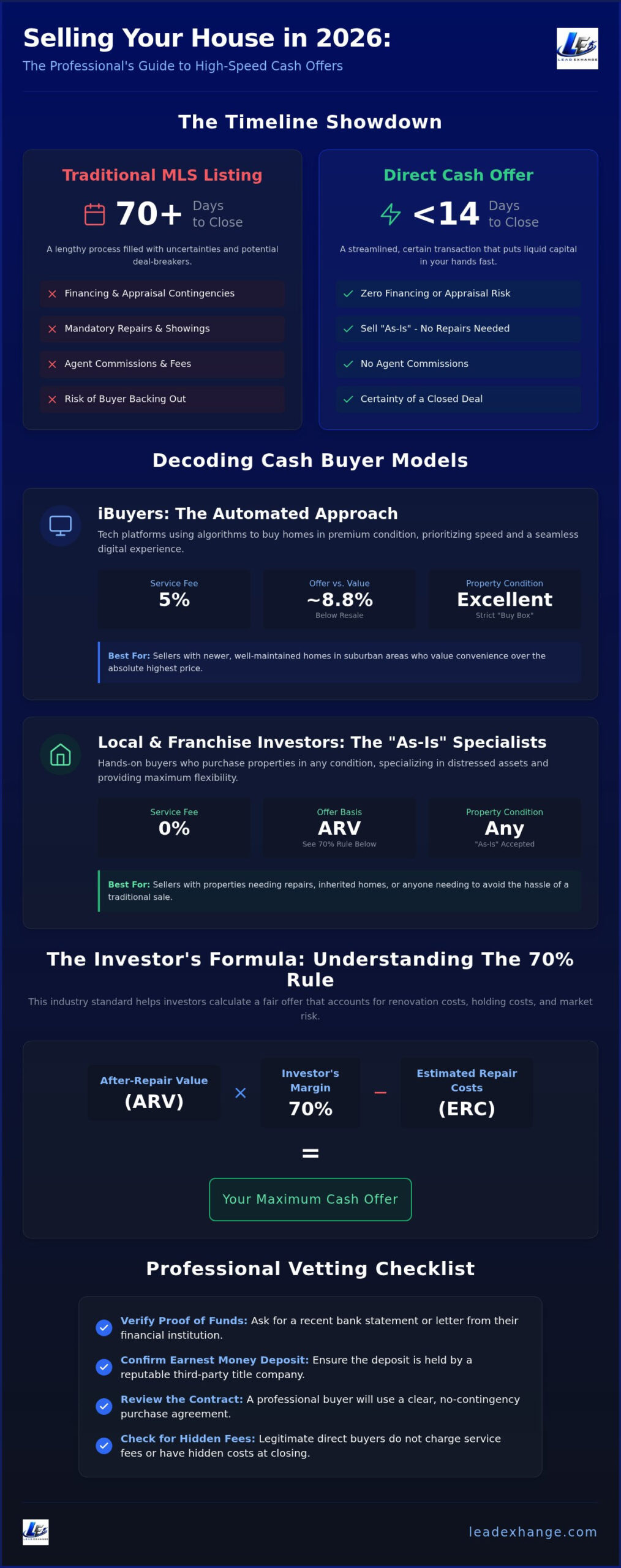
Sellers are increasingly moving away from the Multiple Listing Service (MLS) to avoid the friction of retail sales. The average listing-to-close timeline in many markets still hovers around 70 days. Cash sales compress this window into less than two weeks. You bypass the inspection and repair cycle where retail buyers demand expensive upgrades before closing. Additionally, you avoid appraisal gaps. In a fluctuating market, a bank’s appraisal might come in lower than the agreed price, forcing you to lower your ask or lose the buyer. Cash buyers remove this obstacle entirely, ensuring the price on the contract is the amount you receive at settlement.
Comparing iBuyers, Franchise Investors, and Local Cash Buyers
Selecting the right partner depends on your property’s condition and your financial goals. Not all companies that buy houses for cash operate under the same business model. You must evaluate them based on offer price, closing speed, and condition requirements. For a deeper dive into these options, see our Sell Your Home Fast for Cash: 2026 Comparison & Guide.
iBuyers have a strict “buy box” that often excludes properties with foundation issues, outdated electrical, or significant structural damage. If your home doesn’t look like a move-in ready rental, an algorithm will likely decline the deal. This is where local expertise becomes vital. A buyer in Detroit or Birmingham understands the specific street-level value that a national tech platform misses. They see potential where software sees risk.
IBuyers: High-Tech Convenience with Strict Standards
Major tech-driven platforms prioritize speed through automation. As of early 2026, leading iBuyers typically charge a 5% service fee. Research indicates their offers average approximately 8.79% below the home’s eventual resale value. While the process is efficient, it’s designed for houses in premium condition.
- Pros: You get a streamlined digital process and the ability to pick your own closing date.
- Cons: High service fees and strict condition requirements. They only want “pretty” houses.
- Best for: Sellers with newer homes in suburban markets who prioritize a seamless move over the highest possible price.
Local Investors: Strategic Partners for Distressed Assets
Local investors and national franchises represent a different class of companies that buy houses for cash. They focus on the “as-is” market and don’t charge service fees; their profit comes from the renovation. These buyers typically offer between 50% and 70% of the property’s after-repair value (ARV). This model is essential for properties that don’t meet the standards of Federal Trade Commission consumer protection guidelines for safe, habitable housing without significant investment.
- Pros: They buy in any condition and understand local neighborhood trends that algorithms ignore.
- Cons: Lower cash offers to account for the risk of renovation.
- Best for: Sellers in Memphis, Jackson, or Gulfport with properties needing major repairs. If you need an immediate exit from a difficult asset, you can request a direct cash offer today.
The Economics of Fast-Cash Sales: Value vs. Convenience
Profit is often measured by the final sale price, but sophisticated sellers look at net liquidity. When you evaluate companies that buy houses for cash, you aren’t just comparing offer numbers. You’re comparing the total cost of a transaction. Traditional sales involve a “burn rate” that many homeowners ignore. This includes property taxes, insurance premiums, and utility costs that accumulate every month the home remains on the market. In a slow market, these holding costs can easily erase a significant portion of your equity before you even reach the closing table.
Professional investors typically use the 70% Rule to determine their Maximum Allowable Offer (MAO). This formula calculates the offer as 70% of the property’s After Repair Value (ARV) minus the estimated cost of renovations. After Repair Value is the estimated market value of the home after it has been fully updated to modern standards. While this may seem like a steep discount, it accounts for the risk, labor, and capital the buyer provides. You can use our Cash Offer Calculator: Get Your Atlanta Home Value Now to see how these numbers apply to your specific situation.
Calculating Your Net Proceeds
The math of a retail sale is complex. You start with the retail price and subtract 6% in commissions, 2% in closing costs, and the inevitable repair demands from the buyer’s inspector. Contrast this with a cash offer where the price on the contract is the exact amount you receive. Selling “as-is” means you avoid the cleaning, hauling, and staging costs that often run into the thousands. It’s a binary choice: maximize the gross sale price over six months or maximize your net liquid capital in two weeks.
The Cost of Time in 2026
Time is a liability in a shifting market. If property values stagnate while your home is listed, your “high” retail price becomes a fantasy. Accessing consumer protection resources for homeowners can help you understand the risks of traditional financing in volatile periods. Lead Exchange specializes in providing rapid liquidity in markets like Cleveland and Charlotte, allowing you to redeploy your equity into new opportunities immediately. Having cash in hand today is often more valuable than a theoretical higher amount next year; this is the core of opportunity cost. We bridge the gap between urgent property needs and strategic capital.
Vetting Cash Buying Companies: A Professional Due Diligence Checklist
Market saturation in 2026 has led to an influx of intermediaries posing as direct buyers. You must distinguish between strategic capital and speculative middlemen. Legitimate companies that buy houses for cash operate with transparency and verified liquidity. Without a rigorous vetting process, you risk tying up your property in a contract that never reaches the closing table. For a broader overview of market standards, consult our Cash Home Buyers: A Professional Guide to the 2026 Real Estate Market.
Proof of Funds is your primary defense. A legitimate buyer should provide a recent bank statement or a certified letter from a financial institution showing the specific capital required for your transaction. Don’t accept “letters of intent” or vague promises of future funding. Similarly, the Earnest Money Deposit (EMD) reflects a buyer’s commitment. If a company offers a $10 deposit, they have no skin in the game. A professional firm typically provides a substantial EMD held in escrow to guarantee their performance.
Red Flags to Identify Instantly
Watch for the bait and switch. This occurs when a buyer makes an inflated initial offer only to demand massive price reductions during the inspection period. If an inspection period exceeds 10 days, you’re likely dealing with a wholesaler. These individuals don’t intend to buy your home; they intend to sell the contract to someone else. If they can’t find a secondary buyer, they’ll use a contingency to back out, wasting your time. Avoid any firm using high pressure tactics to force a same day signature. Professionalism is measured by clarity, not coercion.
Verification Steps for Homeowners
Protect your equity by following three concrete steps. First, demand a current bank statement or proof of a line of credit. Second, verify the company’s standing with the Better Business Bureau (BBB) to check for a history of unresolved complaints. Third, request references from recent closings in your specific metro area, such as Atlanta or Detroit. A local track record proves the buyer understands the regional market and has the infrastructure to close quickly. Verifying a physical office presence in your target city adds another layer of security against fly by night operations.
Strategic Exits with Lead Exchange: Direct Liquidity in Major Hubs
Lead Exchange operates as a high-performance facilitator in the 2026 real estate sector. We bridge the gap between urgent property needs and strategic capital. While many companies that buy houses for cash rely on rigid, detached algorithms, we combine national reach with street-level intelligence. Our Direct Cash Home Buying service is built for sellers who prioritize a definitive conclusion over market speculation. You can explore our comprehensive approach in the Cash Offer for My Home: The 2026 Professional Guide to Fast Real Estate Exits.
We focus on the bottom line. Our model removes the friction of traditional sales, allowing you to convert your property into liquid capital on your own timeline. By acting as a direct buyer, we eliminate the uncertainty of third-party financing and the delays of the retail market. Many companies that buy houses for cash prioritize their own margins over seller certainty, but our process is designed to instill confidence through rapid movement and reliability.
Our Core Markets: Memphis, Atlanta, Detroit, and Beyond
We maintain a dominant presence in major hubs including Memphis, Atlanta, Detroit, Cleveland, and Charlotte. This footprint allows us to provide tailored exit strategies for a wide variety of real estate assets. Whether you are liquidating a single-family home in Jackson, a distressed asset in Birmingham, or a multi-family unit in Gulfport, our team understands the local market dynamics. We don’t just provide a price; we provide a timeline you can bank on. Our commitment to price transparency ensures you understand every facet of the transaction before signing a contract.
Securing Your Direct Cash Offer
Securing liquidity shouldn’t be a complex process. Our Direct Cash Home Buying path is built for maximum efficiency through a simple three-step submission.
- Property Submission: Provide the essential details of your asset through our streamlined digital portal.
- Professional Evaluation: Our team analyzes the property against verified 2026 market data in your specific metro area.
- Immediate Execution: Receive a no-contingency offer and move to closing in as little as 14 days.
This process removes the traditional obstacles that stall retail sales. There are no commissions to pay, no hidden service fees to deduct, and no repair requirements to fulfill. You exit the property exactly as it stands today. We act as your seasoned partner, simplifying complex market processes to help you capitalize on high-level opportunities without the burden of cleaning, staging, or renovations.
Executing Your Strategic Real Estate Exit
Navigating the landscape of companies that buy houses for cash requires a focus on verified liquidity and execution speed. You’ve learned that a professional exit bypasses the 70-day retail timeline and eliminates the repair trap that often drains homeowner equity. By prioritizing proof of funds and substantial earnest money deposits, you protect your financial interests from speculative intermediaries who lack the capital to close. Success in the 2026 market is defined by your ability to remove friction and secure a no-contingency contract that guarantees your proceeds.
Lead Exchange facilitates this process through direct acquisitions in over 8 major U.S. investment hubs, including Atlanta, Memphis, and Detroit. We leverage specialized off-market property data and liquidity expertise to provide a streamlined 2026 closing process that typically settles within 7 to 14 days. This allows you to bypass cleaning, staging, and the uncertainty of traditional appraisal gaps. Our results-oriented approach ensures that your property becomes a liquid asset on a timeline that fits your specific financial goals.
Transitioning your property into liquid capital doesn’t have to be a high-friction experience. With a seasoned strategic ally, you can secure a clean contract and move forward with total financial certainty. It’s time to stop waiting for the market and start executing your move.
Frequently Asked Questions
How fast can I actually sell my house for cash in 2026?
You can typically close a transaction in 7 to 14 days when working with professional buyers. This accelerated timeline is possible because cash acquisitions bypass the traditional mortgage underwriting process. In markets like Atlanta and Memphis, Lead Exchange focuses on immediate liquidity. We eliminate the 70-day retail average by removing financing contingencies. Your closing date is often determined by the title company’s ability to verify the deed rather than a bank’s approval.
Do I need to clean or repair my house before a cash buyer visits?
You don’t need to perform any cleaning, repairs, or staging before selling. Professional companies that buy houses for cash specialize in as-is acquisitions. We handle the structural issues, outdated systems, and debris removal after the closing. This approach saves you thousands in upfront renovation costs and weeks of manual labor. Whether your property is in Detroit or Birmingham, you can leave unwanted items behind and walk away with your equity intact.
Will I get a fair price if I sell to a cash home buying company?
You receive a price that reflects the property’s current condition and the speed of the transaction. While cash offers are lower than retail listings, they often net similar amounts after subtracting commissions, repairs, and holding costs. Lead Exchange uses off-market property data in cities like Cleveland and Charlotte to ensure competitive offers. You’re trading a portion of equity for the certainty of a guaranteed exit and immediate access to liquid capital.
Are there any hidden fees or commissions when selling for cash?
There are zero commissions or hidden service fees when you sell directly to Lead Exchange. Unlike the iBuyer model which often charges a 5% fee, our profit is built into the eventual resale or renovation of the asset. You won’t pay for marketing, staging, or administrative convenience charges. This transparency allows you to see the exact amount you’ll receive at the closing table in Jackson or Gulfport without any last-minute deductions.
How do I know if a cash home buying company is legitimate?
Legitimate companies that buy houses for cash always provide a recent bank statement or proof of funds letter upon request. You should also verify their standing with the Better Business Bureau and check for a physical office in your target metro area. Avoid any buyer who offers an unusually low earnest money deposit or refuses to name their title company. A professional partner like Lead Exchange maintains a transparent history of successful closings across our major hubs.
Can I sell my house fast if I am currently in foreclosure?
You can sell your home to a cash buyer to settle your debt before the foreclosure auction occurs. Speed is critical in these scenarios to prevent a total loss of equity. We work with homeowners in Atlanta and Detroit to execute rapid closings that satisfy the lender’s requirements. This strategic exit protects your credit score and allows you to walk away with any remaining equity rather than losing the property to the bank.
Do I still need a real estate agent to sell to a cash buyer?
You don’t need a real estate agent to facilitate a direct cash sale. By selling directly to Lead Exchange, you avoid the standard 6% commission and the complexities of listing agreements. We handle the paperwork and coordinate with a professional title company to ensure a legal and secure transfer of ownership. This direct path is designed for sellers who want to simplify the process and maximize their net proceeds without any intermediary interference.
What is the difference between an iBuyer and a local cash investor?
iBuyers use algorithms to purchase newer, move-in ready homes and charge high service fees. Local cash investors specialize in properties needing repairs and don’t charge fees. While iBuyers often reject homes with structural issues, Lead Exchange has the local expertise to value distressed assets in Memphis and Birmingham. We see the potential in off-market deals that national tech platforms ignore, providing a viable exit for properties in any condition.
Disclaimer
The opinions and information shared on this website are for educational purposes only. Results from real estate investing and lead generation vary, and no specific outcome or profit is guaranteed