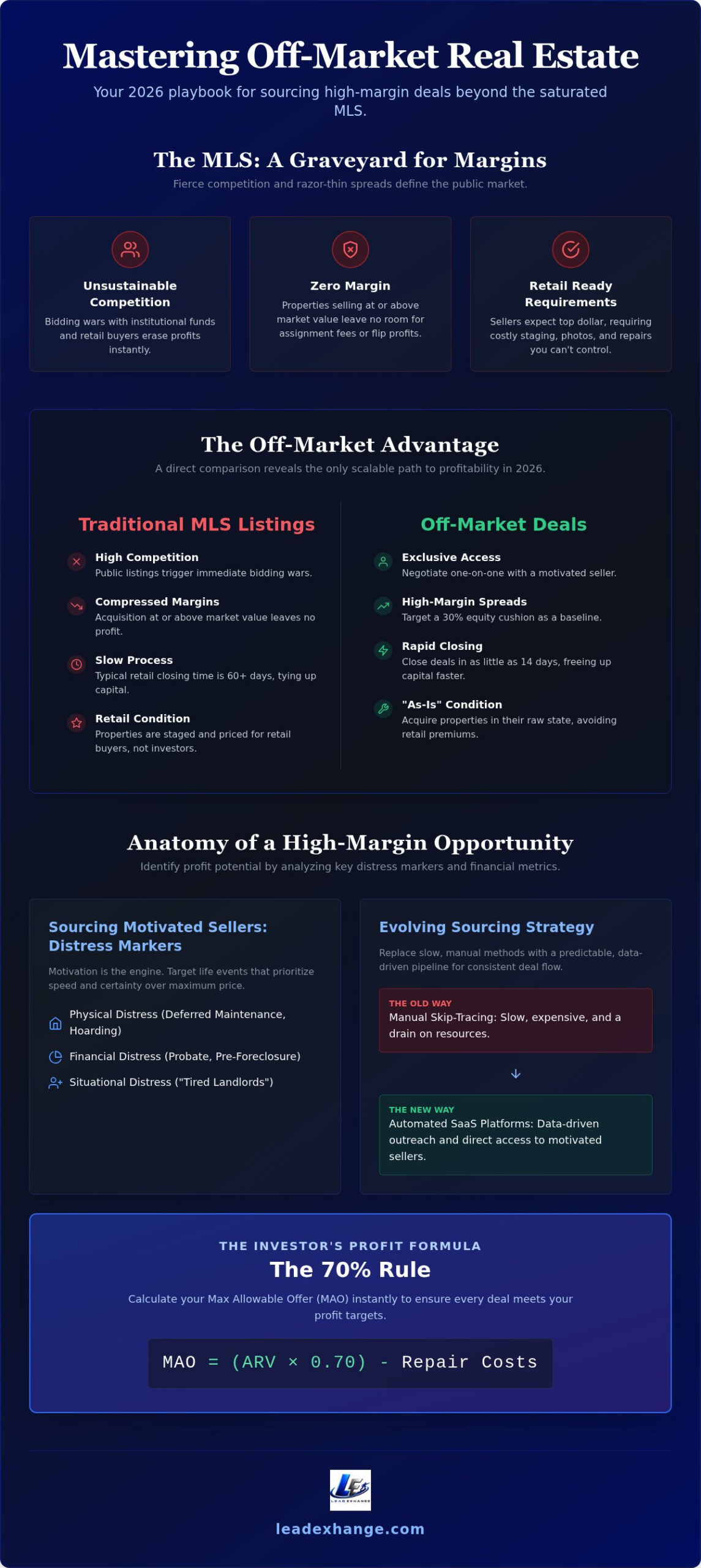
The traditional MLS is no longer a source of profit; it’s a graveyard for margins. With the national median home price sitting at $374,667 and 30-year fixed mortgage rates at 6.75%, the competition for public listings has reached an unsustainable breaking point. You’re likely exhausted by bidding wars that erase your spreads before the ink even dries on the contract. To scale in 2026, you must pivot toward off-market investment deals that your competitors don’t even know exist. These exclusive opportunities are the only way to secure the high-margin spreads required for successful flips and wholesale operations.
We understand that manual skip-tracing is a slow, expensive drain on your resources and your patience. You need a predictable pipeline of leads without the friction of outdated, manual methods. This guide provides the exact strategies you need to master off-market sourcing and close properties that traditional listings miss. We will examine how to leverage distress indicators, navigate new 2026 regulations like the Connecticut wholesaler registration, and use high-performance data to reduce your lead generation time. It’s time to stop chasing crumbs and start engineering your own inventory with professional precision.
Key Takeaways
- Escape the saturated retail market and discover why off-market investment deals provide the only reliable path to high-margin spreads in 2026.
- Identify the specific physical and financial distress markers that signal a motivated seller before they ever consider a public listing.
- Streamline your lead generation by replacing manual skip-tracing with automated SaaS platforms and data-driven outreach campaigns.
- Execute rapid due diligence using the 15-minute triage method to calculate your Max Allowable Offer instantly and accurately.
- Build a scalable pipeline of exclusive inventory in high-growth markets like Atlanta and Memphis using professional-grade subscription plans.
Why Off-Market Investment Deals Outperform the MLS in 2026
The Multiple Listing Service (MLS) is a graveyard for margins. Public listings are picked over by institutional funds, retail buyers, and aggressive algorithms that trigger bidding wars in seconds. In 2026, existing home sales remain near 30-year lows, creating a scarcity that drives prices up and spreads down. Off-market investment deals represent the only remaining territory where you can dictate terms. These properties sell entirely outside the public domain; there is no “For Sale” sign, no Zillow listing, and no competition from the general public.
Effective deal sourcing in this environment requires a direct-to-seller approach. While retail buyers wait for mobile alerts, professional investors engage owners before they even consider a brokerage. This strategy is essential because institutional buyers now dominate public platforms. If a deal is visible on the MLS, it’s already too expensive for a high-margin flip or wholesale fee. You don’t want to compete; you want to be the only option the seller sees.
The Competitive Advantage of Hidden Inventory
Hidden inventory provides a massive strategic edge. You aren’t competing with 50 other offers. You’re negotiating one-on-one with a motivated seller. This direct line allows you to structure creative financing or flexible closing dates that solve the seller’s specific problem. Additionally, these homes are often sold “as-is.” You save thousands by avoiding the cosmetic staging and professional photography required for a retail-ready listing. It’s about finding the property in its raw state before the market adds a “retail premium” to the price.
Margin Analysis: Off-Market vs. Traditional Listings
The math is simple and brutal. In high-growth markets like Atlanta or Detroit, MLS listings often sell at or above market value. This leaves zero room for a $13,000 national average assignment fee or a profitable flip. Off-market investment deals typically target a 30% equity cushion as a baseline. While your marketing costs for direct mail or lead platforms are higher than browsing a free website, the acquisition discount far outweighs the expense. Speed is your final multiplier. Closing a deal in 14 days versus 60 days on the retail market drastically increases your annual ROI by freeing up capital for the next project.
The Anatomy of a High-Margin Off-Market Opportunity
High-margin off-market investment deals aren’t found by chance. They are identified through a cold analysis of distress markers. While recent housing supply data shows that new inventory remains constrained, the most profitable assets are those that never reach the open market due to physical or financial burdens. For a wholesaler, a 30% equity cushion is the non-negotiable baseline. Anything less leaves too little room for error when factoring in the 2026 national average wholesaler assignment fee of $13,000.
Profitability often hides behind “ugly” facades. Properties with severe deferred maintenance or hoarding issues are the most beautiful deals for flippers because they eliminate retail competition entirely. Beyond physical state, savvy investors look for “Highest and Best Use” potential. This involves identifying properties in emerging neighborhoods where rezoning or lot splitting can exponentially increase value. You aren’t just buying a house; you’re buying a strategic asset with multiple exit paths.
Sourcing Motivated Sellers
Motivation is the engine of every off-market transaction. You must target specific life events that prioritize speed over price. Common triggers include probate, pre-foreclosure, and “tired landlords” who no longer want to manage tenants in a high-interest environment. Accessing off-market real estate leads allows you to identify these triggers months before a homeowner reaches out to a realtor. Your value proposition is simple: you offer a certain, rapid exit without the friction of inspections, repairs, or public showings. If you want to scale this process, utilizing a professional Lead Exchange database ensures you’re reaching these sellers first.
Evaluating Distressed Property Data
Speed is irrelevant if the math doesn’t work. Professional evaluation relies on the After Repair Value (ARV) and the 70% rule. This means your Max Allowable Offer (MAO) should not exceed 70% of the ARV minus estimated repair costs. In fast-moving cities like Charlotte, neighborhood comps can shift monthly, making real-time data access critical. Always perform a deep dive into the title history. Red flags such as undisclosed tax liens, clouded titles from inheritance disputes, or unpermitted additions can turn a high-margin deal into a legal liability. Accurate due diligence is your only protection against overpaying for a problem property.
Sourcing Strategies: How Professional Investors Find Hidden Inventory
Engineering a pipeline of off-market investment deals requires a departure from passive browsing. High-performance investors treat lead generation as a data science rather than a hobby. Direct Mail 2.0 is no longer about mass-blasting entire zip codes. It involves surgical targeting based on high-equity markers and specific distress signals. By filtering for owners with 30% equity and specific life-change indicators, you ensure every dollar spent on outreach has a higher probability of conversion.
SaaS platforms have revolutionized this outreach by automating skip-tracing. You can’t afford to spend hours manually hunting for phone numbers. Speed is the primary currency in 2026. While high-tech solutions dominate, niche networking remains a powerful secondary channel. Building relationships with probate attorneys provides a first-look advantage at inherited properties that haven’t hit the market. For those looking for hyper-local inventory, “Driving for Dollars” still works. Identifying physical neglect firsthand allows you to reach owners before data-driven algorithms pick up the distress signal.
Automated Lead Generation vs. Manual Sourcing
Using wholesale real estate software is mandatory for anyone looking to scale in 2026. Manual sourcing is acceptable for a first deal, but it’s an anchor on your growth. Professional wholesalers analyze their cost-per-lead with extreme scrutiny. Automated systems allow you to transition from one deal per month to ten by removing the manual labor from skip-tracing and initial contact. This shift turns your business from a daily grind into a high-output investment engine.
Geographic Hotspots: Memphis, Jackson, and Beyond
The Sun Belt continues to lead as the premier destination for finding off-market investment deals. Markets like Memphis and Jackson offer a unique combination of high rental demand and lower entry prices. In these regions, understanding the local tenant profile is essential for attracting end-buyers. If you’re looking beyond the Sun Belt, cities like Cleveland and Gulfport offer significant opportunities for those who understand local regulations. Successful investors in these hotspots don’t just find houses; they find solutions for sellers in high-demand rental corridors. Focus on areas with 1% rent-to-price ratios to ensure your end-buyers see the immediate cash flow potential.
Vetting Off-Market Leads: Speed and Due Diligence
Speed is your primary defense against competition. In the world of off-market investment deals, the time between receiving a lead and signing a contract determines your success rate. You can’t afford to spend hours on every property. High-performance investors use a 15-minute triage to filter out junk leads before they ever leave their desk. If the numbers don’t align during this initial desktop review, the lead is discarded immediately to preserve your most valuable resource: time.
Execution also requires a specialized legal infrastructure. You must work with a wholesale-friendly title company that understands the nuances of assignment of contracts and double closings. Traditional title companies often stumble over these transactions, causing delays that can spook motivated sellers. A professional partner ensures your paperwork is processed with the same urgency you used to find the deal. Verifying liens and title issues early prevents you from wasting weeks on a property with unresolvable legal baggage.
Step 1: Initial Data Verification
Start by cross-referencing owner-provided information with tax assessor records and recent property history. You must confirm the current ownership and check for outstanding mortgage balances to ensure there’s enough equity to facilitate a deal. If the debt exceeds your potential offer, the lead likely requires a short sale negotiation, which changes your strategy entirely. The Max Allowable Offer (MAO) is calculated by taking the After Repair Value (ARV), multiplying it by 0.70, and subtracting the total estimated repair costs.
Step 2: Rapid Physical Inspection
Your site visit should be a tactical assessment, not a leisurely walkthrough. Ignore cosmetic flaws like outdated carpet or peeling wallpaper; focus exclusively on big-ticket items that kill profit margins. Inspect the roof, HVAC systems, and foundation for signs of structural failure or mechanical age. You don’t need a full contractor bid at this stage to make an informed decision. Use a standardized repair checklist to generate a high-level estimate in minutes. Always include a 10% to 15% repair buffer in your calculations to account for hidden structural issues that only appear after demolition begins. This conservative approach protects your spread and ensures your end-buyers remain profitable.
Lead Exchange: Your Direct Pipeline to Exclusive Deals
The search for high-margin off-market investment deals ends here. You’ve already identified the distress markers, mastered the 70% rule, and recognized the futility of the retail market. Now you need the engine to power your operation. Lead Exchange isn’t a generic listing site; it’s a high-performance facilitator that connects you directly to motivated sellers. We handle the heavy lifting of sourcing through our Direct Cash Home Buying services, ensuring the inventory you see is exclusive, proprietary, and ready for acquisition.
We remove the traditional obstacles that stall your progress. Manual skip-tracing and cold-calling dead ends are replaced with a streamlined, results-oriented platform. Every lead in our database is curated to ensure it meets the professional standards required for high-spread flips and wholesale assignments. We don’t just provide data; we provide a clear path to your next closing. It’s time to stop fighting for retail scraps and start dominating your local market with professional-grade inventory.
Why Lead Exchange Dominates the Local Markets
Our regional expertise is concentrated in high-demand markets like Atlanta, Detroit, and Cleveland. We prioritize these cities because they offer the strongest potential for 2026 growth and investor ROI. Unlike competitors who scrape public data, our leads are proprietary. They haven’t been shopped around the internet or blasted to thousands of other buyers. You’re getting a first-mover advantage in neighborhoods where demand for rental properties and renovated homes is surging. We act as your seasoned, no-nonsense partner focused entirely on your bottom-line results.
Getting Started: Your First Deal is Closer Than You Think
Your choice of subscription tier depends on your specific 2026 goals. The Starter Plan is the ideal entry point for new investors focused on emerging markets like Memphis or Birmingham. It provides the essential lead access needed to secure your first off-market investment deals without overwhelming you with data. For professional wholesalers looking to scale, the Growth Plan offers high-volume lead access and advanced proprietary skip-tracing data. This tier is designed for those moving from one deal a month to a consistent, predictable pipeline of multiple closings.
The platform’s built-in tools allow you to vet properties instantly, keeping your 15-minute triage process efficient and accurate. You get the data you need to make bold, strategic decisions in seconds. Access the platform today to see the difference that exclusive, high-margin inventory makes for your business growth.
Scale your portfolio with Lead Exchange today
Engineer Your Competitive Advantage in 2026
The 2026 real estate landscape doesn’t reward those who wait for public listings. Profitability is reserved for investors who bypass the noise and secure high-margin off-market investment deals through direct-to-seller acquisition. By focusing on specific physical and financial distress markers, you can eliminate retail competition and capture the equity spreads required for scalable growth. Speed remains your most potent weapon. Using proprietary data to vet leads in minutes ensures you stay ahead of institutional funds and manual sourcers alike.
Lead Exchange provides the infrastructure to turn these strategies into a predictable, results-oriented pipeline. Whether you’re utilizing the Starter plan for initial entry into Memphis or the Growth plan for high-volume operations in Atlanta and Detroit, our specialized database removes the traditional obstacles to your success. You don’t have to navigate this saturated market alone. Our direct-to-seller acquisition expertise ensures that the inventory you access is vetted and ready for execution.
It’s time to stop reacting to the market and start dictating your own success. Your next high-margin closing is already waiting in our hidden inventory.
Professional Investor FAQ
What is the best way to find off-market properties for sale in 2026?
Sourcing in 2026 requires a high-performance data strategy. The most effective method is using proprietary lead platforms that provide direct access to distressed homeowners before they reach out to an agent. Manual methods like driving for dollars are useful for beginners, but scaling requires automated skip-tracing and targeted outreach. You need to reach the seller first to secure the best margins on your off-market investment deals.
Are off-market investment deals legal in all states?
Yes, but state-level regulations are increasing. Illinois requires a license for more than one wholesale deal per year. Connecticut implemented a mandatory wholesaler registration effective July 1, 2026, which carries a $285 fee. You must stay compliant with local disclosure laws and registration requirements to protect your business. Always verify local statutes in your target market to ensure your acquisition process remains fully legal.
How do I verify the owner of an off-market property?
You must cross-reference municipal tax assessor records with professional skip-tracing data to confirm ownership. SaaS platforms offer the most reliable ownership history and contact details. Never rely solely on a seller’s word or a hand-written document. Always verify the identity of all parties on the deed and check for outstanding mortgage balances through a preliminary title search before moving to a contract.
Can I use traditional financing for off-market investment deals?
Traditional financing is rarely viable for off-market investment deals because of property condition and closing speed. Conventional lenders typically require properties to be in retail-ready condition and take 30 to 45 days to close. Most off-market sellers expect a cash closing within two weeks. Professional investors use cash, private capital, or hard money to ensure they can meet these aggressive timelines and secure the asset.
What is the difference between a pocket listing and an off-market deal?
A pocket listing is a property held by a real estate agent that isn’t shared on the MLS. A true off-market deal is a direct-to-seller transaction with no agent involvement. Off-market deals are generally more profitable because you aren’t paying agent commissions or competing with retail buyers. You’re negotiating directly with the owner, which allows for more creative terms and significantly higher profit spreads.
How much should I pay for off-market real estate leads?
You should evaluate lead costs based on your cost-per-acquisition rather than the price of a single lead. Professional wholesalers prioritize high-quality, exclusive data over cheap, recycled lists. Spending more on verified leads reduces your time spent on dead ends and increases your overall ROI. Focus on the total marketing spend required to close one deal to determine your ideal lead budget and scale effectively.
Why do sellers choose to sell off-market instead of on the MLS?
Sellers often prioritize speed, privacy, and convenience over a maximum retail price. They may be facing foreclosure, probate, or severe property distress that makes a traditional MLS listing impossible. Selling off-market allows them to avoid expensive repairs, public showings, and the risk of a retail buyer’s financing falling through. You’re providing a certain, rapid solution to their immediate financial or situational problem without the retail friction.
What are the biggest risks when buying off-market properties?
Undisclosed liens and underestimated repair costs are the most significant risks. Without the protections of a traditional listing, you must conduct your own rigorous due diligence. Always use a wholesale-friendly title company to uncover hidden legal issues or clouded titles before you commit capital. Including a 15% repair buffer in your initial analysis is a pragmatic way to protect your margins from unexpected structural failures or mechanical age.
Disclaimer
The opinions and information shared on this website are for educational purposes only. Results from real estate investing and lead generation vary, and no specific outcome or profit is guaranteed