Your spreadsheet isn’t a strategy. It’s a bottleneck that’s costing you five figures in lost equity every single month. Most investors realize that manual lead sourcing is too slow to compete in the 2026 market. You’ve likely felt the frustration of high skip tracing costs paired with low accuracy. Implementing the right wholesale real estate software is no longer optional for those who want to scale. It’s the engine that converts fragmented property data into high-margin off-market deals.
We agree that the traditional methods of hunting for motivated sellers are exhausting and inefficient. You need a system that generates results while you focus on closing. This guide teaches you how to master the digital tools required to source, analyze, and close deals with maximum efficiency. We’ll examine the essential tech stack for 2026, including AI-driven automation and the critical legal disclosures now required in states like Louisiana and Ohio. You’ll learn how to replace messy manual processes with a streamlined deal engine that drives consistent ROI.
Key Takeaways
- Transition from manual “driving for dollars” to automated, data-driven systems to maintain a competitive edge in the 2026 market.
- Identify high-performance features like advanced skip tracing and Automated Valuation Models to verify deal viability in seconds.
- Evaluate wholesale real estate software based on its integration capabilities and ability to scale alongside your deal volume.
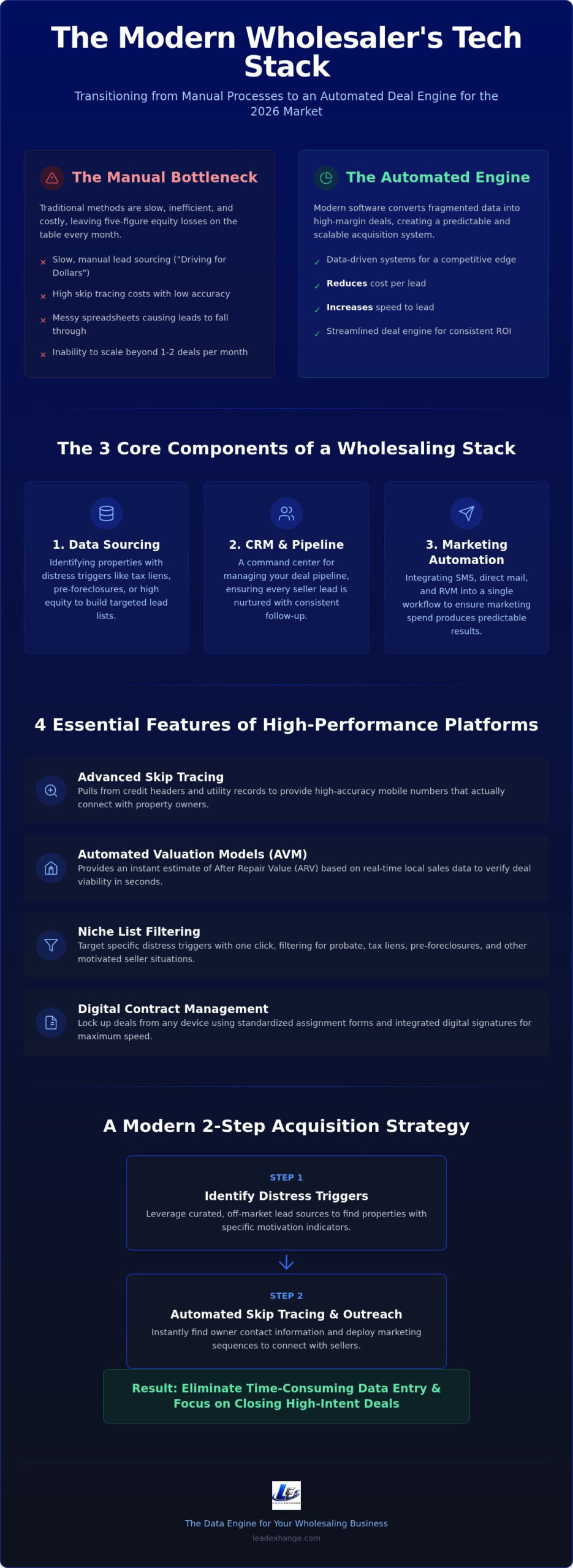
- Implement a two-step acquisition strategy using distress triggers and automated skip tracing to eliminate time-consuming data entry.
- Leverage curated, off-market lead sources to bypass raw data hurdles and focus on high-intent residential property acquisitions.
What is Wholesale Real Estate Software?
Wholesale real estate software is the centralized operating system for modern property acquisition. It is a specialized category of digital platforms built to source, track, and manage off-market property contracts. Unlike traditional brokerage tools that rely on the MLS, this software focuses on the “shadow market” of distressed properties and motivated sellers. It replaces physical legwork with digital precision. The shift from manual “driving for dollars” to data-driven acquisition is a survival requirement in 2026. If you are still hunting for deals with a notepad and a car, you are losing to competitors who use algorithms to find equity before you even start your engine.
Scaling beyond one or two deals per month is impossible without a robust system. Manual lead sourcing is too slow and prone to human error. High-performance investors use wholesale real estate software to achieve two critical metrics: reducing the cost per lead and increasing the speed to lead. In a market where the first person to reach a motivated seller usually wins, speed is your greatest competitive advantage. This software ensures that no lead falls through the cracks of a messy spreadsheet.
The Core Components of a Wholesaling Stack
A functional wholesaling engine requires three primary layers to operate at scale. First is data sourcing. This involves identifying properties with distress triggers like tax liens, pre-foreclosures, or high equity. Second is the CRM (Customer Relationship Management). This is your command center for pipeline management, ensuring every seller lead is nurtured through a consistent follow-up sequence. Finally, marketing automation integrates SMS, direct mail, and ringless voicemail (RVM) into a single workflow. These components work together to ensure your marketing spend produces a predictable volume of contracts.
Real Estate Wholesaling vs. Retail Wholesaling
It’s vital to distinguish real estate wholesaling from the traditional retail model. In a retail context, wholesaling involves buying physical inventory in bulk to sell to retailers. Within the broader scope of real estate investing, wholesaling is an “assignment of contract” model. You aren’t buying the house; you’re securing the right to purchase it and then selling that right to an end buyer.
Because of this unique legal structure, generic business software often fails for investors. You need property-specific data points that a standard retail CRM doesn’t provide. Effective software must track liens, foreclosure status, and mortgage balances in real time. Without these specific data layers, you’re flying blind. Real estate wholesaling requires a tool that understands the nuances of equitable interest and off-market property valuations. If you’re building your foundation from scratch, our step-by-step guide on how to wholesale real estate in 2026 covers the full mechanics of the assignment of contract model alongside the compliance requirements now active in states like Ohio and Louisiana.
Essential Features of High-Performance Wholesaling Platforms
High-performance wholesale real estate software does more than store data. It actively accelerates your deal cycle. To dominate your market in 2026, your platform must provide four essential pillars of functionality. These features transform a simple database into a high-velocity investment engine.
- Advanced Skip Tracing: Skip tracing is the process of locating hard-to-find contact info for property owners. Elite software pulls from credit headers and utility records to provide mobile numbers that actually connect.
- Automated Valuation Models (AVM): You cannot spend hours on a single analysis. Integrated AVMs provide an instant estimate of After Repair Value (ARV) based on real-time local sales data.
- Niche List Filtering: Success comes from targeting specific distress triggers. Your software should filter for probate, tax liens, and pre-foreclosures with a single click.
- Digital Contract Management: Speed to lead is useless if you cannot secure the signature. Standardized assignment forms and integrated digital signatures allow you to lock up deals from any device. Using a properly structured wholesale real estate contract is essential to protect your assignment fee and stay compliant with 2026 state regulations.
Platforms like REI/kit have already been used for over 275,000 real estate deals, proving that the right feature set is the foundation of high-volume success. Without these tools, you are fighting for scraps in a data-driven market.
Data Accuracy and Lead Quality
The biggest drain on your marketing budget is stale data. Many public records are updated on a significant lag, meaning you are often mailing owners who have already sold or resolved their distress. This differs significantly from other real estate investment strategies that rely on stable, public-market information. You need real-time feeds to stay ahead of the competition. Lead Exchange provides exclusive off-market data that bypasses the noise of saturated public lists. By accessing curated leads, you eliminate the friction of unvetted data and focus on properties with genuine motivation.
Communication and Outreach Tools
Marketing automation turns a small operation into a high-volume enterprise. Integrated power dialers allow you to work through hundreds of leads per hour without manual errors. For leads that aren’t ready to sell today, automated drip campaigns handle the follow-up. This ensures you remain top-of-mind when the seller’s situation changes months later. Compliance is also non-negotiable. Modern wholesale real estate software includes built-in TCPA and DNC scrubbers to protect your business from litigation. If you want to fuel these outreach tools with high-quality inventory, consider exploring Off-Market Investment Deals to secure your next contract faster.
Evaluating Software: From Lead Sourcing to Deal Closing
Selecting the right wholesale real estate software is a high-stakes decision that dictates your operational ceiling. You aren’t just buying a tool; you’re investing in an ROI engine. The primary challenge for most investors is balancing a manageable learning curve with deep feature sets. If a platform is too complex, your team won’t use it. If it’s too simple, you’ll outgrow it within three months. Your goal is to find a solution that offers sophisticated automation without requiring a computer science degree to operate.
Integration capabilities are the “make or break” factor for scaling. Your software must talk to your existing stack via Zapier or a robust API. Whether you’re pushing leads from a website or pulling data into a specialized dialer, the flow must be seamless. Mobile accessibility is equally critical. Investors operating in fast-moving markets like Atlanta or Detroit need to manage deals from the field. You should be able to pull up property data, run a quick AVM, and send a contract for signature while standing on the seller’s porch. If you can’t run your business from your phone, you don’t have a modern wholesaling engine.
Starter vs. Growth: Choosing Your Tier
Your software needs should evolve with your deal volume. For those securing their first few contracts, a Starter plan provides the essential tools without the overhead of enterprise-level features. It’s better to master a lean system than to pay for “feature bloat” you don’t use. As you scale to multiple markets or hire acquisition managers, transitioning to Growth tiers becomes necessary. These higher levels offer the advanced team management and multi-market data feeds required to dominate high-competition areas. Avoid the trap of over-complicated enterprise platforms that slow down your speed-to-lead through unnecessary administrative friction.
Local Market Optimization
Successful wholesaling is inherently local. Your software must allow for deep-dives into specific US metros like Memphis or Birmingham. Generic national data isn’t enough; you need a platform that reflects local building codes and the specific foreclosure laws of your target area. For instance, new 2026 regulations in states like Ohio and Louisiana require specific written disclosures. Your software settings should automate these compliance steps based on the property’s zip code. High-performance investors also utilize heat maps to identify “hot” wholesaling neighborhoods. These visual data layers show you exactly where the highest concentration of cash buyers and distressed inventory intersect, allowing you to deploy your marketing budget with surgical precision.
Automation Strategies for Off-Market Property Acquisitions
Automation transforms your wholesale real estate software from a static database into a self-correcting acquisition machine. In 2026, the speed of your workflow determines your market share. You cannot afford to wait for manual data entry while your competitors are already on the phone with the seller. A high-performance automation framework follows five distinct steps to ensure no opportunity is wasted.
- Step 1: Automated List Pulling. Set your software to monitor specific distress triggers like tax liens or pre-foreclosures. The system pulls these lists nightly, so your pipeline is never empty.
- Step 2: Instant Skip Tracing. Once a lead hits your system, skip tracing should happen automatically. This populates contact fields with verified mobile numbers and emails without manual intervention.
- Step 3: Triggered Outreach. The moment data is verified, your software initiates a sequence of SMS or direct mail. This ensures you are the first point of contact for the seller.
- Step 4: Lead Scoring. Not all leads are equal. Use AI-driven scoring to prioritize “hot” motivated sellers based on their response patterns and property equity.
- Step 5: Automated Contract Generation. Speed wins deals. Use pre-loaded templates that pull property data directly from the lead file to send an offer in minutes. Ensure your templates align with the legal requirements outlined in our 2026 wholesale real estate contract guide and template to avoid compliance pitfalls in regulated states.
Removing Friction from the Seller Journey
Every minute a lead sits idle is a minute they might call another investor. Auto-responders are your first line of defense. They acknowledge the seller’s inquiry immediately, creating a sense of professional reliability. By leveraging these integrated workflows, automation cuts response time from hours to seconds. You should also utilize “One-Click” property analysis tools. These features allow you to verify a deal’s viability and calculate your maximum allowable offer (MAO) without ever leaving the CRM interface. This level of efficiency keeps the seller engaged and prevents them from shopping your offer elsewhere.
Managing the Disposition Side
Wholesaling is a two-sided marketplace. Your wholesale real estate software must manage your cash buyer list with the same precision as your seller leads. Segment your buyers by their preferred zip codes, asset types, and budget ranges. When you lock up a contract, the software should generate professional deal flyers and broadcast them to your network automatically. Tracking engagement is the final piece of the puzzle. By monitoring open rates and click-throughs on your email blasts, you can identify your most active buyers. This data allows you to focus your energy on the people most likely to close, reducing your average time to disposition.
Lead Exchange: The Data Engine for Your Wholesaling Business
Lead Exchange serves as the high-octane fuel for your wholesale real estate software. Without high-quality data, even the most advanced automation framework is just an empty shell. We act as the definitive bridge between motivated homeowners and savvy investors, providing the exclusive inventory required to maintain a consistent closing schedule. Our platform connects you with off-market opportunities that never hit the public eye. This ensures you aren’t fighting over the same stale leads as every other wholesaler in your zip code. It’s about moving from a position of scarcity to one of abundance.
We offer subscription tiers designed to match your specific stage of growth. Our Starter tier provides the essential data access needed for solo wholesalers to secure their first high-margin contracts without overwhelming overhead. For firms looking to dominate multiple metros, our Growth tier delivers the volume and depth required for a full-scale acquisition team. This data integrates directly into your broader wholesaling strategy, feeding your CRM and dialers with a steady stream of actionable residential leads. We provide the raw intelligence that your software uses to trigger the automation sequences discussed in previous sections.
Exclusive Access to Distressed Property Data
Curated leads consistently outperform generic bulk lists. While competitors waste their marketing spend on unvetted data, Lead Exchange users focus on residential properties with verified distress triggers. We specialize in high-performance markets, providing deep-dive data for high-growth US cities ranging from Charlotte to Cleveland. This focus on residential off-market inventory ensures your acquisition engine is always tuned for maximum ROI. By targeting properties specifically ready for wholesaling or flipping, you eliminate the friction of raw data sorting. You move straight to the offer phase with confidence in the seller’s motivation.
Getting Started with a Result-Oriented Partner
The most significant shift in your business occurs when you stop searching for deals and start receiving them. Lead Exchange positions itself as a strategic ally in your financial progress, not just a service provider. We provide the exclusive Off-Market Investment Deals that form the backbone of a scaling portfolio. Transitioning to this data-driven model allows you to reclaim your time and focus on high-level negotiation and disposition. You don’t need more leads; you need better ones. Partnering with an elite data provider ensures that every dollar of your marketing budget is aimed at a high-probability contract. It’s time to stop guessing and start closing with a partner that values your bottom line as much as you do.
Future-Proof Your Wholesaling Operation
Success in 2026 requires a permanent shift from manual labor to digital precision. You’ve seen how the right wholesale real estate software acts as a catalyst for growth by automating lead scoring and contract generation. Implementing these strategies reduces the cost per lead and eliminates the friction of messy spreadsheets. You now have the framework to evaluate platforms based on their integration depth and local market optimization.
The most sophisticated software is useless without a reliable lead source. Lead Exchange provides the curated, off-market inventory required to power your acquisition engine. Our Starter and Growth tiers offer access to exclusive residential data in high-growth US investment markets. This is how you transition from chasing deals to closing them with absolute certainty.
Stop fighting for public market scraps. Build a business that operates with speed and reliability. Your next high-margin contract is waiting.
Frequently Asked Questions
What is the best wholesale real estate software for beginners?
REI/kit and REsimpli are top choices for new investors in 2026. These platforms offer intuitive interfaces that minimize the learning curve while providing essential tools like deal analyzers. Beginners should prioritize a system that scales. Starting with a basic tier allows you to master lead management before investing in high-volume automation. This approach prevents you from paying for advanced features you aren’t ready to use yet.
Do I need a CRM to start wholesaling houses?
You absolutely need a CRM if you intend to close more than one deal per year. Wholesaling is a business of persistent follow-up. Most deals happen between the fifth and twelfth contact. Without a centralized system, you’ll lose track of motivated sellers in messy spreadsheets. A CRM ensures every lead is nurtured through an automated sequence, maximizing your ROI on every marketing dollar spent.
How much does real estate wholesaling software typically cost?
Pricing for wholesale real estate software depends on your required feature set and deal volume. As of 2026, REI BlackBook offers a basic plan starting at $97 per month. REsimpli’s pricing ranges from $149 for basic access to $599 for enterprise-level tools. REI/kit provides a starter marketing plan for $64 monthly. Most platforms offer 14-day free trials to test functionality before committing to a subscription.
Can I find off-market properties without expensive software?
You can find off-market properties through manual methods like “driving for dollars” or searching public records. These tactics are cost-effective but extremely slow. They don’t scale. Wholesale real estate software and curated lead providers like Lead Exchange allow you to bypass the manual grind. You can access thousands of distressed leads instantly, giving you a massive speed advantage over investors doing manual research.
Is skip tracing included in most wholesaling platforms?
Skip tracing is rarely included as a “free” unlimited feature. Most platforms offer it as an integrated add-on where you pay per hit or buy monthly credits. This process uses credit headers and utility data to find the owner’s mobile number. Accurate skip tracing is the backbone of your outreach. It’s better to pay for high-quality data than to waste time calling disconnected landlines from cheap providers.
How do I integrate Lead Exchange data into my existing software stack?
Integrating Lead Exchange data is a straightforward process designed for maximum efficiency. You can export your curated off-market leads as a CSV file and upload them directly into your CRM. For those using advanced wholesale real estate software, you can use Zapier or an API to automate the data flow. This ensures your acquisition engine is always fueled with fresh, exclusive inventory without manual data entry.
What is the difference between a lead provider and wholesaling software?
Think of a lead provider as the fuel and wholesaling software as the engine. A lead provider like Lead Exchange gives you the raw data of motivated sellers. The software is the tool you use to manage those leads, automate your marketing, and analyze the deals. You need both to run a high-volume business. One provides the opportunity, while the other provides the system to capture it.
Is software necessary for wholesaling in specific cities like Atlanta or Memphis?
Software is mandatory in high-competition metros like Atlanta and Memphis. These markets are saturated with investors hunting for the same equity. If you’re relying on manual processes, your competitors will reach the seller and sign the contract before you’ve even pulled the property data. Speed to lead is the only metric that matters in these cities. Automation is the only way to achieve it. To understand the full deal-securing process from first contact to assignment fee, review our complete guide on how to wholesale real estate in 2026 for a step-by-step breakdown of every stage.
Disclaimer
The opinions and information shared on this website are for educational purposes only. Results from real estate investing and lead generation vary, and no specific outcome or profit is guaranteed