In the high-stakes Atlanta real estate market, a single math error on an off-market deal can wipe out your entire annual profit margin. Most investors rely on gut feeling, but professional scaling requires a rigorous Maximum Allowable Offer Calculator to ensure every contract is a win. You’ve likely felt that spike of anxiety when estimating the After Repair Value (ARV) or wondering if your assignment fee is high enough to justify the risk. It’s a common fear in competitive hubs like Memphis and Atlanta where inventory is tight and prices are shifting.
This article will give you the definitive framework to protect your bottom line and negotiate with motivated sellers with absolute certainty. We’ll dive into the specific 2026 data points, from Georgia’s intangible taxes to current renovation costs, to help you master the MAO formula. You’ll learn how to analyze deals with speed and precision, turning market volatility into a strategic advantage for your investment portfolio. By the end of this guide, you’ll have the confidence to walk away from bad deals and strike quickly when the numbers align.
Key Takeaways
- Master the MAO as your primary risk-management tool to eliminate emotional overbidding and protect your investment capital.
- Learn to deploy the 70% rule within a Maximum Allowable Offer Calculator to account for rehab, holding, and closing costs automatically.
- Understand the critical math adjustments required to bridge the gap between a wholesaler’s assignment fee and a flipper’s profit margin.
- Discover how to recalibrate your offer percentages based on real-time market temperatures and inventory levels in Atlanta and Memphis.
- Identify why high-margin deals require a steady stream of off-market leads rather than relying on saturated MLS listings.
What is a Maximum Allowable Offer (MAO) in Real Estate?
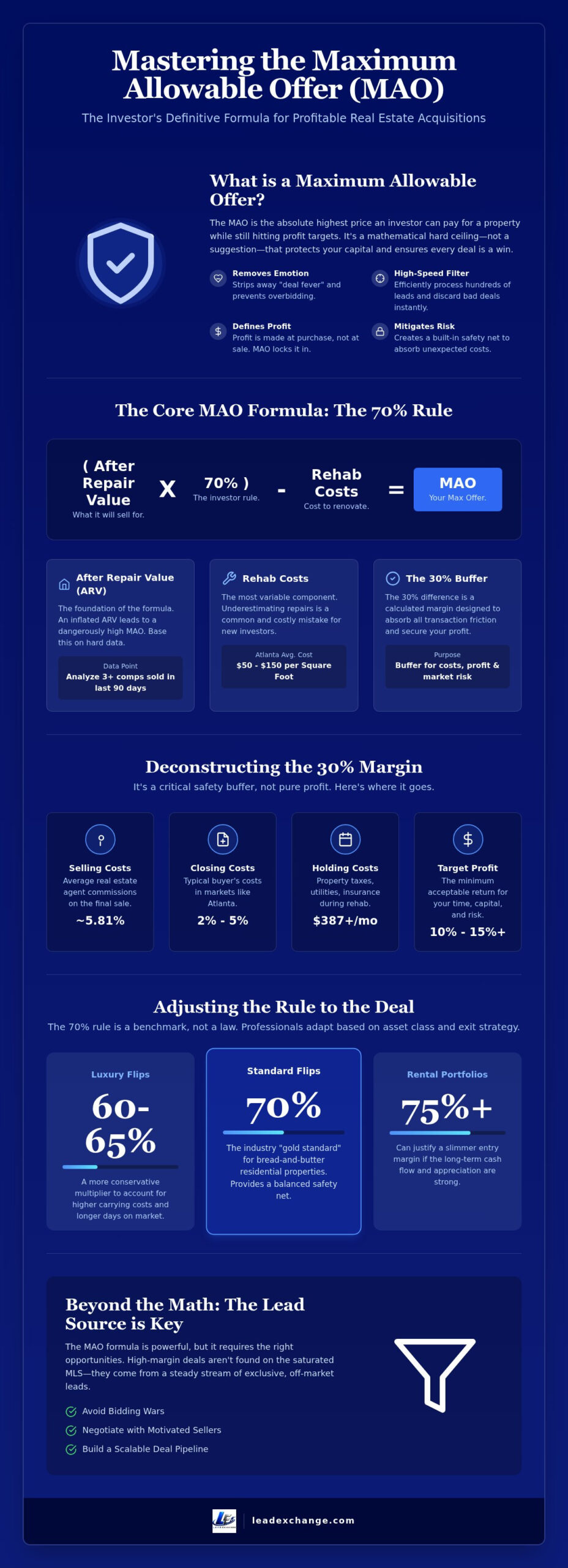
Profit in real estate is made at the time of purchase, not at the time of sale. The Maximum Allowable Offer (MAO) represents the absolute highest price an investor can pay for a property while still hitting their specific profit targets. It isn’t a suggestion; it’s a hard ceiling. Using a Maximum Allowable Offer Calculator allows you to strip away the emotion that often clouds judgment during a negotiation. This mathematical approach is your primary defense against “deal fever,” a common trap where the desire to “win” a competitive bid leads to overpaying and eroding your margins.
Professional investors don’t spend hours agonizing over every lead. They use the MAO as a high-speed filter to process hundreds of off-market opportunities. If a seller’s asking price is significantly higher than the calculated MAO and they aren’t motivated to negotiate, the deal is discarded immediately. This efficiency is what separates casual hobbyists from elite investors who scale their portfolios rapidly. Your MAO reflects your personal risk tolerance and the unique requirements of your exit strategy.
The Role of MAO in Risk Mitigation
Setting a firm offer ceiling protects your capital from the “surprises” that define distressed real estate. Whether it’s a hidden foundation issue or a sudden shift in local interest rates, a disciplined MAO ensures you have enough equity to absorb shocks. It also maintains the necessary spread to make a deal attractive to both wholesalers and end-buyers. MAO is the definitive mathematical boundary for profitable real estate acquisitions. By respecting this boundary, you ensure that every contract you sign has a built-in safety net.
Key Variables: ARV, Rehab, and Profit
The foundation of the entire formula is the After Repair Value (ARV). This figure is derived from a professional Real estate appraisal or a rigorous analysis of comparable sales in the immediate area. If your ARV estimate is inflated, your MAO will be dangerously high. In the 2026 labor market, you must also account for rising renovation costs. With whole-home renovations in Atlanta now ranging from $50 to $150 per square foot, “guesstimating” your rehab budget is no longer an option. Finally, you must establish a “minimum acceptable profit” before you ever set foot on a property. A Maximum Allowable Offer Calculator integrates these variables to ensure your business remains solvent and scalable regardless of market fluctuations. To ensure your exit price is grounded in local data, use an Atlanta ARV Calculator built for accurate real estate valuations before finalizing any offer.
The Core MAO Formula: Breaking Down the 70% Rule
The 70% rule is the backbone of any professional Maximum Allowable Offer Calculator. It provides a standardized framework to ensure you don’t overpay for assets. The logic is straightforward: (ARV x 0.70) – Rehab Costs = MAO. This formula serves as a high-level filter. It allows you to determine a property’s viability within seconds of seeing the numbers. While the math is simple, the execution requires discipline and accurate data inputs.
Executing the formula involves three critical steps. First, establish the After Repair Value (ARV) by analyzing at least three comparable sales within a half-mile radius. These “comps” should have sold within the last 90 days to reflect current 2026 pricing. Second, subtract the estimated cost of repairs. With whole-home renovations in Atlanta currently costing $50 to $150 per square foot, accuracy here is vital. Finally, multiply the remaining balance by 0.70 to arrive at your offer ceiling. To find the volume of deals necessary to keep your pipeline full, you should source exclusive off-market opportunities that avoid the bidding wars of the traditional market.
When to Use the 70% Rule
This rule is the gold standard for “bread and butter” middle-class residential flips. Seasoned flippers in 2026 rely on this benchmark because it provides a conservative safety net against market shifts. However, you must adjust your percentage for different asset classes. Luxury deals often require a 60% or 65% multiplier due to higher carrying costs and longer days on market. Conversely, high-volume rental portfolios might push closer to 75% if the long-term cash flow justifies a slimmer entry margin.
The Math of Holding and Closing Costs
The 30% margin isn’t pure profit. It’s a calculated buffer designed to absorb the friction of a real estate transaction. In Atlanta, buyer’s closing costs typically range from 2% to 5% of the purchase price. You must also account for the 5.81% average real estate commission on the back-end sale. Holding costs are equally aggressive; Fulton County property taxes and monthly utilities (averaging $387 for a standard home) can quickly erode your spread if the rehab drags on. The 30% margin is a buffer for market volatility, not just pure profit. Respecting this margin ensures that your business remains profitable even when unexpected expenses arise. For a deeper breakdown of how to calculate MAO in real estate with localized cost variables, review the How to Calculate MAO for Memphis & Atlanta Real Estate guide.
Wholesaling vs. Flipping: Adjusting Your Maximum Offer
A flipper’s MAO is the final word on their acquisition. A wholesaler’s MAO is fundamentally different because it must account for an additional profit layer. If you’re wholesaling, your offer to the seller must be deep enough to include your assignment fee while still leaving the end-buyer with their target spread. Failing to adjust for this variable is the fastest way to kill a deal before it reaches the closing table. Using a specialized Atlanta Wholesale Deal Calculator helps you visualize these moving parts simultaneously to ensure everyone wins.
The Wholesaler Formula follows a specific sequence: (ARV x 0.70) – Rehab – Assignment Fee = MAO. By including your fee as a mandatory line item, you ensure your profit is baked into the contract from day one. This transparency allows you to present a deal to your cash buyer list with absolute confidence. You aren’t just selling a property; you’re selling a pre-calculated profit margin. Balancing a competitive offer to the seller with a profitable spread for your end-buyer is the core skill of a high-volume wholesaler.
Calculating Your Assignment Fee
Your assignment fee isn’t a random number. It’s a reflection of the value you’ve created through lead sourcing, due diligence, and negotiation. In the 2026 market, standard fees fluctuate based on the complexity of the deal and the quality of the off-market data. High-quality, exclusive leads typically command higher fees because the “spread” is more secure. To accurately determine what the market will bear for your specific deal, consult the Atlanta Real Estate Assignment Fee Calculator & Guide.
Reverse Engineering the Flipper’s Math
Successful wholesaling requires you to think like an end-buyer. Your cash buyers are using their own Maximum Allowable Offer Calculator to vet every deal you send. If your math is tight or your rehab estimates are unrealistic, your reputation in the local investment community will suffer. “Buying deep” is the only sustainable way to build a long-term wholesaling business. Squeezing the margin to increase your own fee is a short-sighted strategy that burns through your cash buyer list. A professional wholesaler prioritizes the end-buyer’s success, knowing that a profitable buyer is a repeat buyer. This reverse-engineering approach ensures your deals sell in hours, not weeks.
Market-Specific Adjustments for Atlanta, Memphis, and Beyond
A Maximum Allowable Offer Calculator is only as effective as the regional data you feed it. Using a static 70% rule across every US market is a rookie mistake that leads to missed opportunities or overpaid assets. In high-demand hubs like Atlanta, you’ll often need to adjust your multiplier to 75% or even 80% to remain competitive against other institutional buyers. Conversely, in a cooling market like Memphis, staying at a conservative 65-70% protects you from price stagnation and longer exit timelines.
Analyzing market “temperature” requires looking at Days on Market (DOM) and inventory levels. Atlanta’s market currently shows 50 to 60 days on market with roughly 2 to 3.6 months of supply. This indicates a balanced market where modest price growth is expected. If inventory drops below two months, competition spikes, and you might safely increase your offer threshold. In Memphis, where inventory has increased to 2.49 months, a more cautious approach is warranted to mitigate risk. Use the Memphis Investor Guide to see how these regional shifts impact your final offer numbers.
Consider a property in a trending Atlanta neighborhood with an ARV of $430,000. A rigid 70% rule might result in an offer that the seller rejects instantly. If that specific zip code has high appreciation potential and low inventory, adjusting to a 75% multiplier could be the difference between securing the contract and losing it to a competitor. These micro-market adjustments are what allow professional investors to win deals in saturated territories.
The “Hot Market” MAO Adjustment
When inventory is tight, paying more can be a strategic move if the appreciation potential justifies the slimmer entry margin. However, you shouldn’t “cheat” the formula by ignoring carrying costs. In the 2026 interest rate environment, where Georgia 30-year fixed rates average 6.6% to 6.75%, your holding costs are significantly higher than in previous years. Over-leveraging based on hope rather than data is dangerous. Always verify your baseline value with an Atlanta ARV Calculator before you decide to push your offer percentage higher.
Regional Rehab Cost Variance
Labor and material costs are not uniform across the Southeast. A kitchen remodel in Atlanta might cost up to $40,600, while a similar project in a smaller market like Gulfport could be 20% less. Local permit times in Georgia also impact your holding period, adding to your hard money interest and utility bills. Atlanta investors currently face average monthly utility costs of $387 for standard single-family homes. Investors must verify local labor rates before finalizing their rehab budget to avoid margin erosion.
Beyond the Math: Sourcing High-Margin Off-Market Leads
A Maximum Allowable Offer Calculator is a high-performance tool, but it’s fundamentally useless without a pipeline of viable deals. In the 2026 real estate landscape, relying on traditional MLS listings is a recipe for margin erosion. Saturated markets like Atlanta and Memphis attract institutional buyers who often bid well above a disciplined MAO. To protect your spreads, you must look where the competition isn’t looking. High-margin investment opportunities are found off-market, where motivated sellers prioritize speed and certainty over a protracted bidding war.
Lead Exchange provides the raw data feed necessary to fuel your acquisition engine. Instead of wasting time on properties that will never meet your 70% threshold, you gain access to exclusive leads that have the built-in equity required for a profitable flip or wholesale. For investors just starting their journey in the Southeast, the Starter SaaS Subscription offers a streamlined entry point. It allows you to transition from theoretically calculating deals to actually closing them with professional-grade data.
Leveraging Exclusive Lead Data
The Lead Exchange Platform is designed for speed and precision in markets like Atlanta, Memphis, and Charlotte. Speed is your greatest competitive advantage. When you identify a motivated seller before they list publicly, you have the leverage to negotiate an offer that aligns with your mathematical boundaries. The platform streamlines deal analysis by providing the critical property data you need to run your numbers instantly. This allows you to submit a firm offer while other investors are still trying to find the seller’s contact information.
Scaling with the Growth Plan
Consistency is the key to moving from a one-off flipper to a high-volume investment business. Scaling requires a shift in mindset; you need enough lead volume to remain selective. When your pipeline is empty, you’re tempted to “cheat” your Maximum Allowable Offer Calculator by inflating the ARV or underestimating the rehab. When you have a steady stream of off-market data through the Growth plan, you can afford to walk away from deals that don’t meet your criteria. This selectivity is what protects your annual bottom line. As you increase your volume, ensure your operational processes are equally sharp by following our Learn How to Wholesale Real Estate: 2026 Step-by-Step Guide. This systematic approach turns real estate from a speculative hobby into a reliable wealth-building engine.
Take Control of Your Investment Margins
Mastering the Maximum Allowable Offer Calculator is the difference between a scalable real estate business and a series of expensive mistakes. You now have the framework to analyze deals with speed, adjust for wholesaler assignment fees, and recalibrate your percentages for high-demand markets. Protecting your bottom line requires more than just a formula; it’s about the discipline to walk away when the numbers don’t align with your profit targets.
Success in 2026 demands a consistent flow of off-market opportunities where the equity spread is secure. By leveraging professional-grade data, you move from theoretical calculations to executing high-margin contracts before your competition even knows a property is for sale. Our Starter and Growth plans provide the exclusive access needed to find motivated sellers in Atlanta, Memphis, and beyond with streamlined lead delivery for faster analysis.
Equip your business with the right data and the right formulas. You’re ready to scale your portfolio with confidence and precision.
Frequently Asked Questions
How do I accurately estimate rehab costs for the MAO formula?
Use detailed contractor quotes or square footage benchmarks based on current 2026 data. In Atlanta, whole-home renovations currently range from $50 to $150 per square foot. Avoid generic guesses. Walk the property with a line-item checklist covering structural, mechanical, and cosmetic needs. Factoring in a 10% to 15% contingency buffer is essential to handle unforeseen issues that often arise during the demolition phase.
Is the 70% rule still valid for real estate investing in 2026?
The 70% rule remains the standard conservative benchmark for residential flips. It provides a necessary safety net against market volatility and high holding costs. While some investors adjust the percentage based on specific market temperatures, keeping the rule at 70% ensures you have a 30% margin to cover commissions, taxes, and unexpected rehab surprises. It’s the most reliable way to protect your capital in shifting environments.
What is the difference between MAO and ARV?
ARV is the property’s estimated value after all repairs are completed, while MAO is the highest price you can pay for the property today. ARV is the foundation of your math, but MAO is your final decision point. You calculate MAO by starting with the ARV and subtracting your profit margin, renovation costs, and carrying fees. Confusing these two numbers leads to overpaying and significant financial losses.
Can I use a higher percentage than 70% in competitive markets like Atlanta?
You can increase your multiplier to 75% or 80% if the local inventory is exceptionally low and appreciation is high. Atlanta currently has roughly 2 to 3.6 months of supply, which allows for more aggressive bidding in high-growth neighborhoods. However, a higher percentage means a slimmer profit margin. Only push the limit if you have highly accurate rehab estimates and a guaranteed exit strategy to mitigate the increased risk.
Should I include my assignment fee in the Maximum Allowable Offer?
Wholesalers must subtract their desired assignment fee from the standard formula to find their specific offer ceiling. If you use a Maximum Allowable Offer Calculator without accounting for your fee, you’ll leave no room for your own profit. Your offer to the seller must be deep enough to satisfy your end-buyer’s profit requirements while still covering your company’s marketing and sourcing costs for off-market deals.
What happens if my MAO is higher than the seller’s asking price?
This scenario represents a high-margin opportunity where the numbers align perfectly with your investment goals. You should move to lock the property under contract immediately before competitors discover the deal. Having a calculated MAO that exceeds the asking price gives you a clear green light to proceed. It also provides a small buffer if your initial rehab estimates end up being slightly lower than actual costs.
How does the 70% rule change for rental properties (BRRRR)?
Rental investors often use a 75% or 80% rule because they prioritize long-term cash flow over immediate flip profits. Since the goal is often to refinance and pull out the initial capital, the MAO must align with local bank appraisal limits. Most lenders will refinance up to 75% or 80% of the ARV. Your offer must ensure that the total project cost stays within that threshold to achieve a no money down deal.
Do I need a special calculator for off-market properties?
You don’t need a different formula, but you do need a Maximum Allowable Offer Calculator that accounts for the lack of agent commissions on the buy-side. Off-market deals often have lower closing costs compared to MLS listings, which can slightly increase your offer ceiling. The primary difference is the source of the data. Successful investors use exclusive off-market leads to find the deep spreads that make the 70% rule work.
Disclaimer
The opinions and information shared on this website are for educational purposes only. Results from real estate investing and lead generation vary, and no specific outcome or profit is guaranteed