Wholesaling isn’t a job; it’s a lead generation and contract arbitrage business that requires professional-grade data to scale. In 2026, the national average assignment fee has reached approximately $13,000, yet the “spray and pray” marketing tactics of the past are officially obsolete. You likely feel the pressure of rising regulations, such as Ohio’s Senate Bill 155 or Louisiana’s Act 807, and worry that a single legal mistake could tank your career before it starts. Learning how to wholesale real estate in this environment requires a shift from raw hustle to surgical execution. You need a way to find off-market properties without the massive capital requirements of traditional investing.
We agree that the complexity of modern contracts and the difficulty of finding genuine leads shouldn’t block your path to financial freedom. This guide promises to teach you the mechanics of securing high-margin deals without risking your own capital. We’ll preview the latest 2026 state laws, show you how to build a repeatable system for lead generation, and explain how to close your first deal within 30 to 60 days. It’s time to move past the noise and master the spread between purchase and resale with absolute confidence.
Key Takeaways
- Leverage contract arbitrage to secure high-margin deals without the capital requirements of traditional fix-and-flip strategies.
- Identify high-intent motivated sellers and build a robust cash buyer network to ensure immediate liquidity for every deal.
- Master the 70% rule and ARV analysis to accurately predict spreads and eliminate financial guesswork during negotiations.
- Follow a proven 5-step framework on how to wholesale real estate, prioritizing the acquisition of exclusive off-market leads.
- Scale your operations by implementing professional software that automates lead management and accelerates your total deal volume.
What is Wholesale Real Estate and Why It’s the Fastest Market Entry
Wholesaling is the most efficient entry point into real estate. It removes the two biggest barriers to entry: massive capital and high credit scores. You act as a professional matchmaker. You find a property owner who needs to sell quickly and a cash buyer looking for their next project. By positioning yourself in the middle, you capture value without ever taking title. This is the essence of how to wholesale real estate effectively. You aren’t selling houses; you’re selling the rights to a contract.
Traditional investing requires hundreds of thousands of dollars in liquidity. Wholesaling requires only enough for a small earnest money deposit. The speed of these transactions is unmatched in the industry. While a “fix and flip” investor spends months managing contractors and permits, a wholesaler moves from contract to cash in under 30 days. You function as a professional problem solver. Sellers in distress often value speed and certainty over top-market price. You provide that exit strategy while securing a fee for your service.
The Mechanics of Contract Arbitrage
You control the asset through equitable interest. When you sign a Purchase Agreement with a seller, you aren’t buying the house yet. You’re buying the right to buy the house. The general concept of Wholesaling as a business model relies on this legal distinction to generate profit without ownership. It’s a high-leverage strategy that rewards market knowledge over deep pockets.
The process involves two main documents. The Purchase Agreement locks the property at a specific price. The Assignment of Contract then transfers those rights to a cash buyer for a higher price. The difference between these two numbers is the “spread.” This fee is your reward for finding the deal and managing the logistics. In the 2026 market, where inventory remains tight, your ability to source these contracts is your most valuable asset. Using a properly structured wholesale real estate contract ensures your equitable interest is legally protected and your assignment fee is enforceable at closing.
Wholesaling vs. House Flipping: Which is Right for You?
Risk management defines the difference between these two paths. House flipping involves significant financial liability. You deal with unpredictable renovation costs and market fluctuations over several months. Wholesaling shifts the focus to marketing effort. Your risk is limited to the time and money spent finding the lead. It’s a lower-stakes way to build a bankroll.
Profit happens fast in wholesaling. You receive an assignment fee at closing, often within weeks. Flippers must wait for the renovation to finish and the retail sale to close. Most importantly, learning how to wholesale real estate builds the foundational skill of lead generation. Once you can find off-market deals, you can choose to flip them, rent them, or wholesale them. It’s the ultimate toolkit for any investor looking to scale quickly.
The Three Pillars of a Successful Wholesale Operation
Scaling a business requires more than just effort. It demands a structured framework. A successful operation rests on three specific pillars: high-intent sellers, liquid buyers, and ironclad contracts. If one pillar fails, the deal collapses. Understanding how to wholesale real estate in 2026 means recognizing that the market has shifted toward professionalization and transparency. You aren’t just finding houses; you’re building a supply chain of distressed assets for hungry investors.
Identifying Truly Motivated Sellers
Distress creates opportunity. To find high-margin deals, you must look where retail buyers don’t. Focus on off-market indicators like pre-foreclosures, probate cases, and tax liens. These sellers are often facing situational or financial pressure that makes a quick cash exit more attractive than a high retail price. Traditional MLS listings are rarely suitable for wholesaling because they are already exposed to maximum competition, which drives prices up and margins down.
The psychology of a motivated seller is unique. They value certainty and speed over every other factor. In 2026, new regulations like Ohio’s Senate Bill 155 and Louisiana’s Act 807 require specific disclosures regarding your intent to assign the contract. Professional wholesalers embrace these laws. Transparency builds trust with sellers who are already in high-stress situations. By positioning yourself as a problem solver rather than a predator, you secure better terms and cleaner deals.
Building a High-Performance Cash Buyers List
A deal is only as good as your ability to exit. You need a list of “end-buyers” who have liquid capital ready to deploy immediately. Focus your networking on local “fix and flip” investors in high-volume markets like Atlanta, Georgia, or Detroit, Michigan. These investors are constantly looking for inventory and will pay a premium for a well-analyzed deal that fits their criteria.
Use public records to identify who is buying properties for cash in your target zip codes. Once you find them, qualify them. Never add someone to your list without asking for a “Proof of Funds” letter. You need to know they can actually close. A list of ten qualified, active buyers is more valuable than a list of 500 “tyre kickers” who lack the capital to perform. If you want to skip the manual search, you can access curated off-market investment deals through professional platforms to accelerate your growth.
The final pillar is the contract. Your paperwork must be legally sound and clearly allow for wholesaling in real estate, also called assignment of contract, to ensure your interests are protected. Ensure your Purchase Agreement includes an “and/or assigns” clause. This language gives you the legal right to transfer your position to your cash buyer for an assignment fee. In 2026, consulting with a real estate attorney to review your templates is non-negotiable. It protects your fee and ensures you remain compliant with evolving state-specific licensing requirements.
Analyzing the Numbers: How to Ensure Your Deal is Profitable
Profit is secured the moment you sign the purchase agreement. Mastering how to wholesale real estate depends on your ability to crunch numbers with surgical precision. If your math is flawed, your cash buyer will walk away, and your reputation will suffer. You must account for every variable to protect your fee while ensuring your buyer sees a clear return on investment. Precision is your best hedge against market volatility.
The 70% Rule remains the industry benchmark for evaluating potential. It dictates that an investor should pay no more than 70% of the After Repair Value (ARV) minus the estimated repair costs. To calculate the ARV, analyze “comps” or comparable sales within a half-mile radius that sold in the last 90 days. Focus on properties with similar square footage, age, and bedroom counts to predict a realistic exit price. Reliable data is the only way to eliminate guesswork.
Estimating Repair Costs (ERC) requires a pragmatic approach to renovation needs. Budget for high-ticket items like roofing, HVAC systems, and foundation repairs before considering cosmetic upgrades. Once you have the ARV and ERC, bake in your profit. While assignment fees vary, most professional wholesalers target a spread between $5,000 and $20,000 per deal. According to 2026 market data, the national average assignment fee is approximately $13,000.
The Wholesale Formula Breakdown
The Maximum Allowable Offer (MAO) is calculated using this specific formula: (ARV x 0.70) – ERC – Wholesale Fee = MAO. You must leave enough “meat on the bone” for your end-buyer to cover their own expenses and profit goals. Professional buyers also factor in closing costs and carrying costs, such as taxes and insurance, during the renovation phase. If your MAO doesn’t account for these friction points, your deal won’t move. For investors operating in competitive hubs like Atlanta, using a dedicated Maximum Allowable Offer Calculator that incorporates Georgia-specific costs like intangible taxes ensures your formula reflects true local market conditions. Investors targeting both the Memphis and Atlanta corridors should also study how to calculate MAO in real estate with localized variables like Memphis property tax assessments and Atlanta’s rising renovation costs to ensure every offer is mathematically guaranteed for profit.
Due Diligence: Avoiding the ‘Bad Deal’ Trap
Verification is your final safeguard before committing to a contract. Always verify the title status to ensure the property is free of hidden liens, judgments, or ownership disputes that could stall a closing. A thorough walkthrough or professional inspection is non-negotiable to confirm the ERC. You cannot afford to discover a structural failure after the contract is signed.
Understanding local demand is equally critical. Analyze absorption rates in target markets like Birmingham or Gulfport to ensure there is an active exit strategy. High-margin wholesaling requires a zip code where renovated homes sell quickly. If the local market is stagnant, your cash buyer will demand a deeper discount, which directly eats into your assignment fee.
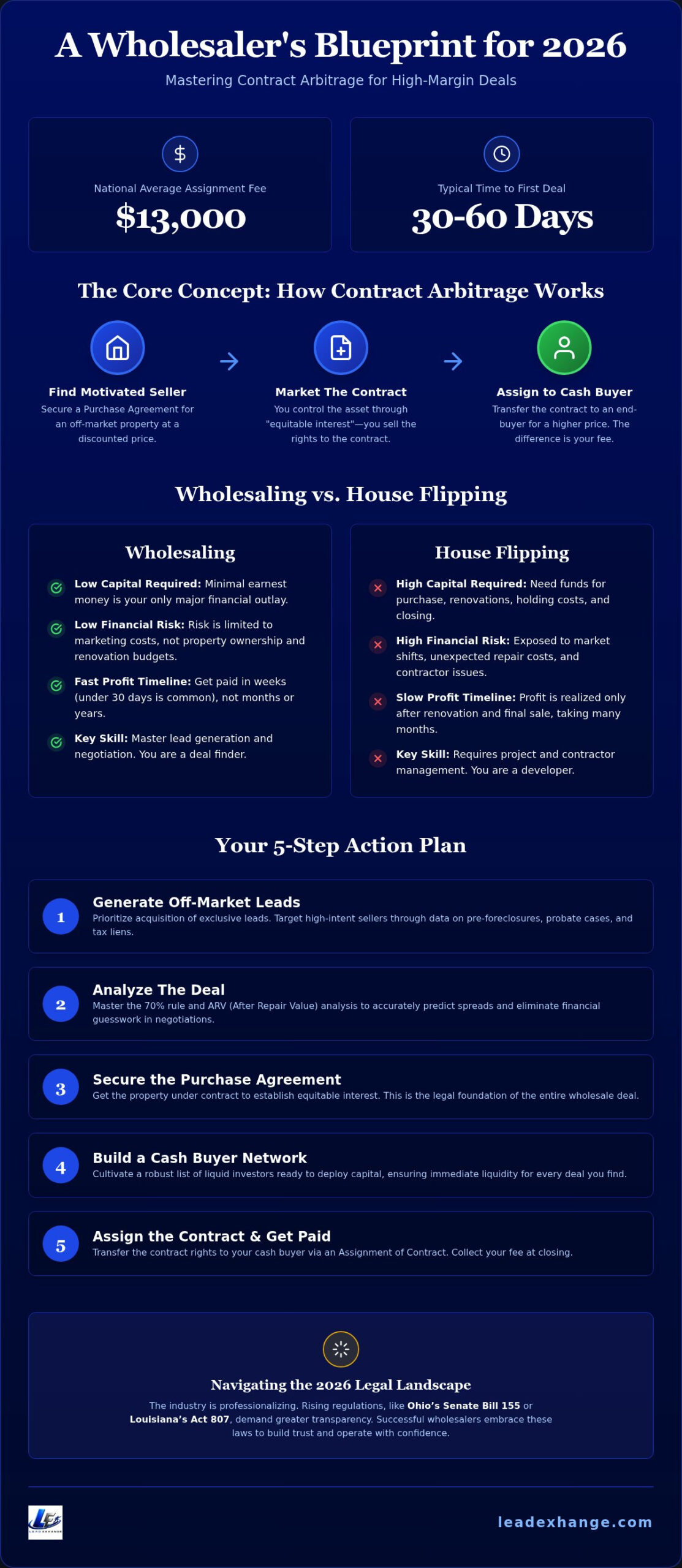
How to Wholesale Real Estate: A 5-Step Action Plan
Execution is the only metric that matters in this business. While many beginners get stuck in the education phase, successful investors focus on the repeatable mechanics of the deal. Mastering how to wholesale real estate requires a disciplined workflow that moves a property from a lead to a closed assignment fee with minimal friction. You must treat each step as a critical link in a chain. If one link breaks, the deal dies.
Follow this 5-step framework to navigate the 2026 market:
- Step 1: Source Exclusive Off-Market Leads. Identify distressed properties before they reach the general public.
- Step 2: Negotiate and Secure the Purchase Agreement. Lock in the property at a price that allows for a profitable spread.
- Step 3: Market the Contract. Present the opportunity to your vetted list of cash buyers.
- Step 4: Execute the Assignment. Formally transfer your equitable interest to the end-buyer.
- Step 5: Collect Your Fee. Receive your assignment check directly from the title company at closing.
Sourcing Leads in High-Competition Markets
Efficiency is your competitive advantage. “Driving for dollars” is a slow, manual process that can’t compete with modern data. In high-activity cities like Memphis, Jackson, and Charlotte, properties move too fast for traditional scouting. Professionals use off-market real estate leads to identify motivated sellers before they even consider listing on the MLS. This data-driven approach allows you to build a pipeline of opportunities while your competitors are still looking for street signs.
Mastering the Assignment Process
Transparency is the key to a smooth closing. When explaining the assignment to a seller, focus on the benefit: they get a guaranteed cash exit without paying agent commissions or repair costs. Your fee is simply the cost of the service you provide. If you’re working on a deal with an exceptionally large spread, consider a “Double Closing.” This involves two separate transactions where you buy and immediately sell the property. It keeps your assignment fee private from both the seller and the buyer, which is often necessary when the profit exceeds $30,000.
Success also depends on your choice of partners. You must work with “investor-friendly” title companies that understand the nuances of wholesale real estate contracts and assignment of contract paperwork. Traditional title companies may get confused by wholesale paperwork, leading to delays or canceled deals. A professional title agent ensures that all 2026 disclosure requirements are met, protecting you from legal liability and ensuring your fee is paid on time. This infrastructure is what allows you to scale from a single deal to a consistent monthly income.
Scaling Your Wholesale Business with Professional Tools
Scaling is the transition from a manual “hustle” to a repeatable investment engine. You can’t build a sustainable career by spending ten hours a day manually searching for leads. Understanding how to wholesale real estate at a high level means shifting your focus from the search to the close. You need a system that delivers opportunities to your inbox while you focus on negotiating and managing your buyer list. This shift is what separates the hobbyist from the professional facilitator.
The implementation of wholesale real estate software is the catalyst for this growth. Professional tools allow you to manage high lead volumes without increasing your workload. By utilizing subscription-based access, such as the Starter or Growth plans, you remove the “feast or famine” cycle that plagues most beginners. You shift from a reactive state to a proactive facilitator in your local market, ensuring a consistent pipeline of revenue regardless of market fluctuations.
Automating the Lead Pipeline
Manual lead scraping is the primary reason wholesalers fail within their first twelve months. It’s an inefficient use of time that prevents you from building relationships with cash buyers. Platforms like Lead Exchange provide curated off-market data, allowing you to bypass the “searching” phase entirely. This automation ensures a consistent flow of deals, making your operation predictable and bankable. You stop being a hunter and start being a manager of high-value assets.
The ROI of a professional lead subscription is immediate. In the 2026 market, where the average assignment fee is $13,000, a single closed deal covers years of software costs. You aren’t just buying data; you’re buying back your time. This efficiency allows you to scale your how to wholesale real estate strategy across multiple markets simultaneously, increasing your total deal volume without hiring a massive team.
Developing a Professional Brand in Your Local Market
A scalable business requires a professional reputation. Homeowners in distress need to trust that you can perform. By presenting professional direct-buying offers, you separate yourself from the unorganized “hustlers.” You become a reliable solution for sellers and a consistent source of inventory for cash buyers in high-demand markets like Cleveland and Detroit. Trust is the currency that accelerates deal flow.
Scaling to a “Growth” mindset means handling multiple contracts at once. You move from closing one deal every few months to closing multiple deals every single month. This level of performance requires the right infrastructure. When you stop acting as a one-man show and start acting as a high-volume facilitator, you unlock the true financial potential of real estate wholesaling. It’s about building a system that works for you, rather than you working for the system.
Master the 2026 Wholesale Market
Success in the current real estate landscape isn’t about working harder; it’s about working with superior data. You’ve learned that profit is secured through the surgical application of the MAO formula and a deep understanding of the three pillars of operation. By mastering the specific mechanics of how to wholesale real estate, you position yourself as a high-stakes facilitator rather than a casual hobbyist. Navigating the new 2026 disclosure laws with transparency will build the trust necessary to close deals in high-competition zones.
The transition from a manual hustle to a scalable investment engine requires professional infrastructure. You need direct access to curated, high-margin off-market deals in markets like Atlanta and Memphis to maintain your momentum. Whether you utilize a Starter plan to secure your first assignment fee or a Growth plan to handle multiple simultaneous contracts, the goal remains the same: efficiency and reliability. High-performance tools remove the traditional obstacles to your financial progress.
Don’t let the difficulty of sourcing deals stall your ambition. Use these strategies to build a repeatable system and claim your place in the local investment ecosystem. Your first high-margin closing is well within reach.
Frequently Asked Questions
Is wholesaling real estate legal in all states?
Wholesaling is legal in all 50 states, but the regulatory landscape has changed significantly in 2026. States like Louisiana and Ohio now mandate specific disclosures and earnest money requirements under Act 807 and Senate Bill 155. You must ensure your contracts comply with these local statutes to avoid being classified as an unlicensed broker. Always consult a real estate attorney to verify the specific legal framework in your target market before executing an assignment.
How much money do I need to start wholesaling real estate?
You can start with minimal capital, often less than $1,000 for an earnest money deposit. Unlike flipping, you don’t need to fund the entire purchase price or renovation. Your primary costs involve marketing and lead generation tools. Learning how to wholesale real estate effectively means allocating your budget toward high-quality data rather than physical assets. This low-barrier entry makes it an ideal strategy for investors without significant liquid reserves.
Do I need a real estate license to wholesale houses?
Most states don’t require a license for occasional wholesaling, but volume-based requirements are increasing. As of 2026, states like Illinois and Arizona require licensing for frequent transactions. California’s AB-2847 classifies anyone assigning more than three properties per quarter as a broker. If you plan to scale into a high-volume operation, obtaining a license provides a layer of legal protection and access to additional market data that isn’t available to the general public.
What is an assignment fee and how is it paid?
An assignment fee is the profit you earn for transferring your contract rights to a cash buyer. It represents the “spread” between your contract price with the seller and the final price paid by the buyer. The title company or closing attorney pays this fee directly to you once the transaction is finalized. In 2026, the national average for these fees is approximately $13,000 per deal, though high-margin markets can yield much more.
What happens if I can’t find a buyer for my wholesale contract?
If you can’t find a buyer, you must use a contingency clause to exit the contract legally. Most professional wholesalers include an inspection period or a “partner approval” clause that allows them to cancel if the deal doesn’t meet their criteria. Without these protections, you risk losing your earnest money deposit. Always ensure your contracts provide a clear exit path to protect your capital and your reputation within the local investment community.
How do I find cash buyers for my wholesale deals?
You find cash buyers by analyzing public records to see who is purchasing properties with 100% equity in your target zip code. Networking at local investment clubs and using professional lead platforms are also effective strategies. Focus on building relationships with “fix and flip” investors who need a consistent supply of inventory. A vetted list of ten active buyers is more valuable than a large database of unverified contacts who lack liquid capital.
What is a ‘double closing’ in real estate wholesaling?
A double closing involves two distinct transactions occurring back-to-back. You buy the property from the seller in the first transaction and immediately sell it to your cash buyer in the second. This method is used to keep your assignment fee private or when a lender doesn’t allow contract assignments. It requires you to have temporary access to “transactional funding” to cover the first purchase for a few hours until the second closing occurs.
Can I wholesale a property that is listed on the MLS?
You can wholesale MLS properties, but it’s significantly more difficult due to high competition and agent involvement. Most listed properties are priced closer to retail value, leaving little room for a wholesale spread. Additionally, many bank-owned properties or short sales have “anti-flip” clauses that prevent assignment. Successful investors focus on how to wholesale real estate by targeting off-market leads where they can negotiate directly with owners without competing against retail buyers.
Disclaimer
The opinions and information shared on this website are for educational purposes only. Results from real estate investing and lead generation vary, and no specific outcome or profit is guaranteed