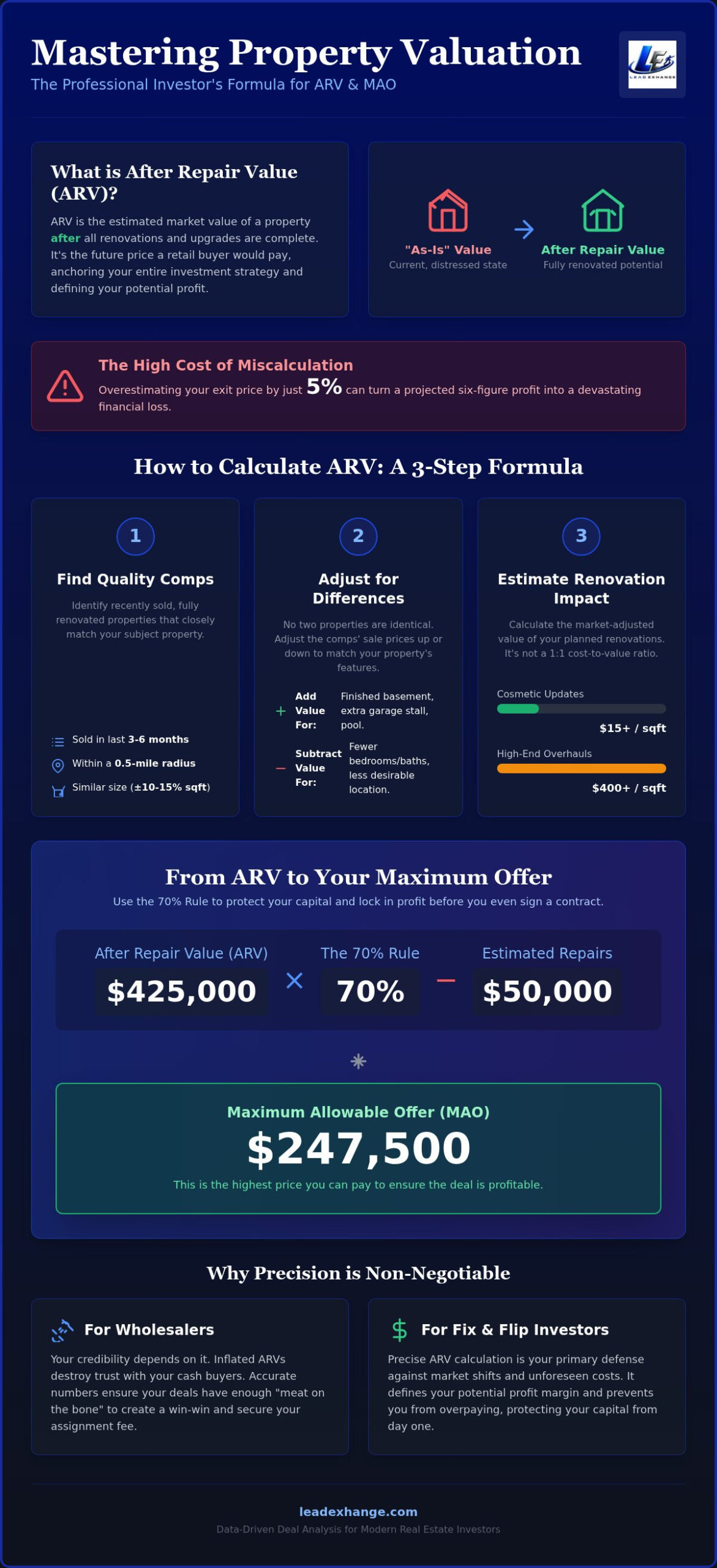
Overestimating your exit price by just 5% can turn a projected six-figure profit into a devastating financial anchor before the first contractor even arrives on site. In a market like Atlanta, where the median sale price is currently $425,000, you cannot afford to rely on inconsistent deal analysis or a basic ARV Calculator that ignores local nuances. You already know that your success depends entirely on the accuracy of your math; if your After Repair Value is off, your entire strategy collapses.
This guide will show you how to master the math behind profitable deals to strip emotion out of your acquisitions and lock in your Maximum Allowable Offer with total confidence. You’ll learn the exact system professional investors use to account for local renovation costs, which currently range from $15 per square foot cosmetic updates to $400 per square foot high end overhauls. We’re breaking down the repeatable formula for scaling your portfolio and presenting bulletproof valuations to buyers or lenders. Accurate valuation is the critical first step before you leverage high volume deal flow to wholesale your next project. It’s time to stop guessing and start calculating for profit.
Key Takeaways
- Distinguish between “as-is” value and future market potential to identify the true profit margin in every distressed property.
- Implement a professional ARV Calculator approach that accounts for market multipliers rather than just adding renovation costs 1:1.
- Protect your investment capital by using the 70% Rule to establish a firm Maximum Allowable Offer before committing to any contract.
- Account for hyper-local variables in Atlanta, Memphis, and Detroit that directly influence final exit prices and buyer demand.
- Scale your portfolio efficiently by sourcing high-potential off-market leads that align with your precise valuation requirements.
What is ARV in Real Estate? Defining After Repair Value
After Repair Value, or ARV, represents the estimated market value of a property once all necessary renovations, repairs, and upgrades are completed. It’s the anchor of every successful investment strategy. Without a clear ARV, you’re essentially gambling on your exit price rather than calculating it. For fix-and-flip investors, ARV determines the potential profit margin; for wholesalers, it dictates the viability of the contract. ARV is the projected price a retail buyer would pay for a fully renovated home in 2026.
ARV vs. Current Market Value
Current market value reflects a property’s “as-is” state. In the distressed market, this price is often suppressed by structural issues, outdated systems, or significant cosmetic neglect. Investors buy based on this lower number to capture the “value-add” potential that exists between the purchase price and the eventual ARV. When assessing real estate investing strategies, professional buyers look beyond the peeling paint to see the modern finishes, improved curb appeal, and structural integrity that will drive the final sale price.
It’s vital to remember that ARV is a projection, not a legal guarantee. It relies on current market data and the assumption that your renovation will meet or exceed the standard of local comparable sales. Using a professional ARV Calculator helps you stay grounded in data rather than optimism. Conservative estimation is your best defense against market shifts. If you overestimate the exit price, your profit evaporates before the project even starts.
Why Wholesalers Need Precise ARV Calculations
Wholesalers must be even more diligent with their math because their reputation depends on it. A wholesaler’s primary job is to find a deal with enough “meat on the bone” to satisfy a cash buyer while still leaving room for an assignment fee. If you present an inflated ARV to your buyers list, you lose credibility instantly. Experienced investors will run their own numbers; if they find your ARV Calculator results were pushed too high to hide a weak deal, they won’t look at your next offer.
Precision allows you to calculate the exact spread available for your fee. You need to know how to find the right distressed properties and then learn how to wholesale real estate with transparency. When your ARV is accurate, your deals become “no-brainers” for your buyers. This clarity speeds up your disposition process and allows you to move on to the next acquisition with confidence. High-performance wholesalers treat ARV as the foundation of their entire business model.
How to Calculate ARV: The Step-by-Step Formula
Calculating ARV isn’t a simple addition exercise. The standard formula is: ARV = Purchase Price + Value of Renovations (adjusted for a market multiplier). You can’t just spend $50,000 on a kitchen and assume the home’s value rises by exactly $50,000. Real estate markets don’t operate on a 1:1 ratio. Instead, you’re looking for the price ceiling established by the highest-quality “comparables” or comps in the immediate area. A reliable ARV Calculator uses these comps to validate your final figure, ensuring your exit strategy stays grounded in reality.
Step 1: Identifying the Right Comparables
Precision starts with your data set. You’re looking for investor-grade comps that meet these strict criteria:
- Sold within the last 3 to 6 months to reflect current market momentum.
- Located within a 0.5-mile radius of your subject property.
- Similar square footage (within 10% to 15%), bedroom/bathroom counts, and lot sizes.
Focus exclusively on properties sold in “fully renovated” condition. These sales represent the maximum price a retail buyer will pay. This is the exact number your ARV Calculator needs to target to ensure your profit margins remain intact.
Step 2: Adjusting for Property Differences
No two houses are identical. You must adjust your valuation based on specific features like garages, finished basements, or pool decks. If a comp has a two-car garage and your property doesn’t, you’ll need to subtract the value of that feature from the comp’s sale price to find your target. Pay close attention to neighborhood boundaries. Crossing a major four-lane road or a school district line can drastically change the market value, even if the houses look the same. An appraiser-style adjustment is the gold standard for ARV accuracy and helps you follow the 70% rule for real estate investors with confidence.
Step 3: Estimating Renovation Impact
Your renovation plan must align with what the market demands. Consult with local contractors to get realistic rehab estimates for the specific area. A cosmetic “lipstick” flip involving paint and flooring costs significantly less than a full-gut renovation but yields a different ARV. Always factor in a 10% to 15% contingency for unexpected repair costs like hidden mold or outdated wiring. Once you’ve mastered these calculations, you can begin sourcing off-market investment deals that fit your precise profit criteria. Accurate estimating ensures you don’t overpay for a property that can’t support the necessary rehab budget.
Using ARV to Calculate Your Maximum Allowable Offer (MAO)
If ARV is your destination, the Maximum Allowable Offer (MAO) is your starting line. You can’t reach a profitable exit if you overpay at the acquisition stage. The 70% Rule serves as the industry benchmark: (ARV x 0.70) minus renovation costs equals your MAO. This 30% spread accounts for holding costs, financing fees, and your net profit. While your ARV Calculator defines the property’s potential, the MAO formula defines your financial safety net. It’s the difference between a high-performance investment and a costly mistake.
Investors often adjust these percentages based on market intensity. In hyper-competitive neighborhoods within Atlanta or Memphis, you might see experienced flippers shift to a 75% or 80% rule. This aggressive approach leaves less room for error and requires a flawless understanding of local demand. High-volume investors often accept these tighter margins for properties in premium school districts where the days on market are low. However, if your math fails at an 80% buy-in, you aren’t just losing profit; you’re likely losing capital. Precision is non-negotiable when margins are thin.
| Investment Factor | Conservative (70% Rule) | Aggressive (80% Rule) |
|---|---|---|
| After Repair Value (ARV) | $400,000 | $400,000 |
| Rule Percentage Value | $280,000 | $320,000 |
| Estimated Rehab Costs | $60,000 | $60,000 |
| Maximum Allowable Offer | $220,000 | $260,000 |
Factoring in Wholesale Assignment Fees
Wholesalers must add another layer to this calculation to ensure they get paid for their effort. To find your contract price, you must subtract your desired assignment fee from the cash buyer’s MAO. If a buyer’s limit is $220,000 and you want a $15,000 fee, your target contract price with the seller is $205,000. Your buyer’s profit margin depends entirely on your valuation accuracy. Utilizing an Atlanta MAO Calculator streamlines this process, ensuring you present deals that actually close. Reliable math builds the trust necessary to scale a massive buyers list quickly.
Common ARV Mistakes to Avoid
Even seasoned pros can fall into traps that skew their ARV Calculator results. Avoid these three common pitfalls to keep your deals viable:
- Relying on active listings: Asking prices are merely aspirations; only “sold” data from the last 90-180 days confirms what the market actually supports.
- Over-improving the asset: Never install high-end marble countertops in a neighborhood where the price ceiling is capped by basic granite or laminate.
- Ignoring external nuisances: A property’s proximity to a highway, high-tension power lines, or an industrial zone can shave 10% to 15% off your ARV regardless of the interior’s quality.
Market-Specific ARV Factors: Atlanta, Memphis, and Detroit
Real estate value is hyper-local. A 1,500 sq ft ranch in Atlanta commands a median price of $289 per square foot, while a similar footprint in Detroit sits at roughly $81 per square foot. These disparities mean a generic ARV Calculator only works if you feed it precise, local data. You can’t apply national averages to cities where value can shift significantly across a single street. Understanding how to calculate MAO in real estate for these specific hubs is the difference between a high-yield project and a stagnant asset.
In cities like Memphis, “block-by-block” volatility is a constant factor. You might find a fully renovated home selling for a premium just two streets away from a cluster of boarded-up properties. This requires a tighter comp radius, often staying within 0.25 miles rather than the standard 0.5 miles. Local school districts also play a massive role in suburban markets like Birmingham or Charlotte, where being on the “right” side of a district line can add $20,000 to $40,000 to your ARV instantly.
Atlanta and Charlotte: High-Growth Market Dynamics
Atlanta’s market in 2026 is measured and intentional. With median sale prices reaching $425,000, investors must account for steady appreciation. Comps from six months ago often fail to capture the current 4.9% annual increase in price per square foot. In these trending markets, retail buyers place a heavy premium on modern, open-concept floor plans and proximity to transit hubs. If you’re using an ARV Calculator in these zones, ensure your comps reflect the “turnkey” standard that today’s buyers demand. High-end renovations here can reach $400 per square foot, so your exit price must justify the finish level. Pairing your ARV analysis with a dedicated Atlanta Wholesale Deal Calculator gives you the surgical precision needed to make competitive offers without sacrificing your profit margins.
Memphis and Detroit: Cash Flow vs. Appreciation
In Memphis and Detroit, the strategy often shifts from pure appreciation to rental parity. BRRRR investors focus on an ARV that supports a refinance based on rental income. In some Detroit zip codes, Section 8 rental rates can actually establish the ARV ceiling because the guaranteed cash flow drives investor demand more than retail buyer interest. You must also verify property taxes and insurance rates; in Detroit, where the average whole-house renovation costs $45,740, these carrying costs can vary wildly by zip code. In Memphis, the median sale price of $209,000 offers a lower barrier to entry, but tight inventory in popular neighborhoods keeps demand high. Using a dedicated Wholesale Real Estate Calculator built for Memphis and Atlanta deals ensures your assignment fees and rehab budgets are calibrated to the specific dynamics of each market.
Scaling Your Investment Engine with Lead Exchange
An ARV Calculator is a precision instrument, but even the most accurate tools are useless without raw material. You need a consistent stream of distressed properties to apply your math and secure your next closing. Lead Exchange serves as the premier source for off-market, high-ARV potential deals in the nation’s most active investment hubs. We provide the high-quality leads that allow you to put your valuation skills to work. Precise math is the bridge between a Lead Exchange lead and a profitable exit.
Our Starter and Growth plans are built to facilitate rapid scaling. These subscription tiers provide the data-rich leads necessary for professional-grade deal analysis. Instead of wasting hours on manual prospecting, you can focus on running your numbers and making offers. This efficiency allows you to analyze more deals in a single afternoon than most investors find in a month. When you have high-volume deal flow, your ability to use an ARV Calculator becomes your primary competitive advantage.
Leveraging Off-Market Data for Better Comps
Off-market deals often lack the transparent history found on the MLS. This data gap requires deeper investigative math to establish a reliable baseline. Lead Exchange helps you find the distressed side of the ARV equation by identifying properties with significant value-add potential. Our subscription tiers empower you to perform higher volume analysis across markets like Atlanta and Memphis. This speed is essential for investors looking to scale their operations without increasing their overhead. You’ll spend less time searching and more time executing profitable acquisitions.
Next Steps: From Calculation to Offer
Once your ARV is established, you can enter the contracting phase with absolute certainty. Use the data sourced from Lead Exchange to justify your offer price to motivated sellers. Presenting a clear, math-based explanation for your Maximum Allowable Offer removes friction from the negotiation. It demonstrates that you’re a serious, high-performance partner focused on the bottom line. Accurate calculations lead to faster acceptances and a more reliable pipeline of closed deals. Stop guessing at your margins and start building a portfolio based on verified data.
Secure Your Profit with Precision Math
Precision is your only shield against market volatility. You’ve now seen that After Repair Value isn’t just a projection; it’s the definitive anchor for every high-stakes investment strategy. By mastering a professional ARV Calculator approach and adjusting for hyper-local factors like school districts or specific renovation multipliers, you remove the dangerous guesswork from your acquisitions. Accurate math ensures you don’t just find deals, but you find the right deals that support your bottom line.
Real success in 2026 requires more than just sharp math. You need a reliable, high-volume pipeline of distressed properties to fuel your engine. Lead Exchange operates as a curated platform for wholesalers and flippers who demand exclusive data on off-market opportunities. With Starter and Growth plans tailored to every investor level, we provide the raw material you need to scale your portfolio with absolute confidence. Stop chasing average returns and start targeting the spreads that professional investors demand.
It’s time to stop analyzing from the sidelines and start executing. Take control of your deal flow today and build a legacy backed by verified data and bulletproof valuations. Your next high-performance deal is waiting for the right calculation.
Frequently Asked Questions
What is the most accurate way to find real estate comps for ARV?
The most reliable method is pulling sold data directly from the Multiple Listing Service (MLS) or an investor-grade lead platform. Focus on closed transactions rather than pending or active listings to see what buyers are actually paying. In markets like Memphis or Detroit, ensure your comps are within the same neighborhood pocket. This data provides the accurate baseline needed for your ARV Calculator to produce a realistic exit price.
Can I use automated online estimates for my ARV calculation?
No, automated valuation models (AVMs) found on consumer real estate portals are notoriously inaccurate for distressed properties. These algorithms don’t account for the specific high-end finishes you plan to install or the current structural neglect. They rely on broad neighborhood trends rather than the “after repair” standard. A dedicated ARV Calculator allows you to input specific value-add data that generic online tools simply cannot see, ensuring your profit margins are protected.
How does the 70% rule change in a high-interest rate environment?
In a high-interest rate environment, investors often tighten the 70% rule to a 65% or 60% rule. Rising borrowing costs increase your monthly debt service and holding expenses, which directly eats into your net profit. If your financing is expensive, you must secure the property at a deeper discount to maintain your margins. Adjusting your Maximum Allowable Offer (MAO) ensures your project remains financially viable even if market days-on-market increase.
What happens if my rehab costs exceed my initial estimate?
When rehab costs exceed your estimate, the overage comes directly out of your net profit. This is why a 10% to 15% contingency fund is a non-negotiable part of your initial budget. If major hidden issues arise, you may need to pivot your finish level or accept a lower return. Precise upfront inspections and contractor walk-throughs are the only way to protect your spread from being erased by unexpected repairs.
Is ARV the same as a professional appraisal value?
ARV is an investor’s projection of market potential, while an appraisal is a formal valuation performed for a lender. While both rely on comparable sales, appraisers follow strict regulatory guidelines that may be more conservative than your investment goals. Your calculated ARV must be realistic enough to pass a bank appraisal once the work is finished. If your valuation is too aggressive, your retail buyer will likely face financing hurdles during the sale.
Do I need to calculate ARV for rental properties (Buy and Hold)?
Yes, calculating ARV is essential for rental strategies like the BRRRR method. You need to know the property’s future value to determine how much equity you can pull out during the refinance phase. Lenders typically limit their loan-to-value (LTV) ratios based on the appraised after-repair condition. If your math is off, you risk leaving too much capital tied up in the deal, which prevents you from scaling your portfolio efficiently across hubs like Birmingham or Charlotte.
How often should I update my ARV during a long-term renovation project?
You should review your ARV every 30 to 60 days during a long-term project. Real estate markets are dynamic; a sudden spike in local inventory or a shift in interest rates can change your exit price. If a superior comp sells nearby, your potential value might increase. Conversely, if the market cools, knowing your updated ARV allows you to adjust your list price or marketing strategy before the renovation is even complete.
Disclaimer
The opinions and information shared on this website are for educational purposes only. Results from real estate investing and lead generation vary, and no specific outcome or profit is guaranteed