In the high-velocity Atlanta market, a gut feeling is the fastest way to lose $20,000 on a single contract. Precision math is your only real defense against market volatility and the persistent fear of overpaying for a distressed property. If you’re still relying on slow manual calculations or “eyeballing” repair costs, you’re losing deals to faster, more prepared competitors. Mastering a professional Wholesale Deal Calculator framework isn’t just a convenience; it’s the foundation of a scalable, high-performance investment business.
You already know that one inaccurate rehab estimate can ruin your profit margins and damage your reputation with cash buyers. It’s exhausting to watch a deal slip away because you couldn’t run the numbers fast enough to make a solid offer. We’ll solve that today. You’re going to learn how to analyze off-market opportunities with surgical precision using the industry-standard wholesale deal formula.
This article provides a repeatable system for deal analysis that delivers a clear Maximum Allowable Offer (MAO) every time. We’ll break down the variables that actually matter, from After Repair Value (ARV) to target assignment fees, so you can negotiate with total confidence. By the end, you’ll have the tools to turn raw property data into decisive, profitable action.
Key Takeaways
- Learn how to utilize a professional Wholesale Deal Calculator to eliminate analysis paralysis and replace gut feelings with objective, data-driven decisions.
- Master the Maximum Allowable Offer (MAO) formula to ensure every contract includes a guaranteed profit margin and a necessary safety buffer for your end-buyers.
- Discover how to adjust standard formulas for hyper-competitive, high-growth markets like Atlanta and Memphis to remain aggressive without sacrificing your bottom line.
- Shift your negotiation strategy from emotional haggling to logic-based offers by establishing a definitive “walk away” number before the conversation begins.
- Scale your operations by integrating precision math with exclusive off-market data through Starter and Growth subscription plans.
Eliminating Guesswork with a Professional Wholesale Deal Calculator
A Wholesale Deal Calculator is not just a spreadsheet; it’s a strategic risk-assessment tool designed to protect your capital and your reputation. In the high-stakes Atlanta market, this tool serves as your primary defense against emotional decision-making. It identifies the “Spread,” which is the critical gap between your acquisition price and the ultimate resale value. Without a standardized way to quantify this gap, you’re essentially gambling on one of the most expensive assets in the world.
Manual math is the enemy of growth. Relying on a scratchpad or mental arithmetic leads to “analysis paralysis,” where you spend so much time second-guessing your numbers that the deal disappears. In 2026, off-market opportunities move at a pace that doesn’t allow for hesitation. If you can’t verify the profitability of a lead within minutes, a more prepared investor will. A professional calculator replaces doubt with data, allowing you to move from a lead to a signed contract with total certainty.
Why Speed is Your Greatest Competitive Advantage
Speed is the primary currency of modern real estate acquisitions. Elite investors use a Wholesale Deal Calculator to submit offers in minutes, not days. High-velocity markets like Atlanta and Memphis require immediate action. While others are still scheduling contractors for walkthroughs, tech-enabled wholesalers have already calculated their Maximum Allowable Offer (MAO) and secured the deal. The cost of “bad math” is catastrophic. One missed zero or an underestimated roof repair can turn a projected $15,000 assignment fee into a $5,000 loss. Modern technology removes human error from the equation, ensuring your operation remains lean and profitable.
The Core Components of Every Wholesale Analysis
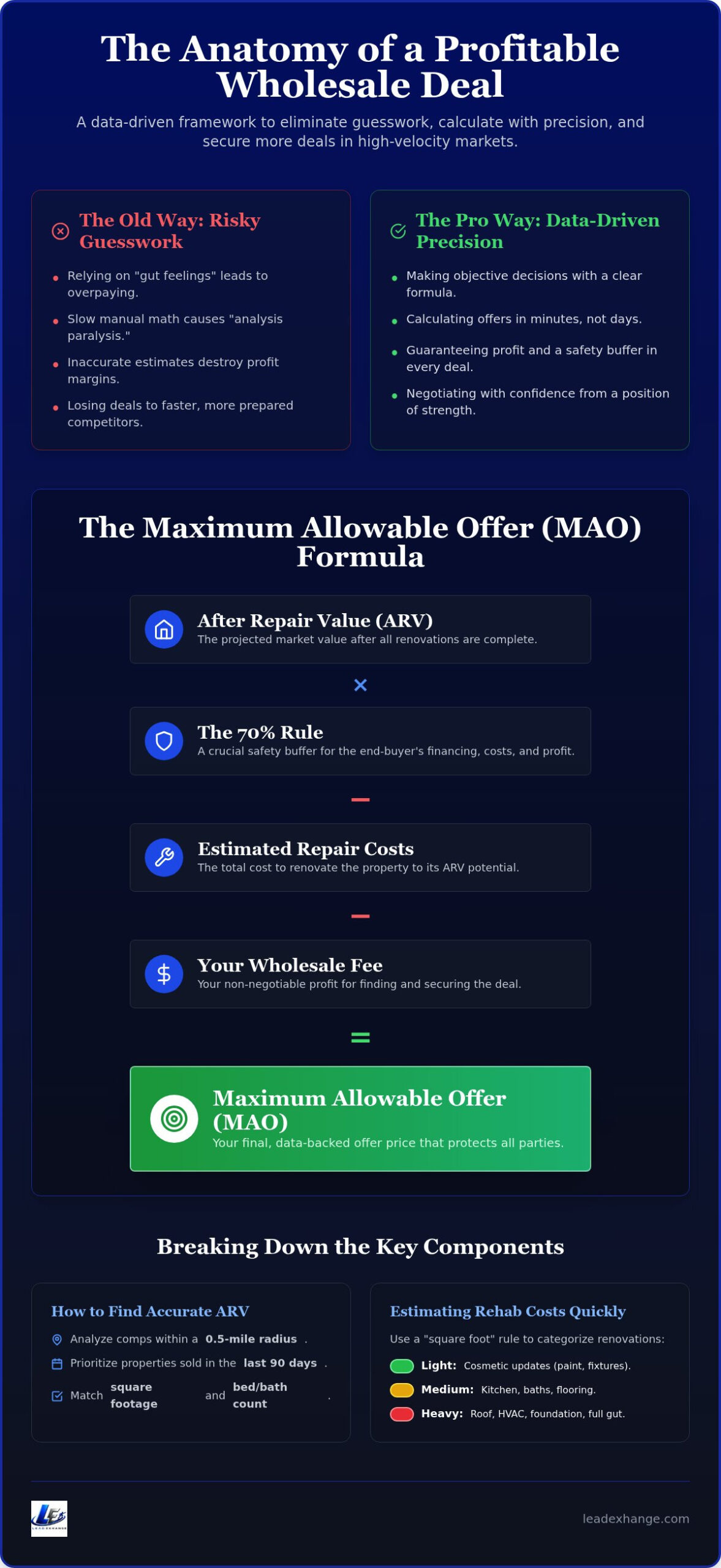
Every profitable deal relies on three non-negotiable pillars: After Repair Value (ARV), estimated rehab costs, and your desired assignment fee. You must maintain a strict emotional disconnect from the property. The house isn’t a “great opportunity” unless the math proves it. Trusting your gut is a liability that leads to overpaying for distressed assets. After Repair Value (ARV) is the projected market value after all renovations are complete. By isolating these variables, you can determine if a lead from Lead Exchange is a high-margin opportunity or a waste of time. Successful wholesalers rely on these numbers to dictate their moves, ensuring every offer is backed by logic rather than hope.
The Anatomy of a Profitable Deal: The 70% Rule and MAO
Success in wholesaling hinges on one number: the Maximum Allowable Offer (MAO). This isn’t a guess. It’s a calculated threshold that ensures your buyer makes money while you get paid. A professional Wholesale Deal Calculator uses a specific formula to protect these margins: (ARV x 0.70) – Repairs – Wholesale Fee = MAO. By strictly adhering to this math, you eliminate the risk of bringing a “deal” to your buyers that actually loses them money.
The “70% Rule” is the industry standard for a reason. It provides a necessary safety buffer for the end-buyer, accounting for their financing costs, closing fees, and target profit. A flipper’s MAO typically stops at the purchase and renovation costs. However, a wholesaler’s MAO must go one step further by subtracting the assignment fee as a distinct line item. If you don’t account for your profit upfront, you’re essentially donating your labor to the investor. Your wholesale fee is a non-negotiable cost of doing business, not an afterthought to be squeezed out at the end.
Calculating the After Repair Value (ARV) Accurately
Your analysis is only as good as your data. To determine a property’s true potential, you must analyze comparable sales (comps) within a 0.5-mile radius. In the fast-moving 2026 market, prioritize properties sold within the last 90 days that match the subject property in square footage and bed/bath count. Relying on outdated data leads to overinflated offers that cash buyers will reject immediately. For those working in Georgia, using the Atlanta ARV Calculator provides the localized precision needed to stay competitive and accurate.
Estimating Rehab Costs without a Contractor
You don’t need a general contractor to run initial numbers. Use a “square foot” rule of thumb to categorize the project into light, medium, or heavy renovations. Light projects might involve paint and flooring, while heavy renovations require structural changes or system overhauls. During your walkthrough, watch for “deal killers” like sagging rooflines or foundation cracks. These issues can double a repair budget instantly. Mastering this skill is vital when calculating MAO for Memphis and Atlanta properties where structural integrity varies significantly by neighborhood. Once you’ve mastered the math, the next step is securing high-quality leads through Lead Exchange to keep your pipeline full of high-margin opportunities.
Adjusting the Math for High-Growth Markets Like Atlanta and Memphis
A generic Wholesale Deal Calculator works in stable markets, but high-growth zones like Atlanta require a more aggressive approach. In these hyper-competitive areas, the standard 70% Rule often results in zero signed contracts. Local investors frequently move to a 75% or even 80% Rule because they bank on rapid appreciation and high buyer demand. If you don’t adjust your math to reflect local competition, you’ll never secure a deal in a “hot” zip code. You aren’t just buying a house; you’re buying into a market’s velocity. For a deeper breakdown of the exact formulas elite investors use in these regions, a dedicated Wholesale Real Estate Calculator for Memphis and Atlanta deals can provide the market-specific precision your analysis requires.
Conversely, markets like Detroit or Cleveland offer lower entry points and different rehab cost structures. In these regions, a fixed percentage might not leave enough room for the absolute dollar amount needed for repairs. You must also factor in property taxes and holding costs, which vary wildly between states. Using a localized Maximum Allowable Offer Calculator ensures your bid accounts for these regional nuances. Relying on national averages is a liability that leads to rejected offers or thin margins.
The Atlanta Strategy: Working with Tighter Margins
Atlanta’s market velocity allows for thinner margins because the exit is almost guaranteed. Investors here often accept a lower profit percentage in exchange for the security of a fast flip. For wholesalers, this means your assignment fees stay healthy even if the purchase price is higher than the national average. The challenge lies in finding the inventory. Success requires a consistent stream of off-market real estate leads in high-demand zones. When demand is high, the math must be precise to stay ahead of the competition.
Memphis and Birmingham: Cash Flow vs. Equity
The math shifts when moving to Memphis or Birmingham. These are primarily “rental-ready” markets where end-buyers are often long-term landlords rather than fix-and-flip investors. A landlord cares about yield and debt coverage ratios, not just the 70% equity rule. Your Wholesale Deal Calculator must pivot to evaluate the property based on its rental income potential. Holding costs in the Southeast, including lower property taxes but higher insurance premiums for distressed assets, must be integrated into your final MAO. This ensures your deals remain attractive to cash-flow-focused buyers who prioritize monthly returns over immediate equity gains.
Negotiating with Confidence: From MAO to Signed Contract
Negotiation is where most wholesalers fail because they rely on persuasion instead of proof. Once your Wholesale Deal Calculator provides a Maximum Allowable Offer (MAO), that number becomes your definitive “Walk Away” point. You must enter every conversation knowing exactly where the deal stops being profitable. By presenting your offer as a result of “Logic and Math,” you remove the emotional friction from the seller. You aren’t offering a low price; the property’s condition is simply dictating the current market value.
Use your detailed rehab estimate to justify your position. If the roof requires $15,000 in work and the HVAC is failing, show the seller those specific line items. It’s much harder for a homeowner to argue with a repair list than a flat offer. This transparency positions you as a professional facilitator rather than a predator. Finally, ensure your contract includes a clear assignment clause. This legal protection allows you to transfer the contract to your cash buyer while securing your fee without taking title to the property.
Using the Calculator as a Visual Aid
Transparency builds trust. Showing the math to a motivated seller often de-escalates the negotiation. Use the “Anchor Price” technique by starting with the property’s current “as-is” value minus the necessary repairs. A simple script for explaining the 70% rule sounds like this: “To make this project work for a cash buyer, they need a 30% margin to cover their financing, closing costs, and a small profit. Based on the $300,000 ARV, that leaves us with a starting point of $210,000 before we even look at the $50,000 in repairs needed.” This approach frames the Wholesale Deal Calculator as an objective third party.
Avoiding Common Calculation Pitfalls
Precision is your best defense against a bad deal. Don’t make the mistake of “over-improving” a property beyond its neighborhood comps. A $50,000 kitchen in a neighborhood where houses top out at $250,000 is a wasted investment that your end-buyer won’t pay for. You must also account for holding costs like utilities, insurance, and property taxes during the renovation period. Forgetting these “hidden” expenses can shave thousands off your assignment fee. If you’re just starting, review the How to Wholesale Real Estate: 2026 Step-by-Step Guide to ensure your operational foundation is solid.
Scaling Your Operations with Lead Exchange Data
Mastering the Wholesale Deal Calculator is only half the battle. Precision math is useless without a steady pipeline of high-margin opportunities to analyze. Lead Exchange serves as the engine that feeds your calculator, providing exclusive access to the distressed property data required to build a scalable business. While competitors waste time on picked-over public listings, our subscribers focus on off-market inventory where the real profit margins live. You need raw material to turn your analytical skills into actual revenue.
Lead Exchange specializes in high-velocity markets like Atlanta, Memphis, and Charlotte. We provide the off-market investment deals that allow you to apply the surgical precision you’ve learned. By integrating professional data with a repeatable analysis system, you move from a hobbyist to a high-performance facilitator. This combination is the only way to consistently secure assignment fees in a competitive landscape.
Why Off-Market Leads Beat the MLS Every Time
Publicly listed properties on the MLS are subject to intense bidding wars that compress your margins. This competition forces you to raise your MAO, often beyond the point of safety. Lead Exchange eliminates this “competition gap” by delivering direct-to-seller leads that haven’t been seen by the general market. These exclusive opportunities allow you to maintain the 70% Rule or other conservative targets, ensuring every deal you contract has a built-in profit. A curated lead subscription saves you hundreds of hours otherwise spent on manual prospecting; it lets you focus entirely on the numbers and the closing.
Choosing the Right Subscription for Your Goals
Your choice of subscription should align with your specific volume targets and market reach. The Starter plan provides the perfect entry point for new wholesalers looking to secure their first few deals in a single market. It offers a manageable lead volume that allows you to refine your negotiation skills without being overwhelmed. For investors ready to scale their operations across multiple cities like Birmingham or Detroit, the Growth plan provides the necessary data velocity to dominate regional markets. The ROI is clear. One successful assignment fee can cover the cost of a subscription multiple times over.
Secure Your Margins with Data-Driven Analysis
Precision is non-negotiable in high-velocity markets. By mastering the Wholesale Deal Calculator and the MAO formula, you’ve replaced gut feelings with a repeatable system for profit. You now have the professional framework to adjust for local volatility in Atlanta and Memphis while justifying every offer with logic-based repair estimates. This level of accuracy is what separates elite facilitators from those who overpay for distressed assets.
The math only works when you have high-quality opportunities to analyze. Lead Exchange provides the exclusive off-market property data needed to dominate competitive landscapes like Atlanta, Memphis, and Detroit. Our Starter and Growth plans are built for rapid scaling, ensuring you always have a pipeline of leads that meet your new, rigorous standards for profitability.
Stop guessing and start closing. Your next high-margin deal is waiting for an offer backed by surgical precision. It’s time to take control of your results and build a business that thrives on data.
Frequently Asked Questions
What is the 70% rule in real estate wholesaling?
It’s a risk-mitigation standard where an investor pays no more than 70% of the After Repair Value minus the cost of repairs. This formula ensures a 30% margin to cover financing, closing costs, and profit for the end-buyer. While common, it’s often adjusted in high-demand markets. It serves as a baseline for determining the maximum price a wholesaler can pay to ensure the deal remains attractive to cash buyers.
How do I calculate the After Repair Value (ARV) for a wholesale deal?
You calculate ARV by analyzing at least three comparable properties that sold within a 0.5-mile radius over the last 90 days. These “comps” must match the subject property in square footage, age, and bedroom count. They should represent the property in its fully renovated state. Looking at active listings is a mistake; only settled sales provide the definitive market data needed for a precise Wholesale Deal Calculator analysis.
What is a typical assignment fee for a wholesale deal in 2026?
Assignment fees vary based on the deal’s total volume, but many industry professionals report an average range of $10,000 to $20,000 for standard residential properties. In high-value markets like Atlanta, fees can scale higher depending on the “spread” you’ve negotiated. The key is to ensure the end-buyer still meets their profit requirements. Your fee is a reflection of the value you provided by sourcing an exclusive, off-market opportunity.
Can I use a wholesale deal calculator for rental properties?
Yes, but the math shifts from equity-based to yield-based. Instead of focusing on the 70% rule, you must evaluate the property’s Cap Rate and Cash-on-Cash return. Landlords prioritize monthly net operating income over immediate flip profits. Your analysis should include localized rental data and long-term holding costs. This ensures the deal appeals to buy-and-hold investors who are looking for sustainable cash flow rather than a one-time payout.
How do I estimate repair costs without a general contractor?
Use a standardized “price per square foot” model based on the renovation’s intensity. Light cosmetic refreshes might cost $20 per square foot, while full gut renovations can exceed $60. Walk the property with a checklist covering the roof, HVAC, plumbing, and electrical systems. Identifying these major “cap-ex” items early prevents budget overruns. Developing this internal database of local material and labor costs allows you to run numbers with high confidence.
What happens if my rehab estimate is too low?
A low rehab estimate can kill your reputation with cash buyers and lead to deals that don’t close. If the end-buyer’s inspection reveals significant costs you missed, you’ll likely have to renegotiate the purchase price with the seller or reduce your assignment fee. It’s better to be conservative and add a 10% contingency buffer to every calculation. This protects your margins and ensures the deal remains viable even if surprises arise.
Is a wholesale deal calculator different from a house flipping calculator?
A Wholesale Deal Calculator includes your assignment fee as a non-negotiable expense, whereas a flipping calculator focuses solely on the flipper’s costs and profit. Wholesalers must work backwards from the flipper’s maximum offer to find their own entry point. Both tools use ARV and repair estimates, but the wholesale version is specifically designed to identify the “spread” available for the middleman before the contract is even signed.
Why do I need a separate calculator for Atlanta or Memphis deals?
Localized calculators account for specific regional costs like Georgia’s closing fees or Tennessee’s property tax structures. Market velocity also dictates different margin requirements; an Atlanta deal might close at 75% of ARV due to high demand, while a Memphis rental deal requires a different set of metrics. Using a tool tailored to these high-margin markets ensures your offers are competitive enough to win but conservative enough to stay profitable.
Disclaimer
The opinions and information shared on this website are for educational purposes only. Results from real estate investing and lead generation vary, and no specific outcome or profit is guaranteed