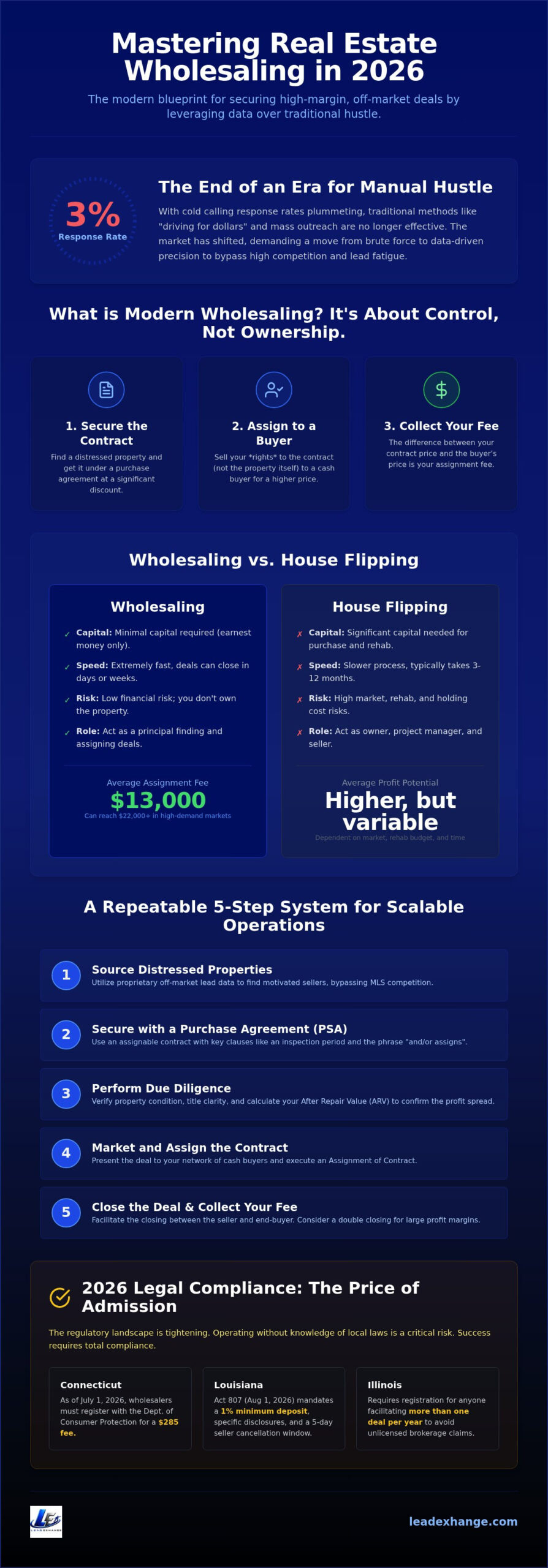
With cold calling response rates dropping to 3% in 2026, the era of manual hustle in real estate is dead. You’ve likely felt the squeeze of high competition on the MLS and the shifting legal landscape in states like Connecticut and Louisiana. Traditional wholesaling methods no longer reliably deliver the $13,000 average assignment fee that top-tier investors expect. Success now requires a pivot from brute force to precision data.
You understand that inconsistent lead quality and legal uncertainty regarding assignment contracts are major roadblocks to growth. You need a reliable way to navigate new registration requirements and disclosure laws without losing your competitive edge. This guide provides the definitive blueprint to master modern mechanics and secure high-margin, off-market deals. We’ll examine a repeatable system for identifying distressed properties, clarify the nuances of legal contract assignments, and show you how to build a scalable profit engine using exclusive data. It’s time to move beyond the 70% rule and start operating with institutional-grade efficiency.
Key Takeaways
- Master the core mechanics of securing and assigning contracts to generate high-margin fees with minimal capital.
- Ensure total legal compliance in a shifting regulatory environment by using precise purchase and sale agreements.
- Determine if wholesaling or flipping offers the best velocity for your specific investment goals and risk tolerance.
- Implement a repeatable five step system to source distressed properties and calculate accurate profit spreads.
- Scale your operations by utilizing proprietary off-market lead data to bypass high competition and lead fatigue.
What is Wholesaling? Redefining the Real Estate Middleman in 2026
Real estate success in 2026 isn’t about owning property. It’s about controlling it. Modern wholesaling functions as a high-speed liquidity tool for the housing market. You identify a distressed asset, secure it under contract at a discount, and then assign your equitable interest to a cash buyer for a fee. To grasp the foundational mechanics, many investors look to the basic definition of What is Wholesaling? to see how it applies across different industries. In real estate, it’s the ultimate low-capital entry point because you don’t need a mortgage or a massive down payment. You’re trading information and contract rights for profit.
This strategy provides essential market velocity. Distressed property owners often need immediate exits that the traditional market cannot provide. By acting as a middleman, you offer speed that a standard listing can’t match. While 20th-century investors relied on door-knocking, the 2026 professional uses digital-first sourcing. Precise data has replaced physical hustle. Using tools like Lead Exchange allows you to skip the “driving for dollars” phase and move straight to the negotiation table with high-intent sellers.
The Role of the Wholesaler in Modern Markets
You are a strategic bridge. You connect motivated sellers with institutional or individual cash buyers who have the capital but lack the time to find deals. Your value lies in discovering off-market opportunities that never touch the MLS. In 2026, wholesaling is defined strictly as a contract-rights transfer rather than a property sale. You are selling the right to purchase the property, not the dirt itself. This distinction is critical for legal compliance and operational speed. You solve the problem of lead fatigue by bringing pre-vetted, high-margin opportunities to the closing table.
Wholesaling vs. Traditional Real Estate Brokerage
The difference between a wholesaler and a broker is significant. Brokers represent clients in a fiduciary capacity and earn percentage-based commissions. Wholesalers act as principals in the transaction, earning assignment fees that averaged approximately $13,000 nationally in 2026. In high-demand markets like North Carolina or Georgia, these fees can climb as high as $22,000. Speed is the primary differentiator. A traditional sale takes months; a wholesale assignment can close in days. However, regulatory oversight is increasing. States like Illinois and Connecticut now require specific registrations for those conducting multiple deals. Louisiana also implemented Act 807 in August 2026, requiring specific disclosures and a 1% minimum deposit. You must understand these local nuances to protect your margins and maintain your status as a high-performance facilitator.
The Mechanics: Contracts, Assignments, and Legal Compliance
Execution requires more than just a signature. In 2026, the mechanics of wholesaling rely on bulletproof legal instruments. You aren’t just finding houses; you’re managing contract rights. The Purchase and Sale Agreement (PSA) serves as your foundation. Without specific language, your ability to profit evaporates. Most professional investors utilize the Assignment of Contract to monetize their equitable interest. This document transfers your rights to the end buyer in exchange for your fee. For deals with massive spreads, consider a double closing. This strategy involves two separate transactions, ensuring your profit remains confidential from both the seller and the final buyer.
Legislators are tightening the screws across the country. As of July 1, 2026, Connecticut requires wholesalers to register with the Department of Consumer Protection for a $285 fee. Louisiana’s Act 807, effective August 1, 2026, mandates a 1% minimum deposit and a five-day cancellation window for sellers. Illinois already requires registration for anyone facilitating more than one deal per year. Understanding Legal Compliance in Wholesaling is no longer optional. It is the price of admission for serious players. If you want to avoid legal friction, start with high-quality data from a Growth tier lead source to ensure you’re dealing with truly motivated sellers.
Essential Contract Clauses for Wholesalers
Your contract must include an inspection period for thorough due diligence. The phrase “and/or assigns” must follow your name to permit the eventual transfer of rights. Include contingency clauses that protect your earnest money deposit if the property fails to meet specific criteria. Never assign a deal without a clear title commitment. This protects your reputation and your buyer’s capital. Clear language prevents disputes and ensures a smooth handoff to your cash buyer.
Navigating the 2026 Legal Landscape
Transparency is your best defense against shifting regulations. Disclose your intent to assign the contract in writing to every seller. This practice, required in Texas since 2017, is now the national professional standard. You are selling your equitable interest, not the property itself. Adopting a strict ethics code prevents “predatory” accusations and builds long-term trust. When you operate with total transparency, you position yourself as a strategic ally rather than a middleman.
Wholesaling vs. Flipping: Choosing Your Investment Velocity
Velocity defines your success in the 2026 market. While flipping offers high-dollar payouts per deal, it exposes you to significant market shifts over a six month renovation cycle. In contrast, wholesaling prioritizes speed. You move from contract to assignment in days or weeks. This rapid turnover minimizes your exposure to interest rate fluctuations and carrying costs. It’s the difference between a high stakes gamble and a calculated data operation. Referencing a Strategic Investor’s Guide helps clarify why speed often beats margin in volatile cycles. You aren’t tied to a single asset for months; you’re moving capital through the market with precision.
Capital requirements create a massive barrier in flipping. You need full acquisition funds plus a renovation budget that often exceeds $50,000 for even basic updates. Wholesaling requires only the earnest money deposit and your monthly tech stack. The deal-to-dollar timeline is also vastly different. A flip consumes your time and energy for months. A wholesale deal delivers a check in as little as two weeks. If you value liquidity and capital preservation, the choice is clear. You can’t scale a business that keeps your cash locked in a construction site for half a year.
Operational Comparison for Investors
Success depends on matching your business model to your lifestyle and risk tolerance. Wholesaling focuses on high volume and low overhead. You function as a marketing and sales machine, turning contracts into cash quickly. Flipping focuses on low volume and high overhead. You function as a project manager and general contractor, dealing with labor shortages and material delays. Many elite investors use a hybrid strategy. They use wholesale fees to fund their long term rental acquisitions. This removes the need for outside private money and builds equity without the headaches of a full time construction business.
The Scalability Factor
Scalability is where these two models diverge most sharply. Managing ten simultaneous renovations is a logistical nightmare that requires a massive team. Managing ten contract assignments is a matter of data management and relationship building. By leveraging off-market real estate leads, you maintain a constant pipeline without the physical limitations of construction crews. Your ultimate business asset is your cash buyer list. This list allows you to exit deals instantly. Transitioning from a solo operator to a data driven enterprise requires this shift in focus. You stop looking for houses and start looking for data-driven spreads that you can move in any market condition.
Building a Scalable Wholesaling Operation in 5 Steps
Scaling your wholesaling business in 2026 requires moving from a manual hustle to a systems-oriented approach. You can’t grow by searching for deals one by one; you must build a machine that identifies, analyzes, and exits opportunities with minimal friction. This transformation starts with high-fidelity data and ends with a professionalized closing process that protects your reputation and your margins. Success in the current market is a game of volume and precision.
- Identify the Target: Use specialized data to find motivated sellers before they reach the open market. Focus on high-intent signals like probate, tax liens, or pre-foreclosure status to find owners who need speed over top-dollar pricing.
- Analyze the Spread: Calculate the After Repair Value (ARV) based on recent 2026 comparables. Determine your Maximum Allowable Offer (MAO) by subtracting estimated repair costs and your target assignment fee from the projected sale price.
- Secure the Contract: Negotiate a Purchase and Sale Agreement that includes “and/or assigns” language and a clear inspection period. This gives you the legal right to market the deal while protecting your earnest money deposit.
- Market the Deal: Present the opportunity to a curated list of cash-ready investors. Provide a comprehensive deal package that includes high-resolution photos, detailed repair estimates, and projected ROI for the flipper.
- Close and Collect: Coordinate with an investor-friendly title company that understands assignment mechanics. Ensure the assignment agreement is signed by the end buyer and the fee is disbursed directly from the settlement statement.
Advanced Deal Analysis
The traditional 70% rule is a useful starting point, but it isn’t a universal law in 2026. Rising renovation costs and shifting interest rates mean you must be more conservative with your projections. Your end buyers are facing tighter margins, so your analysis must be flawless. If you overestimate the ARV or underestimate repairs, you’ll struggle to find a buyer. To calculate your assignment fee without squeezing the buyer’s margin, subtract your fee and the repair budget from 70% of the ARV, adjusting downward in high-interest environments. This ensures your $13,000 average assignment fee is supported by a deal that still makes financial sense for a flipper’s bottom line.
Automating Lead Generation
Stop driving for dollars. It’s a low-leverage activity that limits your reach and burns your most valuable asset: time. Digital lead databases have replaced traditional manual sourcing by providing instant access to distressed property data across entire regions. You can now filter for specific high-intent signals like probate filings or tax delinquencies in seconds. Modern SaaS tools integrate skip-tracing and automated outreach, allowing you to contact owners while your competitors are still looking for parking. To dominate your local market with this technology, subscribe to a Growth tier lead database and start sourcing high-margin deals with precision data.
Lead Exchange: The Competitive Edge in Off-Market Acquisitions
Lead fatigue is the silent killer of wholesaling margins in 2026. Sellers are exhausted by low-quality direct mail and repetitive robocalls from amateurs. To succeed, you must move beyond generic lists and adopt a surgical approach. Lead Exchange solves this by providing a proprietary database of off-market leads that haven’t been picked over by the masses. This isn’t just a list; it’s a pipeline of high-intent opportunities designed for investors who value speed and reliability. You can’t build a professional operation on the leftovers found on public sites.
Your subscription should match your deal volume and ambition. The Starter tier is built for investors establishing their presence or closing their first few deals. It provides the essential data needed to secure that first $13,000 assignment fee without the overhead of a massive marketing department. For those looking to dominate multiple markets and hit the $22,000 fee benchmarks seen in high-growth states, the Growth tier offers the volume and depth required. By integrating this professional lead flow into your daily workflow, you eliminate the downtime between deals and maintain a constant state of momentum.
The Power of Exclusive Data
Bypassing the MLS is the only way to secure high-margin spreads in 2026. Competition on public platforms has driven acquisition prices up while squeezing your assignment fees. Lead Exchange identifies properties suitable for wholesaling months before they appear on traditional sites. You gain access to high-intent signals like probate and pre-foreclosure data that are pre-vetted for accuracy. This targeted approach significantly reduces your cost-per-lead. Instead of spending $5,000 on broad direct mail campaigns with a 0.5% response rate, you can focus your resources on exclusive, off-market investment deals that are ready for a contract assignment.
Ready to Scale Your Wholesale Business?
A professional investor is only as good as their pipeline. Inconsistent deal flow is the primary reason most wholesalers fail to scale into a legitimate enterprise. By utilizing Lead Exchange, you position yourself as a serious buyer with a distinct technological advantage. You stop reacting to the market and start dictating your own growth. High-quality data allows you to present better deals to your cash buyer list, which builds long-term institutional trust. It’s time to stop the manual search and start using a system designed for scalable profits. Maximize your ROI with Lead Exchange subscription tiers today.
Dominate the 2026 Market with Precision Data
The 2026 real estate landscape doesn’t reward manual effort; it rewards strategic data acquisition. You’ve seen how rigorous legal compliance and precise contract mechanics protect your assignment fees. Shifting from traditional door-knocking to a digital-first operation is the only way to maintain a professional edge. Success in wholesaling now depends on your ability to identify distressed properties before they ever reach the open market. You need a system that eliminates lead fatigue and provides a constant pipeline of high-intent opportunities. Lead Exchange offers a streamlined SaaS platform designed for rapid scaling. Our Starter and Growth plans provide the proprietary database required to bypass the competition and secure exclusive spreads. Stop reacting to the market and start dictating your growth. Access Exclusive Off-Market Leads with Lead Exchange. Your next high-margin deal is waiting for you to claim it.
Frequently Asked Questions
Do I need a real estate license to wholesale in 2026?
You don’t need a traditional broker’s license in most states, but registration requirements are expanding. Illinois requires a license for anyone facilitating more than one deal per year. Connecticut now mandates a $285 registration fee for wholesalers as of July 2026. Always confirm local regulations to ensure you’re legally selling contract rights rather than acting as an unlicensed broker.
How much money do I need to start wholesaling houses?
Minimal capital is required compared to flipping, but you’ll need funds for earnest money deposits and data subscriptions. Marketing costs for wholesaling can range from $1,500 to $5,000 per deal using traditional mail. Note that Louisiana’s Act 807 now requires a minimum deposit of 1% of the purchase price. Your primary costs involve securing high-intent leads and professional legal contracts.
Is wholesaling real estate legal in all states?
Wholesaling is legal in every state if you disclose your intent to assign the contract and follow local registration laws. Texas and Oregon have strict disclosure requirements regarding equitable interest. Newer 2026 laws in Louisiana and Connecticut focus on transparency and protecting distressed sellers. You are legally selling your interest in a contract, not the physical property itself.
What is a typical assignment fee for a wholesale deal?
The national average assignment fee in 2026 is approximately $13,000. While fees generally range between $5,000 and $20,000, high-demand markets like Georgia or North Carolina often see fees reaching $22,000. Your profit is determined by your ability to negotiate a deep discount with the seller and the value you provide to the end buyer.
How do I find cash buyers for my wholesale contracts?
Identify active flippers and landlords by searching public tax records for cash transactions within the last six months. You can also find buyers through local investment clubs or by marketing your deals on specialized digital platforms. A small list of five to ten reliable, high-volume buyers is often more effective than a massive list of unvetted contacts.
What happens if I cannot find a buyer for the contract?
You must use your contract’s inspection period or contingency clauses to cancel the agreement before the deadline. This allows you to exit the deal without losing your earnest money deposit. Professional wholesalers ensure their inspection windows are long enough to market the property effectively. If no buyer is found, you simply terminate the contract legally.
Can I wholesale properties that are listed on the MLS?
You can wholesale MLS properties, but it’s difficult because of intense competition and non-assignability clauses used by many banks. Most listed properties require proof of funds and don’t allow for contract assignments. Successful investors in 2026 focus on off-market deals where they can negotiate directly with sellers and avoid the restrictions found in traditional listings.
How does Lead Exchange help wholesalers find off-market deals?
Lead Exchange provides a proprietary database of high-intent leads like probate, tax liens, and pre-foreclosures. This allows you to skip manual sourcing and access distressed property data before it reaches the open market. With Starter and Growth tiers, the platform scales with your business needs. It’s a streamlined SaaS solution that automates the most difficult part of the wholesaling process.
Disclaimer
The opinions and information shared on this website are for educational purposes only. Results from real estate investing and lead generation vary, and no specific outcome or profit is guaranteed