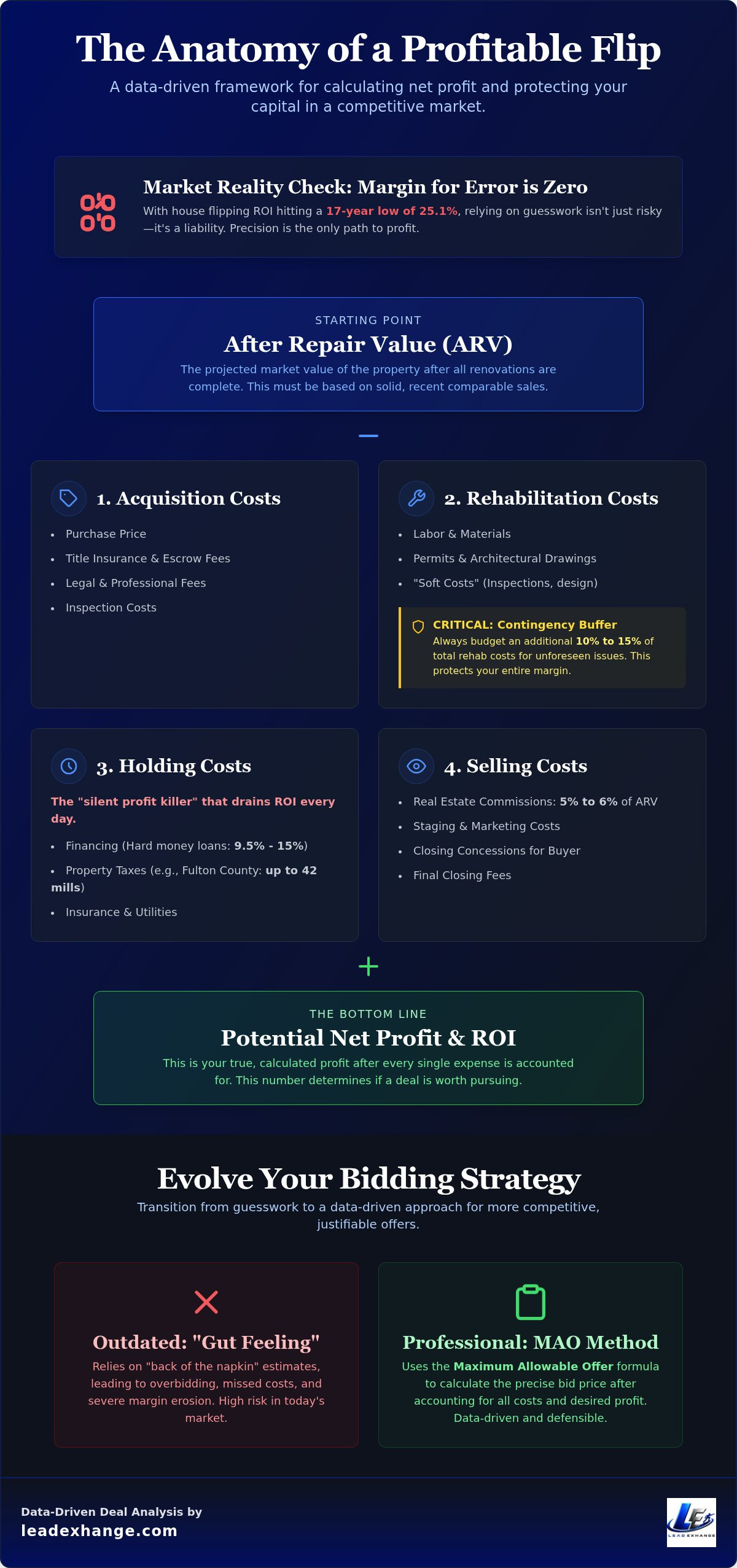
With house flipping ROI hitting a 17-year low of 25.1%, the margin for error in the competitive Atlanta market has effectively vanished. You already know that underestimating rehab costs or overestimating the After Repair Value (ARV) doesn’t just thin your margins; it can derail your entire investment portfolio. In a high-stakes environment where Fulton County property taxes can reach 42 mills and hard money rates often exceed 10%, relying on gut feelings is a liability.
This guide provides a professional-grade House Flip Profit Calculator framework to help you master the math behind every deal. You’ll learn to calculate net profit with surgical precision and understand your true cash-on-cash return before committing capital. We’ll show you how to analyze off-market deals from Starter or Growth plans using a rigid financial model that accounts for every holding cost and closing fee. This article delivers the clarity you need to make competitive offers with total confidence and protect your bottom line.
Key Takeaways
- Precision is mandatory in 2026; learn why a professional House Flip Profit Calculator is your most critical tool for avoiding margin erosion.
- Protect your capital by integrating closing fees and a 10% to 15% rehab contingency buffer into every financial model.
- Transition from “back of the napkin” estimates to the Maximum Allowable Offer (MAO) method for more competitive, data-driven bidding.
- Factor in geographic variables like Atlanta’s property tax rates and local labor costs to ensure your holding costs remain accurate.
- Optimize your results by sourcing exclusive off-market deals through Starter and Growth plans to ensure there’s enough “meat on the bone” for a profitable exit.
Why Every Professional Investor Needs a House Flip Profit Calculator
A House Flip Profit Calculator is a precision financial instrument. It subtracts every acquisition, rehab, and holding cost from the After Repair Value (ARV) to reveal the net spread. For those understanding the basics of flipping, this math is the difference between a scalable business and a bankruptcy filing. In 2026, guesstimating is a fatal strategy. With hard money interest rates ranging from 9.5% to 15%, every day a property sits unfinished is a direct hit to your equity.
Professional investors use these calculations to identify “thin” deals immediately. If the numbers don’t support your desired ROI after accounting for a 15% rehab contingency, you walk away. This data-driven approach is also your primary leverage when seeking capital. Lenders and private partners don’t fund passion; they fund spreadsheets that prove a clear path to profit. When you source leads through our Growth plan, you have the raw data needed to plug into these models and secure funding faster than the competition.
The Risks of Inaccurate Deal Analysis
Overestimating the ARV is the fastest way to lose six figures. If your exit price is off by just 5%, your entire profit margin can vanish. You must also account for the “Holding Trap.” Daily carrying costs, including insurance, utilities, and Fulton County’s millage rates of 39 to 42 mills, can erode 20% of your projected profits if the project timeline slips. Wholesalers using our Starter or Growth plans must run these numbers for their end-buyers to ensure the deal is viable. Providing this level of analysis makes your Off-Market Investment Deals more attractive to seasoned flippers.
Removing Emotion from the Acquisition Process
Treat every property as a sequence of cells in a spreadsheet. Emotion leads to overbidding on a bungalow that has structural nightmares. Establish a rigid “Buy Box” based on specific cash-on-cash return thresholds. When you present a seller with a detailed House Flip Profit Calculator report, you aren’t just lowballing them. You are providing a professional justification for your offer based on market realities. This transparency builds credibility and helps secure off-market deals that others miss.
Breaking Down the Variables: How to Calculate Flip Profits Correctly
A robust House Flip Profit Calculator requires more than just a guess at the sales price. You must account for every dollar that leaves your account from the initial offer to the final wire transfer. The purchase price isn’t just the contract amount; it includes title insurance, legal fees, and the new FinCEN reporting requirements for all-cash purchases effective March 1, 2026. Rehab estimates must be granular, separating labor from materials while maintaining a 10% to 15% contingency buffer for unforeseen structural issues. Professional investors don’t hope for the best; they plan for the worst.
Soft costs often represent the difference between a win and a wash. You need to track every permit, architectural drawing, and inspection fee. These expenses hit your balance sheet before a single hammer swings. Finally, your exit strategy must account for the 5% to 6% in real estate commissions, staging costs, and final closing concessions. If you aren’t calculating these variables upfront, you aren’t investing; you’re gambling.
ARV and Purchase Price: The Bookends of Your Deal
Determining a realistic After Repair Value (ARV) requires analyzing recent comps within a 0.5-mile radius that share similar square footage and finishes. If your ARV is inflated, your profit is fictional. To protect your margins, you need to find lower entry points by utilizing off-market real estate leads rather than fighting over saturated listings. The spread between your total acquisition cost and the ARV must be wide enough to absorb market volatility and your required profit margin. This spread is your only safety net.
Rehab and Holding Costs: Where Margins Often Disappear
Monthly expenses accumulate rapidly while you wait for permits or contractor availability. You must factor in utility bills, property insurance, and property taxes, which in Fulton County can reach $8,000 annually for a $500,000 home before exemptions. Financing costs are equally aggressive; hard money loans in 2026 typically carry interest rates between 9.5% and 15% with additional points due at closing. Carrying costs are the silent profit killer in fix-and-flip, draining your potential ROI every hour the property remains unsold.
To keep these numbers in your favor, you need a consistent stream of high-quality opportunities. You can scale your operations by using Starter or Growth plans to fuel your calculator with deals that actually provide the necessary margin for success.
Strategic Math: The 70% Rule vs. Maximum Allowable Offer (MAO)
The 70% Rule serves as an initial filter for high-volume investors. It dictates that you shouldn’t pay more than 70% of the ARV minus rehab costs. It’s a fast way to kill bad deals before they waste your time. However, this rule often fails in competitive Atlanta pockets like Reynoldstown or West End. In these high-demand zones, investors frequently push to 75% or 80% because the exit speed justifies a tighter margin. Using a professional House Flip Profit Calculator allows you to move beyond these generalizations and build a bid based on actual numbers rather than arbitrary percentages.
Wholesalers must apply an even stricter version of this math. If a flipper’s MAO is $250,000, the wholesaler must secure the property at $230,000 to realize a $20,000 assignment fee. This distinction is vital. If you’re wholesaling Off-Market Investment Deals, your calculator must account for the end-buyer’s profit requirements first. Failure to bake in the assignment fee leads to deals that look good on paper but never close because the “meat on the bone” is gone.
Calculating Your Maximum Allowable Offer (MAO)
The MAO formula is the gold standard for acquisition: (ARV x Efficiency Factor) – Rehab Costs – Desired Profit = MAO. The efficiency factor is your dial for risk. In a volatile market with mortgage rates staying above 6%, you might drop your factor to 0.65 to increase your safety margin. Use the raw data from our Growth plan to validate these inputs against real-time wholesale trends in your target zip codes. This ensures your offer is aggressive enough to win but conservative enough to protect your capital.
ROI vs. Cash-on-Cash Return
Net profit tells you what you made; Cash-on-Cash (CoC) return tells you how efficiently you made it. If you flip a house for a $50,000 profit but had to tie up $200,000 of your own liquidity, your CoC return is 25%. If you used leverage to achieve that same $50,000 profit with only $50,000 of your own cash, your CoC return jumps to 100%. Professional investors prioritize CoC because it measures the velocity of their capital. Always annualize these figures. Comparing a six-month flip to a 12-month hold is impossible without a standardized House Flip Profit Calculator that accounts for the time-value of money.
Local Market Nuance: Adjusting Math for Atlanta, Memphis, and Detroit
A generic House Flip Profit Calculator often fails because it ignores the hyper-local nature of real estate expenses. Real estate isn’t a national commodity; it’s a collection of specific zip codes with vastly different overhead requirements. If you apply Atlanta labor rates to a project in Birmingham, your rehab budget will be inflated and uncompetitive. Conversely, ignoring Detroit’s specific seasonal holding costs can turn a projected 25% ROI into a net loss. Professional investors must calibrate their financial models to the specific city where the dirt resides.
Geographic Variations in Labor and Material Costs
Supply chain volatility in 2026 continues to impact rehab budgets differently across the Southeast and Midwest. In Atlanta, a surge in residential development has tightened the pool of available contractors, driving labor premiums higher than in Memphis or Charlotte. Sourcing local contractors in Memphis requires a different vetting process to ensure accurate estimates that reflect Tennessee’s current material availability. A $50,000 rehab in Detroit looks different than in Atlanta because Detroit projects often require significant mechanical overhauls and furnace replacements to survive harsh winter cycles before any cosmetic staging can begin.
Holding costs also fluctuate based on local tax jurisdictions. In Fulton County, the combined millage rate of 39 to 42 mills means a $500,000 property carries an annual tax burden of roughly $8,000. In Memphis, the 2026 Shelby County tax rate combined with the City of Memphis rate totals $5.283192 per $100 of assessed value. Because residential property in Tennessee is assessed at 25% of its value, your House Flip Profit Calculator must use these specific ratios to avoid underestimating your monthly carry. Memphis investors can sharpen their acquisition strategy further by learning how to apply a precise MAO Calculator to set a definitive ceiling on every offer before market competition drives up the price.
Navigating Local Regulations and Permit Fees
Municipal permit timelines are a critical variable in your “Days on Market” (DOM) projections. Atlanta’s permitting office operates on a different schedule than Wayne County, Michigan. Delays in zoning approvals or “highest and best use” reclassifications can add months to a project. With hard money rates for rehab loans currently ranging from 9% to 14%, a two-month permit delay can erode thousands of dollars in equity. You can mitigate this risk by using wholesale real estate software to track local market comps and regulatory trends in real time.
Seasonality plays a major role in the Midwest. In Detroit, you must factor in snow removal and increased heating costs during the winter months to prevent pipe bursts in vacant properties. These are not optional expenses; they are essential protections for your asset. Your holding period must also reflect the local DOM. If Atlanta houses are moving in 30 days but Memphis properties are averaging 55, your financing and utility projections must adjust accordingly to maintain a realistic net profit figure.
From Calculation to Acquisition: Sourcing High-Margin Flip Deals
Precision math is a defensive tool; strategic acquisition is your offensive play. Even the most sophisticated House Flip Profit Calculator cannot manufacture a profit from a bad deal. If you’re sourcing properties from retail listings, you’re fighting for crumbs in a saturated market. The real margin in 2026 is found in the “meat on the bone” that only off-market properties provide. By securing exclusive data before it hits the MLS, you bypass bidding wars and lock in the low entry points required to hit your ROI targets.
Success in this high-interest environment requires a shift in mindset. You must stop “searching for deals” and start “analyzing opportunities.” This transition is only possible when you have a consistent pipeline of distressed properties delivered directly to your dashboard. When you feed your calculator with high-spread Off-Market Investment Deals, you move from speculative gambling to predictable, data-driven execution. This exclusivity is your primary competitive advantage over investors who rely on public data.
Plugging Exclusive Leads into Your Analysis
Lead Exchange sources distressed and off-market properties specifically for professional investors who prioritize speed and spread. Our SaaS platform identifies motivated sellers and equity-rich opportunities that aren’t visible to the general public. This allows you to reduce your initial acquisition cost, which is the single most effective way to maximize your final profit margin. By using our automated data feeds, you can plug verified property details into your House Flip Profit Calculator in seconds. This speed allows you to make firm, competitive offers while other investors are still trying to verify the property’s condition. Atlanta-focused investors can take this a step further by using a dedicated Atlanta Real Estate Deal Analyzer to generate fast, accurate Go/No-Go decisions on every opportunity before the competition even runs their numbers.
Scaling with Lead Exchange SaaS Subscriptions
Scaling a flip business requires a volume-based approach to lead generation. Choosing the right SaaS plan depends on your current capacity and growth targets:
- Starter: Ideal for investors looking to secure their next 1-2 high-margin flips per quarter with a steady stream of local data.
- Growth: Designed for high-volume teams that need a massive pipeline to keep multiple crews working simultaneously across Atlanta, Memphis, or Detroit.
- Direct Cash Home Buying: Use our expertise to move fast on acquisitions without the traditional friction of middle-market delays.
Whether you’re a wholesaler looking for assignment fees or a fix-and-flip pro, your success depends on the quality of your inputs. Use our raw data as the engine for your financial models. Stop wasting time on low-margin retail listings and start focusing on the exclusive opportunities that drive real growth.
Dominate Your Market with Data-Driven Acquisition
Success in the 2026 real estate landscape requires a shift from speculative guessing to surgical precision. By mastering the Maximum Allowable Offer (MAO) and accounting for hyper-local carrying costs, you protect your capital from market volatility. You’ve learned that a professional-grade House Flip Profit Calculator is only as powerful as the deals you plug into it. High-margin opportunities are rarely found on retail listings; they are built through exclusive, off-market channels.
Leveraging SaaS tools for rapid scaling allows you to move with the speed and confidence of an elite investor. Whether you’re navigating Memphis tax assessments or Atlanta’s competitive bidding environment, your focus must remain on the bottom line. It’s time to stop searching for leads and start analyzing high-spread opportunities that guarantee your desired ROI.
Take control of your acquisition pipeline today. Your next profitable flip is waiting for a data-driven offer.
Frequently Asked Questions
What is a good profit margin for a house flip in 2026?
Aim for a minimum net profit margin of 15% to 20% after all expenses are paid. While median gross profits can exceed $65,000, your net figure is what determines the sustainability of your business. In the current volatile market, a larger safety buffer is mandatory. If your projections show a net margin below 10%, the deal is likely too thin to survive unexpected construction delays or high interest rate environments.
Does the house flip calculator account for hard money interest?
Yes, a professional House Flip Profit Calculator must include debt service as a primary line item. You should calculate interest based on current market rates, which typically range between 9.5% and 15%. Factor in both the monthly interest payments and any “points” or origination fees due at closing. These financing costs represent a significant portion of your total holding expenses and directly impact your final cash-on-cash return.
How do I estimate rehab costs if I am not a contractor?
Use a tiered estimation model based on square footage and renovation intensity. Categorize projects as cosmetic, average, or full gut rehabs using local price-per-square-foot averages for your specific market. Always secure three detailed quotes from licensed contractors to validate your initial numbers. Including a 15% contingency buffer in your House Flip Profit Calculator is essential for non-contractors to account for hidden structural or mechanical issues found during demolition.
What is the difference between ROI and Cash-on-Cash return in flipping?
ROI measures the total profitability of the project relative to the total investment, including all debt. Cash-on-Cash return measures the annual return on the actual liquid capital you personally deployed into the deal. For example, if you use a hard money loan to cover 80% of the project, your Cash-on-Cash return will be significantly higher than your total ROI. Professional investors focus on Cash-on-Cash return to evaluate capital efficiency across multiple deals.
Should I include my own labor in the flip profit calculation?
Always account for the value of your time by assigning a market-rate salary to any labor you perform. If you don’t include these costs, your profit figure is artificially inflated and doesn’t reflect the true performance of the investment. Treating your labor as an expense allows you to determine if the project is actually profitable or if you’re simply buying a job. Professional scaling is impossible if the model relies on unpaid labor.
How does the 70% rule apply to high-priced markets like Atlanta?
The 70% rule is a baseline that often requires adjustment in premium Atlanta neighborhoods. In areas with rapid appreciation and low inventory, investors may move to a 75% or 80% rule to remain competitive. This adjustment is only safe if you have high confidence in your ARV and a reliable contractor network. Use the calculator to stress-test these tighter margins against potential price drops or extended holding periods before submitting an offer.
What holding costs are most commonly missed by new investors?
Utilities, landscaping, and builder’s risk insurance are frequently overlooked during the analysis phase. You must also account for property taxes, which are often reassessed at a higher value after the sale is recorded. In cities like Atlanta or Memphis, these recurring monthly expenses can total thousands of dollars over a six-month project. Missing these line items in your financial model leads to margin creep, where small expenses slowly erode your profit.
Can I use this calculator for wholesale deal analysis?
Wholesalers must use the House Flip Profit Calculator to ensure their Maximum Allowable Offer leaves enough profit for the end-buyer. Your analysis should start with the flipper’s required ROI and work backward to include your assignment fee. If the numbers don’t support both a healthy flip margin and your fee, the deal won’t move. Providing a detailed profit breakdown based on MAO Calculator methodology and off-market data increases your credibility with cash buyers and speeds up the process.
Disclaimer
The opinions and information shared on this website are for educational purposes only. Results from real estate investing and lead generation vary, and no specific outcome or profit is guaranteed