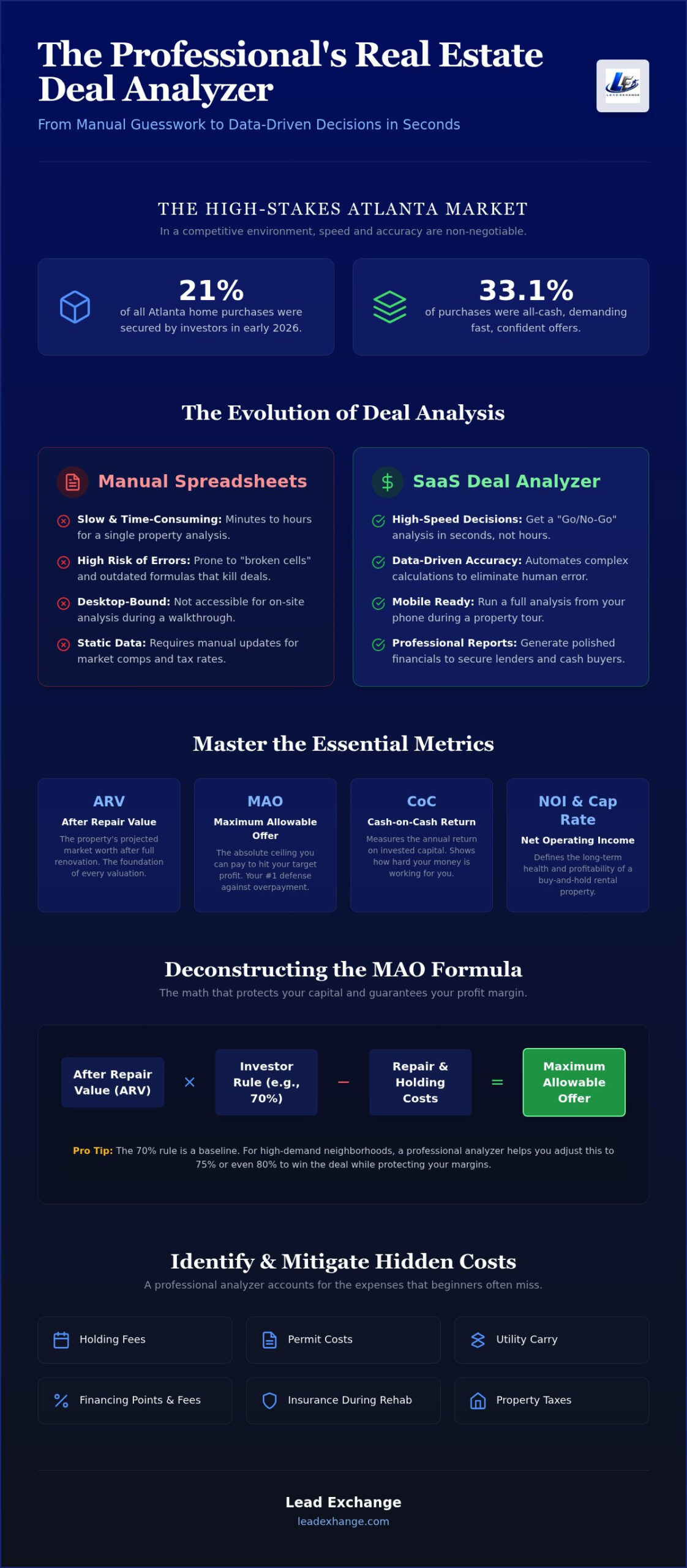
In a market where investors secured 21% of all Atlanta home purchases in early 2026, hesitation is a profit killer. You’ve likely felt the stress of staring at a manual spreadsheet, worried that a single inaccurate repair estimate will turn a high-margin opportunity into a financial liability. Overpaying for a distressed property isn’t just a mistake. It’s a setback that stalls your momentum. You need a professional Real Estate Deal Analyzer that replaces guesswork with high-speed, data-driven precision.
You want fast, reliable “Go/No-Go” decisions that give you the edge over the competition. This guide teaches you to master the metrics required to evaluate off-market deals with elite accuracy and professional speed. We’ll show you how to calculate a rock-solid Maximum Allowable Offer (MAO) and generate the polished reports that lenders and cash buyers demand. From Starter plan basics to advanced Growth strategies, you’ll learn to filter the noise and focus on the numbers that actually drive ROI. Stop wasting time on manual math and start securing high-performance assets with confidence.
Key Takeaways
- Master After Repair Value (ARV) and Maximum Allowable Offer (MAO) to set firm price ceilings and protect your investment margins.
- Replace slow, error-prone manual spreadsheets with a high-performance Real Estate Deal Analyzer to cut evaluation time from minutes to seconds.
- Adjust your financial models for localized variables, including Atlanta’s specific property tax assessment ratios, for hyper-accurate profit projections.
- Learn to source exclusive off-market inventory through Lead Exchange to bypass competitive public listings and find higher-margin deals.
- Generate professional financial reports that provide the data-backed confidence required to secure funding from lenders and cash buyers.
What is a Real Estate Deal Analyzer and Why is it Essential?
A Real Estate Deal Analyzer is a systematic tool designed to project the financial performance of a property with surgical precision. It isn’t just a calculator; it’s a decision-making engine. By inputting variables like purchase price, renovation costs, and financing terms, you generate a clear forecast of your potential ROI. The core purpose is to remove emotional bias. In the high-stakes environment of real estate investing, “falling in love” with a property is a liability. The analyzer forces you to look at the cold, hard numbers instead.
Data integrity is the most critical factor in this process. Professionals follow the “Garbage In, Garbage Out” rule. A complex tool won’t save you if your repair estimates are off by 20%. Accuracy in your inputs always beats the complexity of the software. Whether you’re a wholesaler looking for a quick assignment fee, a fix-and-flip investor protecting a slim margin, or a buy-and-hold landlord seeking steady yield, this tool is your primary defense against overpayment. New investors using a Starter plan often find that disciplined analysis is the only way to compete with seasoned pros.
The Shift from Spreadsheets to SaaS in 2026
Traditional Excel models are becoming obsolete in 2026. They’re too slow for today’s market. Manual spreadsheets often suffer from “broken cells” or outdated formulas that can ruin a deal. Modern SaaS platforms offer real-time data integration, allowing you to pull local market comps and tax rates instantly. This cloud-based approach is now the industry standard. It enables mobile accessibility, so you can run a full analysis on your phone during a property walkthrough. When you’re sourcing high-margin opportunities through Lead Exchange, you don’t have 30 minutes to go home and open a laptop. You need answers on-site.
Risk Mitigation Through Mathematical Modeling
Mathematical modeling protects your capital by stress-testing your exit strategies. A professional Real Estate Deal Analyzer identifies “hidden” costs that beginners often miss. These include holding fees, permit costs, and utility carry during the renovation phase. By accounting for these line items, you ensure your Maximum Allowable Offer (MAO) is realistic. It allows you to see the “worst-case” scenario before you sign a contract. Deal analysis is the bridge between speculation and professional investing.
Essential Metrics Every Professional Analyzer Must Calculate
Profitable investing isn’t about intuition; it’s about the math. Your Real Estate Deal Analyzer must prioritize After Repair Value (ARV) as the foundation of every distressed property valuation. ARV represents the property’s worth after it’s fully renovated to market standards. If this number is inflated, your entire profit margin evaporates before you even start. You must also track Cash-on-Cash Return (CoC) to measure how hard your invested capital is working. For those focused on long-term wealth, Net Operating Income (NOI) and Cap Rates are the metrics that define the health of your rental portfolio.
A high-performance Real Estate Deal Analyzer should also automate the calculation of your Maximum Allowable Offer (MAO). This is the absolute ceiling you can pay while still hitting your target profit. In a market like Atlanta, where 33.1% of purchases were all-cash in early 2026, knowing your MAO allows you to bid with speed and certainty. You won’t waste time on deals that don’t meet your criteria, and you’ll never overpay in a bidding war.
The Wholesaler’s Formula: MAO and Assignment Fees
Wholesalers must move fast to secure contracts. Using a professional MAO Calculator ensures you leave enough meat on the bone for your end buyer. The traditional 70% rule (ARV x 0.70 minus repairs) is a solid starting point, but high-demand neighborhoods often require adjusting this to 75% or 80%. You must factor in your assignment fee without pushing the total price beyond what a fix-and-flip investor will pay. Precision here is what builds your reputation with cash buyers.
Fix and Flip Projections: Rehab and Holding Costs
Fix-and-flip success depends on managing the “Cost of Money” and construction timelines. You can estimate these variables accurately using a House Flip Profit Calculator. Beyond just materials and labor, you must account for interest, points, and private money fees. Atlanta’s average effective property tax rate of 0.97% should be factored into your holding costs. Always build in a 10-15% contingency buffer for rehab. Unexpected permits or structural issues shouldn’t kill your ROI; your analyzer should account for them from day one. For investors targeting both the Atlanta and Memphis markets simultaneously, a dedicated House Flipping MAO Calculator built specifically for these markets ensures your offer price is calibrated to local comps and labor costs before you commit capital.
Once you’ve mastered these metrics, you need a steady stream of inventory to evaluate. You can source high-margin off-market investment deals through Lead Exchange to keep your pipeline full and your analyzer busy.
Manual Spreadsheets vs. SaaS Analyzers: A Comparative Analysis
Speed is the primary differentiator between a professional investor and a hobbyist. In Atlanta’s competitive landscape, where investors buy 21% of available homes, you can’t afford to spend 30 minutes manually entering data into an Excel file. A cloud-based Real Estate Deal Analyzer slashes evaluation time from 30 minutes to 30 seconds. This efficiency allows you to filter through dozens of leads to find the one that actually hits your profit targets. When a high-margin deal hits your inbox, the speed of your “Go/No-Go” decision determines whether you secure the contract or lose it to a faster competitor.
Accuracy and formula integrity are equally critical. Manual spreadsheets are notorious for “broken cells” and hidden calculation errors. A single typo in a complex formula can misrepresent your ROI by thousands of dollars, leading you to overpay for a property. Professional SaaS tools maintain rigid formula integrity, ensuring that every calculation is consistent and reliable. This precision eliminates the fear of overpaying for a distressed property and gives you the confidence to move forward with high-stakes offers.
Reporting capabilities also set software apart from basic sheets. Lenders and cash buyers require more than just a verbal “the numbers look good.” A professional Real Estate Deal Analyzer generates polished PDF reports that detail your ARV, MAO, and projected exit strategy. These reports act as a resume for your deal, proving to partners that you’ve done the due diligence required to protect their capital. While a subscription involves a recurring cost, the time saved and the errors avoided provide a massive return on investment.
When a Spreadsheet is Sufficient
Manual spreadsheets still have a place for specific, low-complexity scenarios. If you’re analyzing a single-family rental with a standard 20% down payment and no renovation needs, a simple sheet is often enough. It’s also a valuable exercise for new investors to perform “back of the napkin” math manually. Doing the calculations by hand helps you understand the underlying mechanics of real estate math before you automate them. However, once you move beyond basic buy-and-hold scenarios, the limitations of Excel become a bottleneck for growth.
The Power of Integrated Data Import
The real advantage of modern software is its ability to pull live data instantly. Instead of searching multiple tabs for property taxes or neighborhood comps, the tool does the heavy lifting for you. In Atlanta, factoring in the 0.97% effective property tax rate happens automatically, reducing the risk of manual entry errors. These platforms also offer collaboration features, allowing teams to manage high lead volumes simultaneously. When you integrate your analyzer with exclusive lead sources like Lead Exchange, you create a seamless pipeline from discovery to acquisition. This integration ensures that every off-market deal is vetted with professional precision the moment it becomes available.
Localized Deal Analysis: Memphis and Atlanta Market Strategies
National market averages are a trap for serious investors. To maintain professional precision, your Real Estate Deal Analyzer must be calibrated to the specific street-level data of your target market. A deal that makes sense in Gulfport, Mississippi, might fail in Atlanta due to higher labor costs or property tax structures. Start by identifying local market cap rates. While Detroit or Cleveland often present higher yields, these markets require different management strategies than high-appreciation hubs like Charlotte or Atlanta. A localized Real Estate Deal Analyzer allows you to stress-test these variables before committing capital.
Regional property tax variations can swing your ROI by several percentage points. In Atlanta, the effective property tax rate sits at approximately 0.97%. However, investors must also account for the upcoming HOME Act (SB 33), which introduces an inflation-rate assessment cap in 2027. Your analysis needs to factor in these legislative shifts to ensure long-term profitability. Finally, you must adjust rehab estimates based on local material availability and labor rates. Neighborhood-level comps are the only way to avoid the “average” trap; zip-code data is too broad for professional-grade decisions.
Analyzing the Southeast: Atlanta and Birmingham Nuances
The Southeast market, particularly the Atlanta metro area, is defined by rapid appreciation and intense competition. With 21% of homes bought by investors in early 2026, you must calculate your MAO with extreme discipline. Overbidding even slightly can erase your exit margin. Leveraging off-market real estate leads is the only way to find the hidden margins that public listings no longer offer. Birmingham offers a similar narrative but with lower entry prices, requiring a slightly different risk-to-reward calibration in your modeling.
The Midwest Value Play: Detroit and Cleveland Metrics
Midwest markets like Detroit and Cleveland are pure value plays focused on high cash-flow-to-price ratios. These stable rental markets require a deep dive into municipal requirements and point-of-sale (POS) inspections. Ignoring these costs in your initial analysis can lead to thousands in unexpected compliance fees. You should also calculate long-term vacancy rates specifically for urban corridors rather than city-wide averages. This granular approach ensures your “Go/No-Go” decisions are based on reality, not optimism.
Beyond the Math: Sourcing High-Margin Deals with Lead Exchange
Mathematical precision is only half the battle. A Real Estate Deal Analyzer is a high-performance engine, but it requires high-octane fuel to generate actual profit. That fuel is exclusive, pre-vetted off-market lead data. Most investors fail because they rely on the MLS, where bidding wars are the norm and margins are razor-thin. Lead Exchange shifts the advantage back to you by providing direct-to-seller opportunities across major US hubs. By sourcing deals that aren’t visible to the general public, you feed your analyzer inventory that already has built-in equity.
This approach moves you beyond the “garbage in, garbage out” trap. Instead of trying to force a deal to work, you’re evaluating properties curated for their investment potential. This is the bridge between a hobbyist and a professional. You aren’t just calculating numbers; you’re executing a strategy based on exclusive information. When you start with a high-margin lead, your Real Estate Deal Analyzer becomes a tool for confirming profit rather than searching for it.
Subscription Tiers for Every Level of Investor
The Starter plan serves as the ideal entry point for new investors mastering their first few acquisitions. It provides the essential access needed to apply these analysis techniques to real-world scenarios without the distraction of excessive volume. For established wholesalers and flippers ready to dominate multiple markets, the Growth plan scales lead flow across cities like Atlanta, Memphis, and Jackson. In 2026, exclusive lead access is the ultimate competitive advantage. While the masses fight over table scraps on public platforms, Lead Exchange subscribers are already running the numbers on high-margin opportunities.
Implementing a Fast-Exit Strategy
Professional analysis allows you to identify properties suitable for direct cash buying with total confidence. When you combine your analysis with specialized wholesale real estate software, you manage a high-volume pipeline with surgical efficiency. This workflow closes the loop between discovery and acquisition. The process is straightforward: source the lead from the platform, analyze the metrics to find the MAO, and move to a direct cash offer. This speed is what lenders and cash buyers respect. When you present a deal backed by professional-grade analysis and an exclusive source, you aren’t just a buyer; you’re a high-stakes facilitator.
Accelerate Your Investment Momentum
Success in the 2026 real estate market depends on your ability to move faster than the competition without sacrificing accuracy. You’ve learned that a professional Real Estate Deal Analyzer is more than a convenience; it’s a risk-mitigation engine that protects your capital. By mastering metrics like ARV and MAO and shifting from manual sheets to integrated SaaS solutions, you eliminate the emotional bias that leads to overpayment.
However, the best math in the world can’t save a deal with no margin. You need exclusive access to the high-yield, off-market inventory that public platforms miss. Lead Exchange provides the curated leads you need in Atlanta, Memphis, and beyond, backed by a proven track record in direct acquisitions. Whether you’re starting with your first flip or scaling a wholesale operation, the right data combined with the right tools creates a clear path to financial growth.
Take the guesswork out of your next acquisition and secure your competitive edge today.
Frequently Asked Questions
How do I calculate the After Repair Value (ARV) accurately?
Accurate ARV calculation requires a rigorous Sales Comparison Approach. Identify 3-5 similar properties sold within a 0.5-mile radius over the last 90 to 180 days. Adjust these “comps” based on square footage, bedroom count, and finish quality to match your intended renovation level. Avoid using automated valuation models or broad zip-code averages. Verified local sales data is the only reliable way to project what a property will actually sell for on the open market.
What is the “70% Rule” in real estate deal analysis?
The 70% Rule is a benchmark suggesting your purchase price should not exceed 70% of the ARV minus estimated repair costs. This formula is designed to protect a 15% to 20% profit margin while covering closing fees and holding costs. While it is a valuable vetting tool, investors in competitive markets like Atlanta often adjust this to 75% or 80%. High-demand neighborhoods require tighter margins to remain competitive while still ensuring a safe exit. Memphis investors can apply this benchmark instantly using a 70% Rule Calculator to make definitive go or no-go decisions in under 60 seconds.
Can I use a real estate deal analyzer for commercial properties?
Yes, but the logic shifts from comparable sales to income capitalization. A commercial Real Estate Deal Analyzer focuses on Net Operating Income (NOI) and market-specific Cap Rates. You must input detailed operating expenses, vacancy allowances, and debt service coverage ratios (DSCR). While residential tools focus on rehab-to-retail margins, commercial analysis is fundamentally about the property’s ability to generate consistent cash flow and support long-term debt obligations for the owner.
What are the most common mistakes in property analysis?
Underestimating renovation timelines is a frequent error that spikes holding costs and erodes profit. Many investors also fail to account for “soft costs” like permits, architectural drawings, or utility carry during the construction phase. Another mistake is using stale data. Market conditions shift rapidly; relying on year-old comps rather than 90-day data points can lead to overpaying for a property that the current market no longer supports at your target price point.
How much does a professional deal analyzer subscription cost?
Subscription costs vary based on the depth of data integration and the number of target markets included. Most professional-grade tools offer tiered pricing to accommodate different investor levels. Entry-level plans generally focus on basic analysis for a limited number of deals, while premium plans offer unlimited reports and integrated lead data. Evaluate whether the time saved and the accuracy gained through automation justify the monthly overhead for your specific investment volume and growth goals.
Is a deal analyzer necessary for a long-term rental strategy?
It is essential because it calculates the Cash-on-Cash return over a multi-year horizon. Unlike a flip, rental analysis must account for long-term maintenance reserves, property management fees, and annual rent appreciation. A dedicated Real Estate Deal Analyzer helps you project your 5-year or 10-year equity growth accurately. It ensures your passive income isn’t eroded by hidden expenses like the 0.97% effective property tax rate common in the Atlanta metro area.
How do I adjust my analysis for high-interest rate environments?
Stress-test your exit strategy by using current mortgage rates, such as the 6.63% average for 30-year fixed loans recorded in August 2026. High rates increase your debt service and lower your total Cash-on-Cash return. You must adjust your Maximum Allowable Offer downward to compensate for these higher borrowing costs. If the numbers don’t work at current market rates, the deal is not viable. Never assume rates will drop significantly during your project’s lifecycle.
What is the difference between a deal analyzer and an MAO calculator?
An MAO calculator is a specialized component of a broader analysis tool. It focuses strictly on the maximum price you can pay to maintain a specific profit target. A full Real Estate Deal Analyzer provides a comprehensive view, including multi-year cash flow projections, tax implications, and multiple exit scenarios. Use the MAO calculator for rapid initial vetting and the full analyzer for deep due diligence before committing capital or signing a final purchase contract. Flippers operating across both markets can streamline this process with a purpose-built House Flipping MAO Calculator for Atlanta and Memphis that accounts for each city’s unique cost structures and comp data.
Disclaimer
The opinions and information shared on this website are for educational purposes only. Results from real estate investing and lead generation vary, and no specific outcome or profit is guaranteed