The difference between a high-margin flip and a financial disaster in 2026 isn’t luck; it’s math. You’ve likely felt that knot in your stomach when submitting an offer. You wonder if your repair estimates are too low or if you’re overpaying for a property that will sit on the market for 60 days. It’s a common fear in competitive hubs like Memphis and Atlanta. Learning how to calculate MAO in real estate is the only way to silence that doubt and move with the speed the current market demands.
This guide transforms your approach to deal analysis. We provide a battle-tested formula that accounts for localized variables, from Memphis property tax assessments to the rising renovation costs in Atlanta. You’ll master the Maximum Allowable Offer calculation. This ensures every off-market deal you strike is mathematically guaranteed for profit. We break down the 70% rule, analyze current market velocity, and give you the confidence to walk away from bad deals while closing the winners.
Key Takeaways
- Establish a non-negotiable price ceiling to eliminate emotional bidding and protect your investment capital.
- Apply the 70% rule and ARV benchmarks to master How to Calculate MAO in Real Estate for any off-market deal.
- Tailor your offer strategy for wholesaling or flipping by accurately factoring in assignment fees and specific exit requirements.
- Account for localized “hidden” costs, including Memphis property taxes and Atlanta holding expenses, to safeguard your net profit.
- Utilize detailed repair estimates as a strategic negotiation tool to justify your offer price and close more motivated seller leads.
Understanding Maximum Allowable Offer (MAO) in Real Estate Investing
Success in real estate acquisition starts with a single, non-negotiable figure. The Maximum Allowable Offer (MAO) serves as your professional price ceiling. It’s the absolute highest dollar amount you can pay for a property while maintaining your required profit margin. Investors who understand How to Calculate MAO in Real Estate operate with a “buy right” philosophy. They don’t hope for profit; they engineer it at the point of purchase.
Three foundational pillars support every MAO calculation. First is the After-Repair Value (ARV). This is the projected market value once the property is fully renovated. Second is the total cost of the project, including repairs, holding costs, and closing fees. Third is your minimum required profit. Unlike “Market Value,” which reflects what a retail buyer might pay, MAO is a specialized investment metric. It prioritizes your bottom line over the seller’s asking price.
Why MAO is Critical for 2026 Market Volatility
The 2026 market presents unique challenges. Shifting interest rates can quickly erode your exit strategy margins if you don’t account for them during the acquisition phase. Emotional bidding is the primary killer of real estate ROI. It leads investors to ignore red flags in pursuit of a win. MAO functions as the ultimate barrier against “deal fever,” ensuring that logic always triumphs over excitement during a high-stakes negotiation.
Accurate valuation is the starting point for this math. To establish a reliable ARV, you must understand the nuances of Understanding Real Estate Appraisal. This process helps you identify comparable sales and market trends that justify your projected end price. Without a solid appraisal foundation, your MAO becomes a guess rather than a guarantee.
The Relationship Between MAO and Investment Strategy
Your specific strategy dictates your MAO threshold. A “Fix and Flip” specialist typically requires a deeper discount to cover intensive renovation costs and short-term financing. In contrast, a “Buy and Hold” investor might accept a slightly higher offer if the long-term rental yield is strong. Regardless of the exit, you need a deal with enough spread to make the numbers work. Sourcing off-market real estate leads provides the inventory necessary to find these high-margin opportunities. Using a consistent formula allows you to build a scalable investment engine that performs in any market cycle.
The Core MAO Formula: Breaking Down ARV and the 70% Rule
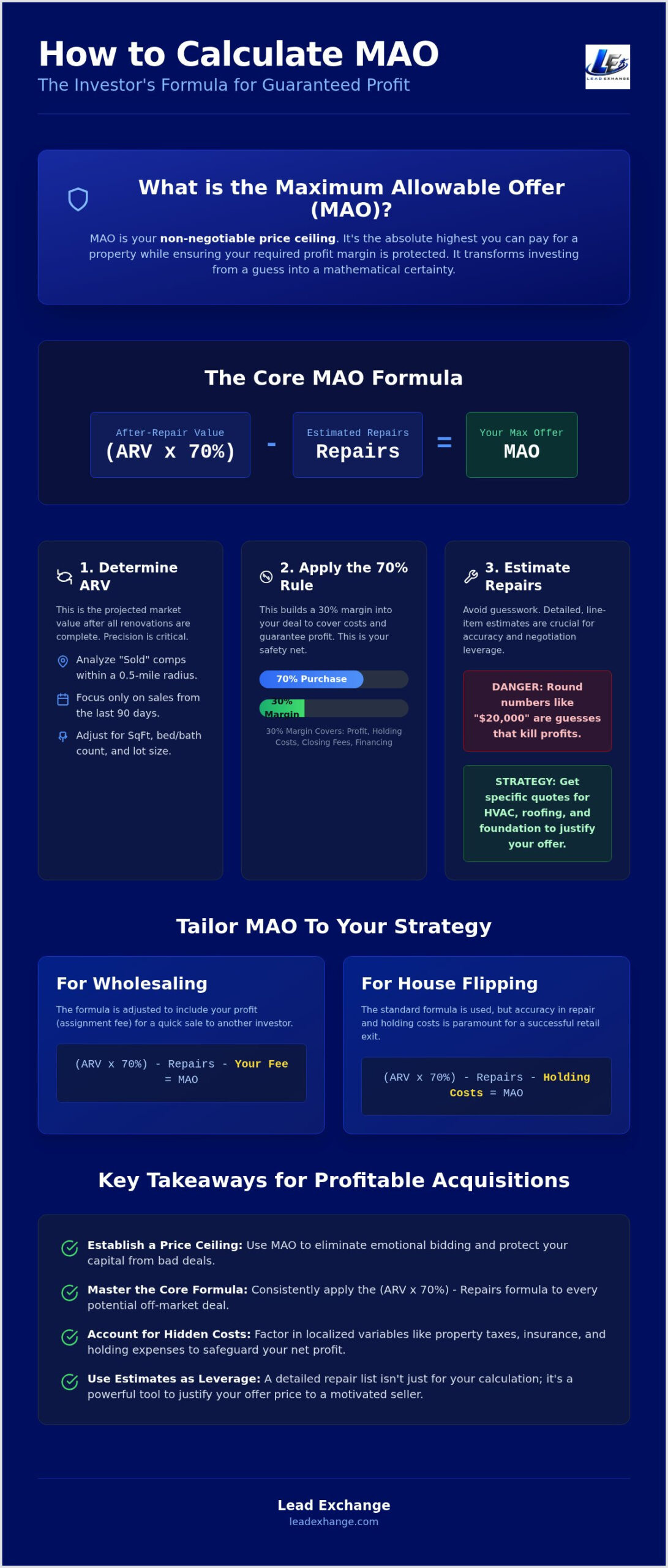
Professional investors don’t rely on gut feelings. They use a standardized equation to eliminate risk and ensure profitability. The formula is: (ARV x 0.70) – Repairs = MAO. This math is the industry standard for a reason. Learning How to Calculate MAO in Real Estate gives you a repeatable framework to evaluate any property in seconds. The math is absolute. It protects you from overpaying for a property that looks like a deal but carries hidden liabilities.
After-Repair Value (ARV) is the cornerstone of this calculation. It’s the professional estimate of what a property will sell for once it’s fully renovated. The “70% Rule” acts as your safety net. This 30% margin isn’t just profit; it covers closing costs, financing fees, and holding expenses. If you ignore this buffer, you’re essentially gambling with your capital. Your repair figure must be a detailed line-item estimate. Round numbers like “$20,000” are dangerous guesses. You need specific quotes for big-ticket items like HVAC, roofing, and foundation work to keep the math accurate.
Determining Accurate After-Repair Value (ARV)
To find a reliable ARV, you must look at “Sold” comps within a 0.5-mile radius of the subject property. Focus exclusively on sales from the last 90 days to capture current market velocity. You must adjust for specific features, including square footage, bed/bath count, and lot size. ARV is the most volatile variable in your math. If your valuation is off by even a small percentage, your entire projected ROI is at risk. Precision here is what separates elite investors from amateurs. For Atlanta properties specifically, using a dedicated ARV Calculator that accounts for local market nuances ensures your exit price projections are grounded in accurate, hyperlocal data.
The 70% Rule vs. 75% Rule: When to Adjust
In high-competition markets like Atlanta, many investors feel pressure to squeeze their margins. You might see offers calculated at 75% or even 80% of ARV. While this can help you win more bids, it leaves zero room for error. Lowering your margin buffer in a cooling market is a recipe for disaster. If renovation timelines slip or market prices dip, that extra 5% or 10% you gave away becomes your loss. Finding deals with enough spread is the real challenge. Accessing high-margin off-market deals allows you to stick to the 70% rule without losing out on inventory.
| Multiplier | ARV | Estimated Repairs | Maximum Offer (MAO) |
|---|---|---|---|
| 70% Rule | $300,000 | $50,000 | $160,000 |
| 75% Rule | $300,000 | $50,000 | $175,000 |
| 80% Rule | $300,000 | $50,000 | $190,000 |
Calculating MAO for Wholesaling vs. House Flipping
A flipper focuses on the end-sale price, but a wholesaler must account for the transaction itself. Understanding How to Calculate MAO in Real Estate for wholesaling requires an extra step in your equation. You aren’t just calculating the spread for the rehab; you’re calculating the spread for your own business. If you ignore your fee during the initial offer, you’ll find yourself with a contract that no cash buyer will touch.
The standard Wholesaler Formula is: (ARV x 0.70) – Repairs – Assignment Fee = Wholesale MAO. This ensures that when you assign the contract, your buyer still has their full 30% margin intact. Professional wholesalers use transparency as a competitive advantage. Sharing your MAO math with buyers builds long-term trust and positions you as a sophisticated partner rather than a middleman. To accelerate your analysis, an Atlanta MAO Calculator can help you run these numbers for high-volume markets in seconds.
Setting Your Assignment Fee Goals
In the 2026 market, typical assignment fees for “quick turn” wholesale deals often range between $10,000 and $25,000. You must balance your desired profit with the end-buyer’s need for a “meat on the bone” deal. If you squeeze the flipper’s margin too tight, they’ll look elsewhere for inventory. Defending your fee becomes easy when your math is accurate. When you present a deal backed by hard data and a realistic MAO, buyers respect the fee because the value is self-evident.
Reverse Engineering the End-Buyer’s MAO
You must think like a cash buyer to ensure your contract is actually assignable. This means knowing the specific “buy box” percentages of your buyer list. Some investors in high-demand Atlanta neighborhoods might accept a 75% multiplier, while Memphis investors often stick to a strict 70% due to local tax rates. A wholesaler’s MAO is always lower than a flipper’s MAO because it must account for that essential assignment fee. If you don’t reverse engineer the buyer’s exit strategy, you risk holding a contract that lacks the necessary margin to attract a professional rehabber.
Sourcing high-margin inventory is the only way to satisfy both your fee and the buyer’s profit requirements. High-performance investors use specialized platforms to find the spread they need. This allows you to focus on the math while the system handles the search friction. When the deal has enough room, the assignment fee becomes a non-issue for the buyer. Using a dedicated Wholesale Deal Calculator built for the Atlanta market ensures you can run these numbers with surgical precision before making any offer.
Factoring in Fixed Costs and Market-Specific Variables
The 30% margin in the standard formula isn’t pure profit. It’s a survival buffer. Professional investors know that the friction of a transaction can erode a deal if it isn’t quantified. When you’re learning How to Calculate MAO in Real Estate, you must account for “Buying and Selling Costs” upfront. In Memphis, the average real estate commission is 6.05%. In Georgia, that figure is 5.66%. When you add title fees and transfer taxes, your transaction costs often hit 8% to 10% of the sale price. A 10% to 15% contingency fund for repair surprises is also a non-negotiable line item to protect your capital from the unexpected.
Holding costs are the silent profit killers in any project. These include insurance, utilities, and the interest on hard money loans. Every day a property sits in your portfolio, your net ROI drops. You must also include a line item for marketing. If you aren’t using traditional brokerage services, you’ll need a budget to reach your own buyer list or run digital campaigns to move the asset quickly.
The Investor’s Fixed Cost Checklist
Local taxes vary significantly and must be localized in your math. Memphis properties within city limits face a combined tax rate of approximately $5.283 per $100 of assessed value. Atlanta investors in Fulton County deal with millage rates between 43 and 46 mills. Hard money points are another fixed cost that hits your bottom line the moment you close. If you’re paying 2 points and 12% interest, those payments must be baked into your MAO ceiling. Failing to account for these specific regional variables turns a “guaranteed” profit into a break-even scenario.
Adjusting for Local Market Velocity
Speed dictates your risk profile. The “Days on Market” (DOM) metric in your target city tells you how long your holding costs will accumulate. In Memphis, the median DOM is currently 59 to 66 days. Atlanta moves faster, with a median of 45 to 54 days. Faster markets allow you to squeeze your MAO margins slightly because your capital is at risk for a shorter duration. This is where “Opportunity Cost” becomes a factor. A deal with a smaller margin in a fast market is often more valuable than a high-margin deal that stays on your books for six months. Mastering How to Calculate MAO in Real Estate means adjusting your offer based on how quickly you can recycle your cash for the next opportunity.
Executing the Offer: From Calculation to Closing Deals
Knowing How to Calculate MAO in Real Estate is only half the battle. You must translate that number into a signed contract. Presenting an offer that is 30% or 40% below market value requires a strategy beyond just stating a price. To avoid sounding “cheap,” lead with the logic of the deal. Transparently share your After-Repair Value (ARV) and your line-item repair estimate. When a seller sees that your offer is a direct result of necessary renovation costs, the conversation shifts from an arbitrary price war to a factual discussion about property condition.
Use your repair estimate as your primary negotiation tool. If a seller pushes back on the price, revisit the specific costs for the roof, HVAC, or foundation. This approach justifies your position and keeps the focus on the reality of the asset. Speed is your greatest leverage in this phase. Success in how to wholesale real estate depends on your ability to provide a firm, cash offer within hours of the first walkthrough. Once the math is clear, move immediately to the contract to secure the deal at your calculated MAO.
Sourcing Deals with MAO Potential
The 70% rule rarely works on the MLS. Competition drives prices up and margins down. Off-market properties are the only reliable way to find deals that fit the MAO framework. A subscription to Lead Exchange Starter or Growth plans provides the raw data needed for deep MAO analysis before you even step on-site. Exclusive leads reduce the friction of competition-driven price inflation. This allows you to stick to your math without being outbid by emotional buyers. High-performance investors use these specialized leads to maintain a consistent pipeline of high-margin opportunities.
Next Steps: Scaling Your Deal Analysis
Scaling your business requires a “Deal or No Deal” mindset. If the math doesn’t hit your MAO, walk away. Logic must dictate every acquisition. To handle higher volume, utilize wholesale real estate software to automate your MAO calculations and track your leads. This technology ensures that as your deal flow increases, your precision remains absolute. Professional investors don’t guess; they calculate. Master How to Calculate MAO in Real Estate and secure your next profitable deal with Lead Exchange.
Secure Your Profit Margin with Mathematical Precision
Mastering How to Calculate MAO in Real Estate is the single most effective way to protect your capital in any market cycle. You now have the tactical formula to analyze properties in Memphis and Atlanta with absolute clarity. By factoring in local tax rates, current renovation costs, and holding expenses, you eliminate the guesswork that leads to overpaying for a “lemon.” Successful investing isn’t about the deals you win; it’s about the bad deals you have the discipline to walk away from.
High-performance investors don’t wait for mediocre deals to appear on the MLS. They utilize exclusive off-market property data to find the spread required for a profitable 70% offer. Lead Exchange offers the streamlined deal analysis and specialized leads that flippers and wholesalers need to scale their volume. Whether you’re targeting the fast-paced Atlanta market or the high-yield neighborhoods of Memphis, your success depends on the quality of your data and the precision of your math.
Your next high-ROI deal is waiting. Trust the formula, maintain your price ceiling, and build an investment portfolio that thrives on mathematically guaranteed margins.
Frequently Asked Questions
Is the 70% rule still valid in high-competition real estate markets?
The 70% rule remains the gold standard for risk mitigation. While aggressive investors in Atlanta might stretch to 75% due to high demand, doing so reduces your safety net. In Memphis, where home values recently dipped by 3.2% year-over-year, that 30% buffer is essential. It protects your capital against price corrections and longer hold times. Sticking to a disciplined formula is the only way to ensure How to Calculate MAO in Real Estate results in profit.
How do I accurately estimate repair costs if I am not a contractor?
Use localized square footage benchmarks to build your initial estimate. For a standard Memphis renovation, costs typically range from $65 to $100 per square foot. In Atlanta, a high-end refresh costs between $100 and $150 per square foot; gut projects can exceed $400. Always walk the property with a trusted contractor during your due diligence period to refine these numbers. Accurate repair estimates are the most critical variable in your MAO math.
Does MAO include my closing costs or are those separate?
Your closing costs are covered within the 30% margin provided by the 70% rule. This spread isn’t pure profit; it accounts for the 2% to 5% buyer closing costs and the 8% to 10% seller costs you’ll face upon exit. In Memphis, you must also account for the average 6.05% real estate commission. If your specific project carries higher transaction fees, you may need to lower your MAO multiplier to 65% to stay profitable.
What is the difference between MAO and ARV?
ARV is the projected market value of a property after all renovations are complete. It represents your final exit price. MAO is your acquisition ceiling. It’s the absolute maximum you can pay today to reach that ARV while covering repairs and profit. Understanding the relationship between these two figures is the foundation of How to Calculate MAO in Real Estate. ARV is a market prediction; MAO is a strategic limit you control.
Can I use the MAO formula for rental properties (BRRRR strategy)?
You can adapt the MAO formula for rental strategies like BRRRR, but the multiplier often shifts. Rental investors frequently use a 75% or 80% rule because they prioritize long-term cash flow over immediate flip margins. However, your offer must still allow you to refinance the property and pull out your initial capital. If your MAO is too high, you’ll leave dead equity in the deal, which slows your ability to scale your portfolio.
How does the MAO calculation change for a wholesaler?
Wholesalers must subtract their desired assignment fee from the standard flipper’s MAO. If a rehabber’s max offer is $150,000 and you want a $15,000 fee, your wholesale MAO is $135,000. This ensures the deal remains attractive to your end-buyer. Failing to account for your fee during the negotiation with the seller is the most common reason wholesale contracts fail to close. Always calculate the buyer’s exit first and work backward to your offer.
What happens if I offer more than the calculated MAO?
Offering more than your calculated MAO directly reduces your profit or increases your risk of a loss. In a shifting market like Memphis, where properties now sit for an average of 59 to 66 days, overpaying can be catastrophic. If your holding costs rise or the market dips further, you won’t have the equity to pivot. Sticking to your MAO ceiling is a non-negotiable rule for professional investors who value long-term financial survival.
How often should I update my MAO formula variables?
Update your formula variables at least once per quarter or whenever significant market shifts occur. In 2026, localized data like Atlanta’s millage rates or Memphis property tax assessments can change annually. You must also monitor real-time labor and material costs, as these fluctuate faster than home prices. Relying on outdated repair costs or stale ARV data will lead to inaccurate offers that either lose deals or lose money. Precision requires constant data refreshment.
Disclaimer
The opinions and information shared on this website are for educational purposes only. Results from real estate investing and lead generation vary, and no specific outcome or profit is guaranteed