In the high-stakes markets of Atlanta and Memphis, a single math error doesn’t just cut into your profit; it can bankrupt your entire portfolio. You’ve likely felt the pressure of staring at a distressed property, wondering if your bid is a strategic masterstroke or a massive mistake. Using a precise House Flipping MAO Calculator is the only way to ensure you aren’t overpaying before you even swing a hammer. Most investors fail because they rely on gut feelings instead of the hard data required for off-market success.
You need more than just a guess to pull the trigger on a six-figure investment. This guide provides the definitive framework to remove the guesswork and secure high-margin deals with absolute certainty. You’ll learn how to establish a reliable offer price that guarantees your specific ROI, regardless of whether you’re targeting a $425,000 median home in Atlanta or a $209,000 entry in Memphis. We’ve stripped away the fluff to focus on the numbers that drive actual wealth.
We’re breaking down the math that separates elite flippers from the amateurs. We will analyze current 2026 rehab costs, factor in the 8% to 15% interest rates typical of today’s hard money loans, and show you how to apply the 70% rule to high-quality leads. Build a clear framework for analyzing deals and gain the confidence to dominate your local market.
Key Takeaways
- Establish an absolute price ceiling to protect your profit margins and eliminate emotional bidding in high-stakes markets.
- Master the 70% rule using our House Flipping MAO Calculator framework to account for After Repair Value and specific renovation costs.
- Learn to adjust your offer for wholesaling versus flipping by factoring in assignment fees and holding costs.
- Identify the critical regional differences in labor costs and property taxes that dictate your success in Atlanta and Memphis.
- Discover why high-quality off-market leads are the essential raw material for securing deals that meet your strict profitability criteria.
Why the Maximum Allowable Offer (MAO) Defines Your Investment Success
The Maximum Allowable Offer is the absolute ceiling you can pay for a property without compromising your profit. It isn’t a suggestion or a starting point for negotiations; it is the final line in the sand. In high-velocity markets like Atlanta and Memphis, profit is secured during the acquisition phase. If you overpay at the start, no amount of high-end finishes or clever marketing can rescue your ROI. Understanding what house flipping is requires a shift in mindset from property hunting to margin protection. A reliable House Flipping MAO Calculator serves as the gatekeeper for your capital, ensuring every deal has the necessary spread to survive market volatility.
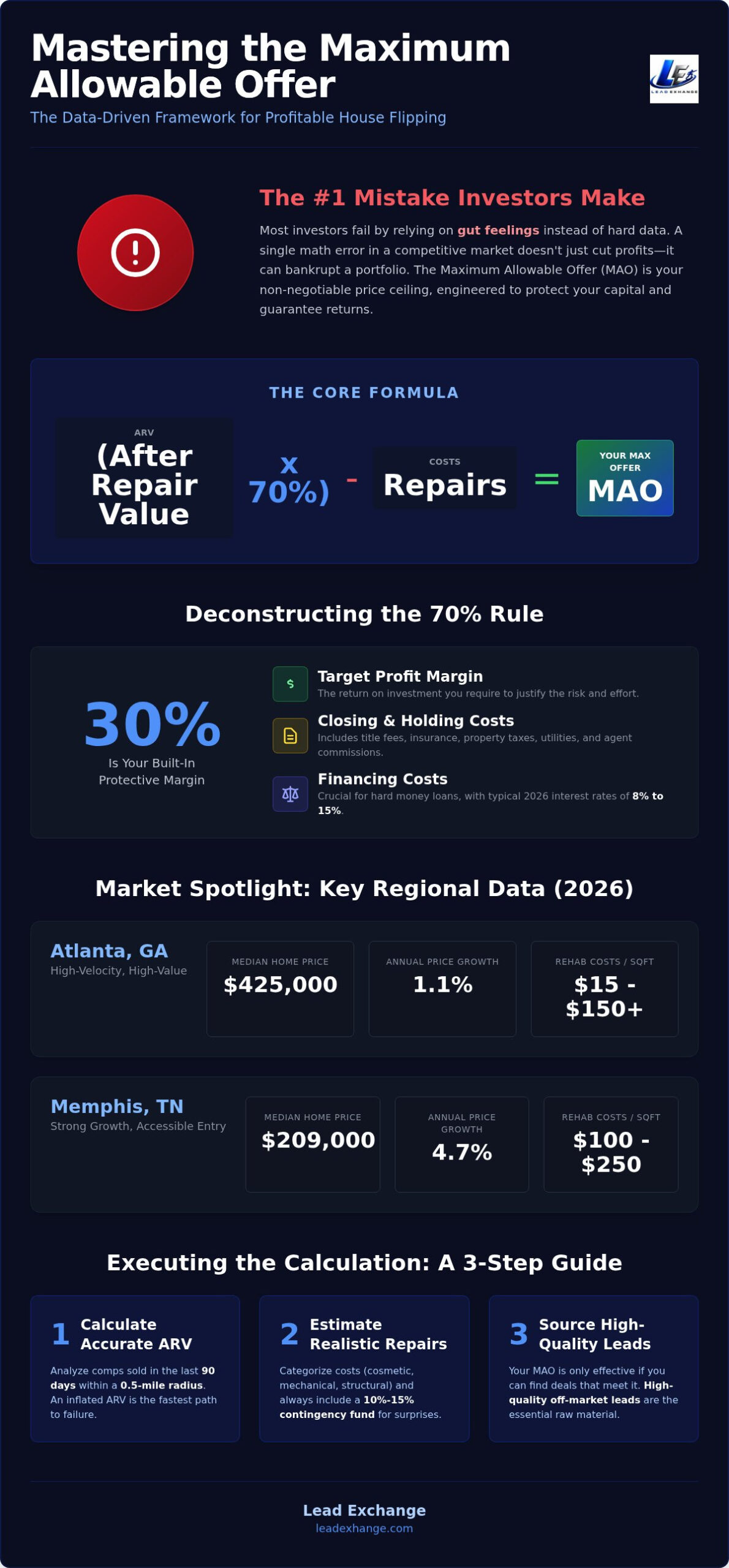
The “deal spread” represents the gap between your purchase price and your eventual exit price, minus all costs. When you use a House Flipping MAO Calculator, you’re defining the minimum profit you’re willing to accept for the risk you’re taking. In Atlanta, where the median home price hit $425,000 in mid-2026, even a 5% error in your MAO can evaporate $20,000 of potential profit. Precision math is the only way to compete with institutional buyers and seasoned locals who know their numbers down to the cent.
The Consequences of Overpaying for Distressed Property
Overpaying erodes your safety net immediately. Every extra dollar spent on the purchase price is a dollar stolen from your rehab contingency fund. When renovation surprises occur, you’ll have no financial cushion to absorb the blow. High purchase prices also inflate your financing costs. With 2026 hard money rates sitting between 8% and 15%, carrying an overpriced property is a recipe for disaster. If your holding period stretches because of labor delays in Memphis, those interest payments will quickly turn a profitable flip into a break-even burden. Buying right is the only foundation for real estate wealth.
MAO as a Risk Management Tool
Strategic investors use MAO to filter out low-margin noise quickly. It provides a non-negotiable walk-away price before you ever enter a negotiation. This discipline is vital in Atlanta, where inventory is expected to grow by 9% to 11% in 2026. As the market balances, your exit strategy must remain viable even if home price growth slows. Lead Exchange provides the off-market leads that make these calculations work. By sourcing deals with higher initial spreads, you gain the flexibility to adjust your MAO and still hit your ROI targets. Knowing when to walk away is just as important as knowing when to buy.
The House Flipping MAO Formula: Mastering the 70% Rule
Profitable investing relies on a cold, calculated formula: (ARV x 0.70) – Repairs = MAO. This standard ensures you don’t just “hope” for a profit but engineer it from the start. The 30% margin isn’t arbitrary. It must cover your target profit, closing costs, and the 8% to 15% interest rates typical of 2026 hard money loans. Using a professional House Flipping MAO Calculator allows you to stress-test these variables in seconds, ensuring your capital only flows into high-probability assets.
Step 1: Calculating Accurate After Repair Value (ARV)
Your ARV is the projected sale price after all renovations are complete. To find it, analyze comparable sales within a 0.5-mile radius that have sold in the last 90 days. Adjust your comps based on square footage, age, and 2026 market trends, such as Atlanta’s 1.1% annual price growth or Memphis’s stronger 4.7% appreciation. Be aware that high-end flips often trigger special appraisal requirements, which can impact your exit timeline and buyer financing options. Accuracy here is non-negotiable; an inflated ARV is the fastest way to a financial loss. Using a dedicated ARV to MAO Calculator built for the Atlanta market ensures your comps translate directly into a defensible, precise offer price before you ever approach a motivated seller.
Step 2: Estimating Realistic Rehab and Repair Costs
Categorize your repairs into cosmetic, mechanical, and structural buckets to avoid missing hidden expenses. In 2026, a cosmetic refresh in Atlanta ranges from $15 to $60 per square foot, while a full gut renovation can exceed $150 per square foot. Memphis remains more affordable, with comprehensive remodels averaging between $100 and $250 per square foot. Always include a 10% to 15% contingency fund. This buffer protects your spread against the inevitable labor delays or material price spikes that occur during high-stakes renovations. For a more precise breakdown of Atlanta-specific labor rates and permit fees, an Atlanta Rehab Cost Calculator can help you itemize every line item before you finalize your offer.
Step 3: Applying the 70% Rule and Adjusting for Risk
The 70% rule is a baseline, not a law. In ultra-competitive, high-demand markets like Charlotte or parts of Buckhead, you might adjust to a 75% rule to secure the deal. Conversely, if you’re tackling a complex structural project or a property in a slower-moving Memphis suburb, dropping to a 65% rule provides the necessary risk premium. Once you’ve subtracted your estimated repairs from 70% of the ARV, you’ve reached your Maximum Allowable Offer. If the seller won’t budge, walk away. You can always source higher-margin off-market deals that actually fit your profitability criteria.
Wholesaling vs. Flipping: Adjusting Your MAO for Higher Spreads
Wholesalers and flippers use the same foundational math but target different end-points. While a flipper targets the profit spread within the 70% rule, a wholesaler must subtract their assignment fee from that same calculation to ensure the deal remains attractive to an end-buyer. You can Use the 70% rule as a starting point, but your success depends on how you layer these specific variables. A House Flipping MAO Calculator that doesn’t account for these distinct exit strategies is a liability, not an asset. Precision acquisition is the only way to protect your reputation and your revenue.
The “Wholesaler MAO” formula follows a strict hierarchy: (ARV x 0.70) – Repairs – Wholesale Fee = MAO. If you’re analyzing a property with an ARV of $300,000 and $50,000 in repairs, a flipper’s MAO would be $160,000. To secure a $10,000 assignment fee, your offer to the seller cannot exceed $150,000. This $10,000 gap is your margin for error and your profit. Without this adjustment, you’ll find yourself holding contracts that no serious investor will touch.
Integrating the Assignment Fee into Your Offer
Your assignment fee is the reward for finding, vetting, and securing the lead. Standard fees for off-market residential deals typically scale with the complexity of the rehab and the total deal volume. Transparency with your end-buyer depends on a solid MAO. If you’re analyzing a property in a high-demand submarket, use the 70% Rule Calculator to determine exactly how much room remains for your fee after accounting for Memphis-specific closing costs and the state’s $0.37 per $100 transfer tax. Providing value to the buyer while securing your profit is a delicate balance that requires exact data.
Exit Strategy Nuances: Flip, Wholesale, or Wholetail
The “buy box” of your local investor network dictates your MAO. Fix-and-flip investors often require a strict 70% ceiling to handle the 8% to 15% interest rates on hard money loans. However, “wholetailing” may allow for a slightly higher MAO if the property is already in decent condition and can be listed on the MLS with minimal cosmetic updates. If your end-buyer is a rental investor using the BRRRR method, they might prioritize long-term cash flow over immediate equity, potentially allowing you to push your offer higher. Your House Flipping MAO Calculator must be flexible enough to pivot between these strategies in real-time. Lead Exchange provides the high-margin leads that allow for this strategic flexibility.
Market-Specific MAO Factors: Navigating Atlanta and Memphis Real Estate
A generic House Flipping MAO Calculator often ignores the geographic variables that determine a deal’s viability. Labor costs in Atlanta are rising, while Detroit faces different seasonal constraints and material logistics. Property taxes also create massive swings in your holding costs. In Atlanta, combined city and Fulton County rates can reach 46 mills, whereas Memphis investors deal with a $2.70 rate per $100 of assessed value. These aren’t minor details; they’re the difference between a successful exit and a capital loss. Precision acquisition requires adjusting your math to the local zip code.
High-velocity neighborhoods in Birmingham or Cleveland might require you to push your MAO to 75% to beat out local competitors. However, doing so without premium off-market data is reckless. Lead Exchange provides the exclusive leads that allow you to maintain a strict MAO while still winning deals. Precision starts with the right raw material.
Atlanta Real Estate: High Demand vs. Rising Rehab Costs
Atlanta’s market is transitioning into a balanced phase, but competition remains fierce in emerging zip codes. You’ll need an Atlanta House Flip Profit Calculator to account for the 5.81% average commission and 3.21% seller closing costs. Permitting in the city can be slow, extending your holding period and increasing interest payments. Since 2026 hard money rates remain high, every extra month of waiting for an inspector eats directly into your 70% rule margin. You must factor these delays into your initial offer to protect your ROI. Using a dedicated fix and flip rehab cost calculator built for Atlanta’s labor market ensures your renovation budget reflects current permit fees and local contractor rates before you commit to a purchase price.
Memphis and Jackson: Analyzing High-Yield Cash Flow Deals
In markets like Memphis, the 70% rule might be too aggressive for low-value rental properties. When the median sale price is $209,000, fixed costs like the $2,197 annual insurance premium represent a larger percentage of your budget than in higher-priced markets. Refer to the Memphis Investor Guide to adjust your math for older housing stock that often requires mechanical overhauls. Out-of-state turnkey buyers expect specific finishes, so your MAO must reflect the premium they’re willing to pay for move-in-ready assets. Success in these markets isn’t about the lowest price; it’s about the most accurate repair estimation.
From Calculation to Acquisition: Sourcing Deals That Fit Your MAO
A House Flipping MAO Calculator is only as effective as the data you feed it. You can master the math, but if you’re applying it to properties on the MLS, you’ve already lost. Retail markets are crowded with emotional buyers who ignore profit ceilings, driving prices far beyond any logical MAO. To secure high-margin deals, you must look where the competition isn’t. Lead Exchange bridges the gap between theoretical math and actual acquisitions by providing the raw material for your success: exclusive off-market leads.
Success in 2026 requires speed. When a motivated seller lead hits your dashboard, you have minutes, not days, to act. Our platform streamlines this process, allowing you to move from lead discovery to a calculated offer in record time. By the time other investors see a property on a public listing, you’ve already secured the contract at a price that guarantees your ROI. We eliminate the friction between finding a property and pulling the trigger.
Leveraging Off-Market Leads for High-Margin Flips
Motivated sellers are the lifeblood of a profitable flipping operation. These homeowners often prioritize speed and convenience over top-market pricing, creating the exact spreads your House Flipping MAO Calculator requires. Lead Exchange identifies these opportunities before they reach the general public. This exclusivity protects your MAO by eliminating the bidding wars that erode contingency funds. You stop being a lead seeker and start being a deal closer. Our data-driven approach ensures you spend your time negotiating with sellers who actually need to sell, rather than fighting over-leveraged retail listings.
Scaling Your Portfolio with Professional Lead Subscriptions
Scaling a real estate business requires a consistent, predictable flow of opportunities. Our Starter and Growth subscription plans are designed to match your investment stage. The Starter tier provides the essential data needed to land your first few high-margin deals, while the Growth plan is built for investors looking to dominate multiple territories. Whether you’re targeting the high-velocity neighborhoods of Charlotte, the emerging markets in Detroit, or the coastal opportunities in Gulfport, we provide the localized data you need to win. Stop fighting for scraps on the MLS and start building a portfolio based on exclusive, high-margin data.
Access exclusive off-market leads now
Master the Math and Dominate the Market
Precision is your greatest competitive advantage in the current real estate landscape. By sticking to a strict House Flipping MAO Calculator, you eliminate the emotional bidding that drains capital and destroys portfolios. You’ve seen how regional factors like Atlanta’s high demand and Memphis’s unique tax structures require specific adjustments to the standard 70% rule. Protecting your profit margin starts with the right offer, but it ends with finding the right property before your competitors do.
Scaling a portfolio requires a consistent flow of high-margin opportunities that simply don’t exist on the MLS. Our subscription plans deliver the exclusive, distressed property data you need to win in Atlanta, Memphis, and Detroit. You now have the definitive framework to analyze off-market deals with absolute certainty and speed. It’s time to stop guessing and start closing.
Take control of your acquisitions today. Build your investment wealth on a foundation of hard data and exclusive market access.
Frequently Asked Questions
What is the 70% rule in house flipping?
The 70% rule is a foundational guideline stating an investor should pay no more than 70% of a property’s After Repair Value, minus renovation costs. This 30% spread is designed to cover your target profit, closing fees, and financing expenses. In high-stakes markets, this rule acts as a primary filter for risk. It ensures you have enough equity to survive unexpected delays or market shifts during the renovation phase.
How do I calculate the MAO for a wholesale deal?
Wholesalers calculate MAO by subtracting their desired assignment fee from the standard investor offer. The formula is (ARV x 0.70) – Repairs – Assignment Fee. If a flipper’s max offer is $160,000 and you want a $10,000 fee, your MAO to the seller is $150,000. This adjustment ensures the deal remains attractive to your end-buyer while securing your revenue. Accuracy here is vital for maintaining credibility within your local investor network.
Can I use a higher percentage than 70% for my MAO calculation?
You can use a higher percentage, such as 75% or 80%, in high-demand markets like Atlanta where inventory is tight. However, doing so significantly reduces your profit margin and increases financial risk. If you push your House Flipping MAO Calculator to 80%, you have almost no room for renovation errors or appraisal misses. Most institutional investors only increase their percentage when they have high confidence in rapid appreciation or extremely low rehab costs.
What is the difference between ARV and MAO?
After Repair Value (ARV) represents the projected retail sale price of the home once all renovations are complete. Maximum Allowable Offer (MAO) is the absolute ceiling you can pay to purchase the property today. ARV is the destination; MAO is the entry point. You calculate your MAO by working backward from the ARV, subtracting profit margins and repair estimates. Confusing these two numbers leads to overpayment and total project failure. Atlanta investors can eliminate this confusion by using a purpose-built ARV to MAO Calculator that accounts for Georgia-specific closing costs and current renovation rates.
How do I accurately estimate repair costs for the MAO formula?
Accurate estimation requires using localized price-per-square-foot baselines for cosmetic, mechanical, and structural work. In 2026, Atlanta cosmetic refreshes range from $15 to $60 per square foot, while Memphis remodels typically cost between $100 and $250 per square foot. Always include a 10% to 15% contingency fund in your House Flipping MAO Calculator. This buffer protects your profit spread against the inevitable labor delays or hidden structural issues found in older housing stock.
Does the MAO include closing costs and holding fees?
The MAO itself is just the purchase price, but the 30% margin in the 70% rule must account for all auxiliary expenses. This includes Atlanta’s 3.21% average seller closing costs and property taxes that can reach 46 mills. You must also factor in 2026 hard money interest rates, which currently range from 8% to 15%. If these carrying costs exceed the 30% buffer, you must lower your MAO to maintain profitability.
Why is an MAO calculator essential for new real estate investors?
An MAO calculator is essential because it replaces emotional “gut feelings” with objective, results-oriented math. New investors often overpay due to a lack of market data or an eagerness to close their first deal. A professional House Flipping MAO Calculator provides a non-negotiable walk-away price. This discipline ensures you only acquire properties with a guaranteed ROI. It serves as a critical risk management tool that filters out low-margin deals before you commit capital.
How often should I adjust my MAO formula based on market trends?
You should recalibrate your formula at least quarterly or whenever interest rates fluctuate significantly. With 2026 hard money rates sitting between 8% and 15%, even a small shift in financing costs can evaporate your profit spread. You must also monitor local inventory growth, such as the 9% to 11% increase expected in Atlanta this year. Frequent adjustments ensure your offers remain competitive while protecting your bottom line against shifting economic conditions and appraisal trends.
Disclaimer
The opinions and information shared on this website are for educational purposes only. Results from real estate investing and lead generation vary, and no specific outcome or profit is guaranteed