A single math error in your initial offer is the fastest way to turn a potential six-figure assignment fee into a professional liability. In an Atlanta market where the median sale price reached $425,000 in June 2026, guessing at margins is no longer a viable strategy. You need a repeatable system to ensure you never overpay for a distressed property again. By mastering a professional ARV to MAO Calculator, you can move from gut-feeling estimates to clinical precision. This tool allows you to account for every variable, from Georgia closing costs to fluctuating renovation rates, before you ever present an offer to a motivated seller.
It’s frustrating to lose credibility with cash buyers because your margins were too thin or your rehab estimates were off by twenty percent. This lack of accuracy is the primary obstacle to scaling your investment volume and protecting your bottom line. We promise to provide you with the exact formula required to safeguard your profit margins and secure high-margin wholesale deals. This guide previews the essential components of a bulletproof deal analysis. You will learn how to integrate current Atlanta renovation costs and the 5.81% average commission rate into a formula that guarantees your success.
Key Takeaways
- Master the 70% rule formula to establish a mathematically sound ceiling price that protects both your assignment fee and the end-buyer’s profit.
- Eliminate offer guesswork by using a professional ARV to MAO Calculator to account for Atlanta-specific closing costs and holding expenses.
- Learn to apply rapid repair cost shortcuts to categorize renovations and vet potential deals with clinical precision before the competition.
- Leverage exclusive off-market data from Lead Exchange to find motivated sellers where these formulas provide the highest competitive advantage.
- Protect your professional credibility with cash buyers by presenting data-backed offers that ensure high-margin spreads and reliable closings.
Why the ARV to MAO Calculation Dictates Your Wholesaling Success
In real estate wholesaling, your contract is only as valuable as the math behind it. Professional investors don’t buy properties based on potential; they buy based on a spread that guarantees a return. If your offer exceeds the Maximum Allowable Offer, you aren’t holding a deal. You’re holding a liability that cash buyers will ignore. An ARV to MAO Calculator acts as the final gatekeeper between a profitable assignment fee and a wasted week of negotiations.
Overpaying for off-market properties creates “dead deals” that sophisticated cash buyers will simply ignore. When you present a thin margin to an experienced flipper, you lose more than just a sale; you lose your reputation as a reliable source. Cash buyers want to see a clear path to profit, not a deal that requires a miracle to break even. Presenting a firm, data-backed offer provides a psychological edge when negotiating with motivated sellers. They sense the difference between a wholesaler who is guessing and a professional who understands local market dynamics. In high-velocity markets like Atlanta and Birmingham, speed is a competitive necessity. You don’t have hours to ponder a deal when other investors are using precise tools to move in minutes.
The Cost of Inaccurate Valuations
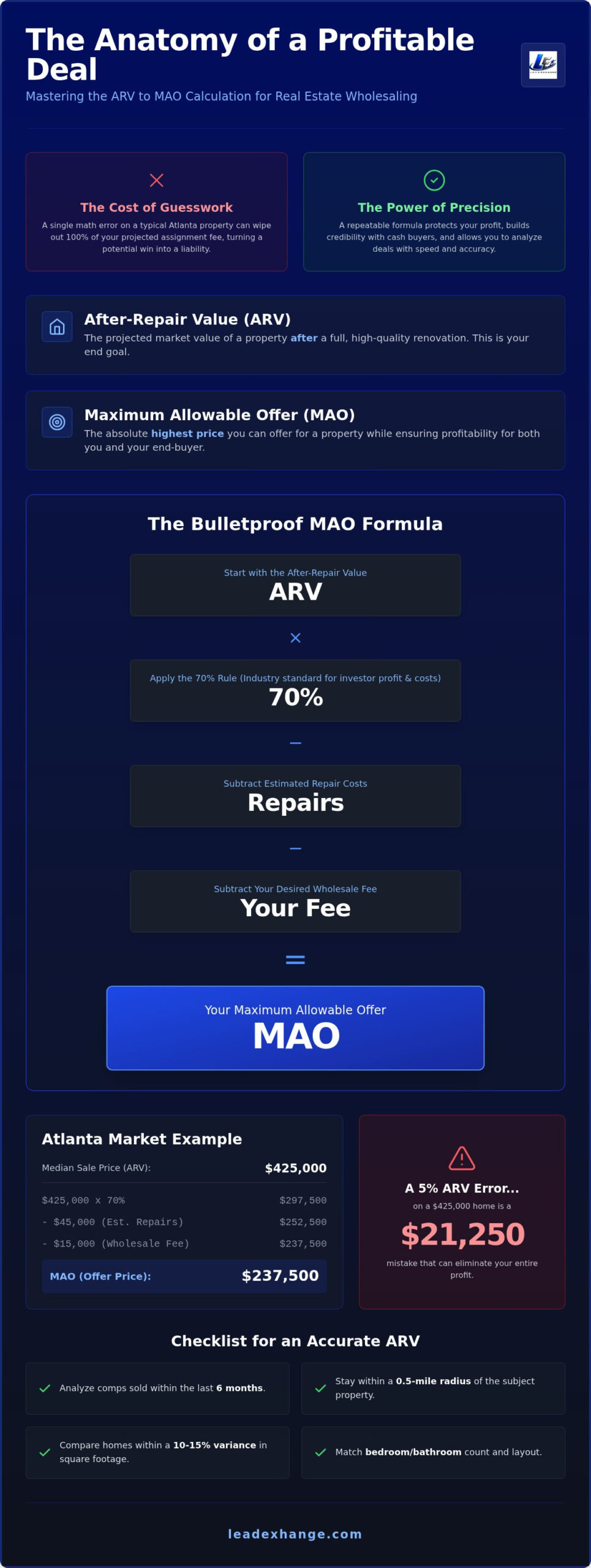
Precision is everything in this business. A 5% error in your After Repair Value calculation on a $425,000 home represents $21,250 in lost equity. For most wholesalers, that error consumes 100% of the projected assignment fee. Underestimating rehab costs has a similar ripple effect, as every dollar missed in the budget is a dollar taken directly from your profit. If you miss a $10,000 foundation issue or a roof replacement, your MAO is instantly invalidated. Speculative wholesaling without verified data is the fastest way to bankrupt your investment career.
Speed vs. Accuracy in Deal Analysis
Success in real estate requires rapid filtering of hundreds of opportunities. When sourcing from a high-volume lead database, you must identify the gold within seconds to stay ahead of the curve. Professional investors prioritize conservative math over optimistic projections every time. They know that a deal that only works if everything goes perfectly is actually a trap. You can use the Atlanta Real Estate Deal Analyzer: Evaluate Profits Fast for immediate vetting. This allows you to maintain high accuracy while moving at the speed the Atlanta market demands. Using a reliable ARV to MAO Calculator ensures your volume never compromises your deal quality.
Defining the Variables: Understanding ARV and MAO Mechanics
Mastering the ARV to MAO Calculator requires a deep understanding of two specific financial metrics. These variables dictate whether a property is a high-margin opportunity or a financial trap. After Repair Value (ARV) represents the projected market value of a property once it has undergone a full, high-end renovation. It is a forward-looking projection, not a reflection of the current distressed state. Conversely, the Maximum Allowable Offer (MAO) is the absolute ceiling price an investor can pay while still hitting their required profit targets.
Wholesalers must approach these calculations from the perspective of their end-buyer. If your MAO doesn’t leave enough room for a fix-and-flip investor to cover their holding costs and profit, the deal won’t move. You are essentially reverse-engineering the deal to ensure it remains attractive to the cash buyers in your network. Understanding the relationship between a property’s distressed condition and its final retail potential is the foundation of professional deal analysis.
Determining Accurate After Repair Value (ARV)
Establishing a reliable ARV starts with hyper-local data. You must analyze comparable sales (comps) located within a 0.5-mile radius of the subject property. Limit your search to homes sold within the last six months to ensure the data reflects current market sentiment. Adjust your valuation based on specific criteria:
- Square footage: Compare homes within a 10% to 15% variance.
- Bedroom and bathroom count: Ensure the layout matches your post-renovation plan.
- Finish quality: Look for “top-of-market” renovations to set your ceiling.
Using investor-grade data is non-negotiable. Traditional retail data often lacks the nuance needed to project the “after” value of a gut renovation. Accuracy here prevents you from overestimating the exit price, which is the most common reason wholesale deals fail to close.
Maximum Allowable Offer (MAO) Explained
The MAO is your ultimate “walk-away” number. It’s the point where the math stops making sense. This figure accounts for the ARV, estimated repair costs, fixed expenses like taxes and insurance, and the buyer’s desired profit. For a fix-and-flip investor, the MAO is often lower because they carry higher risk and holding costs. A long-term hold investor might have a slightly higher MAO because they prioritize cash flow over immediate equity. To find the highest quality opportunities to apply these formulas, you should access exclusive off-market leads that haven’t been picked over by the general public.
The 70% Rule: A Foundation for Profitable Acquisitions
The 70% rule is the industry standard for protecting your capital. The formula is straightforward: (ARV x 0.70) – Repairs – Wholesale Fee = MAO. This 30% margin isn’t arbitrary. It covers essential expenses including holding costs, utilities, property taxes, and seller closing costs, which average 5% to 10% in Georgia. Using an ARV to MAO Calculator based on this foundation ensures your deals remain attractive to serious flippers who need a guaranteed return on their time and capital.
For investors managing high-volume pipelines, you can use the 70% Rule Calculator: Memphis Real Estate Investing as a rapid triage tool. It allows you to filter out non-starters before committing to a deep-dive analysis. Evaluating the risk profile of a deal based on the percentage used is the difference between a secure contract and a speculative gamble. If you’re working with a new buyer, sticking to a conservative percentage builds immediate trust in your deal-finding capabilities.
How the 70% Formula Works
Consider a property with an ARV of $300,000. Applying the rule starts with $210,000 ($300,000 x 0.70). If repairs are $50,000 and your wholesale fee is $10,000, your MAO is $150,000. This equity cushion protects the end-buyer against market fluctuations and unexpected renovation hurdles, such as the rising cost of materials. The 70% rule is an investment formula that limits an acquisition price to 70% of the property’s post-renovation value minus repair costs and assignment fees. Visualizing this cushion helps you explain the offer’s logic to a motivated seller who might be fixated on the higher retail price.
Adjusting for Local Market Conditions
Strict adherence to 70% can cause you to lose deals in hyper-competitive environments. In hot markets like Atlanta or Charlotte, investors often squeeze margins to 75% or even 80% to secure inventory in a balanced market where inventory is growing by 9% to 11%. Conversely, in emerging markets like Jackson or Gulfport, staying conservative at 70% protects you against lower liquidity and higher volatility. You can leverage the House Flipping MAO Calculator for Atlanta & Memphis to adjust your percentages based on specific regional demand and buyer sentiment. Risk profiling each deal ensures your ARV to MAO Calculator outputs remain realistic for the current economic climate.
Factoring in Wholesale Fees and Estimated Repair Costs
Precision in your ARV to MAO Calculator depends on the accuracy of your deductions. Once you’ve established the After Repair Value, the two most significant variables remaining are the cost of renovation and your intended assignment fee. Wholesalers often fail because they treat these figures as flexible. In reality, your end-buyer will use a professional inspector to verify your claims. If your repair estimates are off by even 10%, your buyer’s profit evaporates, and your deal dies at the closing table. Building long-term credibility requires you to present math that stands up to professional scrutiny.
Protecting your assignment fee is a matter of reverse engineering. You must subtract your desired profit from the investor’s Maximum Allowable Offer to determine your purchase price from the seller. If an investor’s MAO is $200,000 and you require a $10,000 fee, your contract price with the motivated seller cannot exceed $190,000. This ensures the end-buyer still hits their target margins while you get paid for sourcing the opportunity. Transparency with buyers about these numbers builds a reputation for high-quality, “plug-and-play” deals.
Estimating Rehab Costs Without a Contractor
You don’t need a general contractor to perform initial deal triage. Using a “price per square foot” shortcut allows for rapid vetting of leads. In the 2026 Atlanta market, a cosmetic refresh involving paint, flooring, and fixtures typically costs between $15 and $60 per square foot. Mid-range renovations that include kitchen and bath updates range from $80 to $200 per square foot. For a full gut renovation on a 2,000-square-foot home, expect costs between $100,000 and $200,000. Categorizing repairs into these tiers helps you avoid thin margins. Always include a 10% to 15% buffer for “hidden” costs like debris removal and permit delays. For a more granular breakdown of Atlanta-specific labor rates and material costs, an Atlanta Rehab Cost Calculator can help you build itemized budgets that satisfy both your bottom line and your lender’s requirements.
Protecting Your Assignment Fee
Setting a minimum fee based on deal complexity ensures your time is compensated fairly. A simple cosmetic flip might warrant a $5,000 fee, while a heavy structural project could justify $15,000 or more. You should always consult the Memphis Investor Guide: How to Use an MAO Calculator for detailed fee-structuring tips that work across high-velocity markets. By accounting for your profit within the ARV to MAO Calculator from the start, you avoid the awkward position of trying to “squeeze” a fee out of a deal that doesn’t have the room to support it.
From Calculation to Closing: Leveraging Lead Exchange Data
Precision math requires high-quality inputs. Applying an ARV to MAO Calculator to properties already listed on the MLS is a losing strategy. By the time a distressed property hits public platforms, the margins are already compressed by bidding wars. Lead Exchange provides direct access to exclusive, off-market leads, allowing you to source motivated sellers before the competition even knows the property exists. This exclusivity is the only way to ensure your calculated spreads remain intact through to the closing table. Accuracy only matters if you have the right deals to analyze.
Transitioning from a single-deal mindset to a high-volume acquisition engine requires a shift in how you process data. You need a reliable pipeline that feeds your analysis tools consistently. Professional tools allow you to present offers that sellers can actually accept because they’re rooted in market reality, not optimistic guesses. When your lead source provides the distressed property data required for accurate ARV analysis, your speed to contract increases exponentially. This momentum is what separates elite investors from those struggling to find their next assignment fee.
Scaling with Starter and Growth Subscriptions
The Starter plan serves as the entry point for investors needing the raw data to establish their first ARV comps. It provides the essential foundation for testing your ARV to MAO Calculator on real-world scenarios. For serious wholesale operations, the Growth plan offers high-volume lead access designed for scaling volume across multiple high-velocity markets like Atlanta and Memphis. This subscription tier eliminates the friction between finding a property and calculating a profitable offer. It allows you to focus on closing deals rather than hunting for fragmented data points across multiple platforms. Growth subscribers can process more leads in a single morning than most part-time investors see in a month.
Executing the Maximum Allowable Offer
Negotiation is simpler when you have total confidence in your numbers. When a seller pushes back on your price, standing firm on your MAO is a sign of professional competence. You aren’t being difficult; you’re following a mathematical necessity. A data-backed offer carries a “take it or leave it” power that emotional pleas lack. Sellers often respect a clear, logical explanation of how repair costs and market comps dictate the final number. This transparency often leads to higher acceptance rates among truly motivated sellers who value a guaranteed, fast closing over a theoretical higher price. Using professional tools to present these offers ensures you’re viewed as a seasoned partner rather than a casual buyer.
Secure Your Competitive Edge in Atlanta
Success in the Atlanta market depends on your ability to move faster and with more precision than the competition. You’ve learned that a professional ARV to MAO Calculator is the only tool that bridges the gap between a speculative guess and a guaranteed profit spread. By mastering the 70% rule and accounting for local renovation costs, you protect your assignment fees and your reputation with cash buyers. Precision math ensures you never overpay for a property, even in a balanced market where inventory is rising.
Sustainable growth requires a consistent pipeline of high-quality opportunities. Relying on public data results in thin margins and wasted time. Lead Exchange provides the professional lead data you need for Memphis, Atlanta, and Detroit. Our Starter and Growth subscription plans offer direct-to-seller sourcing, ensuring you capture the highest possible margins on every deal. It’s time to stop chasing dead deals and start executing a high-volume acquisition strategy with confidence.
Take control of your deal flow today. Your next high-margin wholesale contract is waiting for a data-backed offer.
Frequently Asked Questions
What is the difference between ARV and current market value?
ARV represents the property’s potential worth after a complete renovation to retail standards. Current market value is the price a buyer would pay for the property in its existing, often distressed condition. Investors use an ARV to MAO Calculator to bridge this gap. While current value reflects today’s reality, ARV provides the target for your exit strategy. Understanding this distinction prevents you from overpaying for a property that lacks sufficient equity potential.
How do I calculate MAO if I am a fix-and-flip investor instead of a wholesaler?
Fix-and-flip investors calculate MAO by focusing on their desired net profit rather than an assignment fee. The formula remains ARV multiplied by 70% minus repairs, but the flipper must account for higher holding costs like 6.5% interest rates and utilities. While a wholesaler subtracts their fee from the final number, a flipper keeps that margin as their sweat equity. This shift requires a deeper look at long-term carrying costs and final selling commissions.
Is the 70% rule still relevant in 2026 real estate markets?
The 70% rule remains a vital safety net for protecting capital in 2026. However, in competitive markets like Atlanta, many investors now adjust their ARV to MAO Calculator inputs to 75% or 80%. This adjustment allows them to win deals in a balanced market where inventory is growing. You should stick to 70% for high-risk projects or emerging markets to ensure you have a sufficient equity cushion against potential price volatility.
How much should I estimate for repairs if I cannot enter the property?
Sight-unseen estimates require a conservative, tiered approach based on exterior conditions and property age. Assume a heavy renovation tier if you cannot verify the state of mechanical systems or structural integrity. Use square footage shortcuts, such as $80 to $100 per square foot for mid-range updates, and add a 20% contingency buffer. This protects your margins against hidden issues like mold or outdated electrical panels that only become visible after closing.
Can I use the ARV to MAO calculator for rental properties?
You can use the calculator for rentals, but your profit target usually shifts from immediate equity to long-term yield. Buy-and-hold investors often accept a higher MAO because they prioritize monthly cash flow over a quick flip profit. Instead of a strict 70% rule, these investors might use a 1% rule or cap rate analysis. However, the ARV still matters for future refinancing or the eventual sale of the asset to another landlord.
What happens if my ARV is lower than the sellers asking price?
If your calculated ARV is lower than the asking price, the property is likely not a viable investment deal. You should present your data-backed findings to the seller to justify a lower offer. If they refuse to budge, walk away immediately. Professional investors never compromise their math to fit a seller’s unrealistic expectations. Chasing a deal with no margin is the fastest way to lose credibility with your cash buyer network.
Should I include my assignment fee in the MAO or subtract it?
You must subtract your assignment fee from the end-buyer’s Maximum Allowable Offer. If an investor’s MAO is $200,000 and you want a $10,000 fee, your contract price with the seller must be $190,000. This ensures your profit is built into the deal without exceeding the price your buyer is willing to pay. Using an ARV to MAO Calculator helps you visualize this deduction clearly during the initial analysis phase of your wholesale business.
How do I find accurate comps for ARV in a rural market?
Rural markets require you to expand your search radius beyond the standard 0.5 miles, often up to 5 or 10 miles. You should also look back 12 months instead of six to find enough data points. Focus on properties with similar acreage, outbuildings, and utility access rather than just square footage. This broader view helps you establish a realistic ARV when high-density comparable sales are not available in the immediate vicinity.
Disclaimer
The opinions and information shared on this website are for educational purposes only. Results from real estate investing and lead generation vary, and no specific outcome or profit is guaranteed