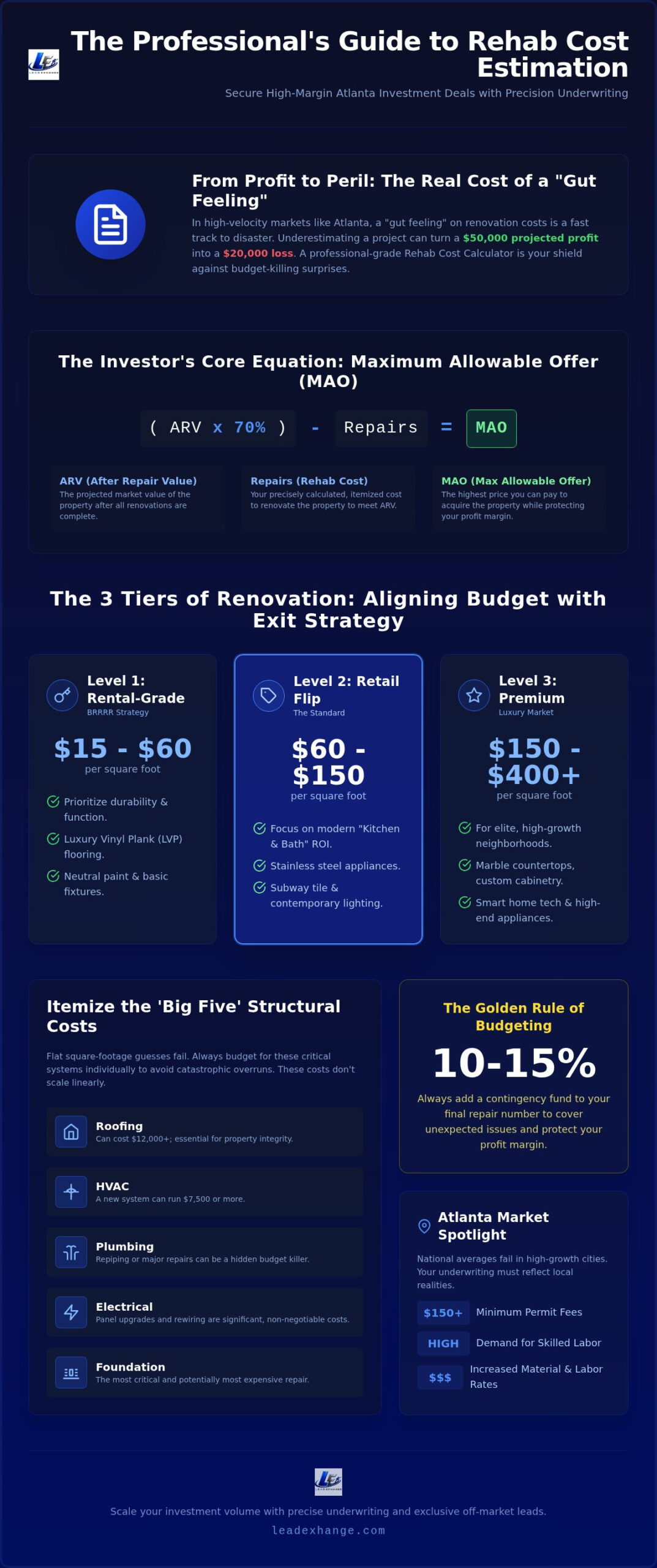
In the high-velocity Atlanta market, a “gut feeling” on renovation costs is a fast track to financial disaster. You already know that missing a single structural issue or underestimating local labor rates can turn a projected $50,000 profit into a $20,000 loss before the first permit is pulled. Relying on generic national averages won’t save your margins when permit fees start at $150 and gut renovations in 2026 can reach $400 per square foot. This guide introduces a professional-grade Rehab Cost Calculator framework designed to help you master the math behind every stud and fixture.
We’ll move past the basic 70% rule to build a reliable underwriting system that satisfies both your bottom line and your lender’s requirements. You will learn how to itemize budgets for Atlanta’s specific labor market and calculate the exact spread needed to secure high-margin investment deals. This deep dive provides the tools you need to analyze off-market opportunities with speed and precision; it ensures every project contributes to your financial growth without the risk of budget-killing surprises.
Key Takeaways
- Master the balance between speed and precision to secure lucrative off-market properties before your competitors can react.
- Align your renovation scope with your specific exit strategy to prevent over-spending on rentals or under-improving retail flips.
- Protect your profit margins by accurately itemizing structural “Big Five” costs, including updated HVAC and roofing estimates for the 2026 market.
- Deploy a professional Rehab Cost Calculator and a 10-15% contingency fund to ensure your 70% Rule math remains bulletproof against surprises.
- Scale your investment volume by pairing precise underwriting with exclusive off-market leads from Lead Exchange Starter and Growth subscriptions.
Why Accurate Rehab Estimation is the Core of Investor Success
A Rehab Cost Calculator is a strategic tool that itemizes labor and materials to define a property’s renovation budget. It moves beyond guesswork. In high-velocity markets like Atlanta, speed and accuracy must coexist. If you take three days to walk a property with a contractor, an aggressive investor using professional underwriting will close the deal first. Conversely, moving too fast without a granular budget leads to budget creep. Professional investors treat their math as a shield against the 20% budget overruns that typically plague amateurs who rely on generic square-footage guesses.
Investors use itemized system audits to avoid the hidden cost trap. Amateurs often assume a flat dollar-per-square-foot rate, yet this approach fails to capture the nuance of a specific asset’s needs. If a property requires a $12,000 roof and a $7,500 HVAC system, those costs don’t scale linearly with square footage. By adopting standardized Cost Estimation Methodologies, you transform your Rehab Cost Calculator into a high-performance deal engine. This precision allows you to negotiate with absolute authority. Sellers are more likely to accept a lower price when you can prove the financial burden of the renovation with line-item clarity.
The Link Between Rehab Costs and Your MAO
Your Maximum Allowable Offer (MAO) depends entirely on the precision of your repair estimate. The standard formula, ARV multiplied by 70% minus repairs, leaves little room for error. Underestimating a project by even $5,000 can instantly vaporize a wholesaler’s assignment fee or a flipper’s contingency fund. The Repair Estimate (REO) serves as the primary subtractive variable that determines your maximum entry price relative to the projected After Repair Value (ARV).
Local Market Variables: Atlanta vs. Memphis
Labor availability in high-growth cities like Atlanta creates significant cost volatility. In 2026, the demand for skilled trades in the metro area remains high; this drives up daily labor rates compared to secondary markets like Memphis or Detroit. While a roof replacement in a lower-cost region might be predictable, Atlanta’s strict permitting requirements and $150 minimum fees add layers of expense. You must account for these regional material and labor variances to ensure your underwriting reflects the reality of the local zip code, not a national average.
The Three Levels of Property Renovation: Strategic Finish Frameworks
Successful investors don’t renovate based on personal preference. They select finishes based on a rigid exit strategy. A Rehab Cost Calculator helps you categorize expenses into three distinct tiers to ensure your budget aligns with the neighborhood’s median price point. Over-renovating a rental is as dangerous as under-renovating a retail flip; both scenarios destroy your ROI and inflate your holding costs. Matching your material choices to the specific demands of the local market is the only way to maximize appraisal values and minimize Days on Market (DOM).
Level 1: Rental-Grade (BRRRR Strategy)
Rental renovations prioritize durability and rapid depreciation cycles. Choose Luxury Vinyl Plank (LVP) flooring for its resilience and neutral paint for broad appeal. While granite is often more durable than lower-end quartz, stick to basic patterns that are easily replaced. In 2026, cosmetic rental updates typically range from $15 to $60 per square foot. These choices ensure the property meets code and safety standards without inflating the basis beyond what local rents support. Focus on functional reliability over aesthetic flair.
Level 2: Retail Flip (The Standard)
Retail buyers demand a modern aesthetic that justifies a premium mortgage. Focus your budget on the “Kitchen and Bath” rule; these rooms provide the highest return on investment. Install stainless steel appliances, subway tile backsplashes, and contemporary lighting fixtures. Using a professional Rehab Cost Calculator ensures your material choices mirror the appraisal requirements of your target zip code. According to data tracked by institutions like the Texas Real Estate Research Center, matching finishes to local buyer expectations is critical for securing a high-margin exit in a competitive environment.
Level 3: Premium/Luxury Finishes
High-end finishes like marble countertops, custom cabinetry, and smart home technology are reserved for elite neighborhoods in high-growth cities. Avoid “The Golden Hammer” by ensuring your improvements don’t exceed the neighborhood’s ceiling. If the median home price doesn’t support a $400 per square foot renovation, you’re merely gifting equity to the next owner. Identify the specific luxury markers that buyers in that block expect before committing to a premium budget.
Finding properties that fit these specific finish frameworks requires access to high-quality inventory. You can identify off-market investment deals that match your desired renovation level before they hit the public market, allowing you to lock in margins before the first hammer swings.
Itemizing the ‘Big Five’: Critical Systems and Structural Costs
Your Rehab Cost Calculator is only as effective as the data you feed it. While cosmetic updates drive sales, the “Big Five” systems determine if a deal is actually viable. Unlike surface-level AI tools that guess health from photos, a professional audit identifies the actual age of a roof or the hidden corrosion in a main plumbing stack. In the Atlanta market, ignoring these systems often leads to five-figure surprises during the inspection period. These are the non-negotiables that lenders and appraisers prioritize.
Roofing remains a primary variable. Asphalt shingle replacements are standard, but metal roofs are gaining traction in premium flips for their durability and appraisal boost. HVAC systems require specific attention in 2026 due to evolving regulatory standards for energy efficiency. Budgeting for a full unit replacement is safer than hoping a $500 service call fixes a failing compressor. Electrical and plumbing costs escalate quickly when you open the walls of distressed properties in historic neighborhoods. Upgrading to a 200-amp panel or replacing galvanized pipes is an essential expense that protects your liability and ensures compliance with modern codes.
Foundation issues are the ultimate budget killers. Identifying horizontal cracks or significant settling early allows you to bring in a structural engineer before you commit capital. These foundational costs must be hard-coded into your underwriting to maintain your margin. Financing these major overhauls often requires specialized products, such as the FHA 203(k) program, which allows for substantial renovation funding alongside the purchase price. Precision here is the difference between a successful project and a total loss.
The Cost of Exterior Curb Appeal
Exterior math focuses on the first impression. Siding, windows, and paint provide the highest psychological impact for potential buyers. In competitive zones like the BeltLine, specific landscaping budgets are essential for a fast resale. Use the Atlanta Real Estate Deal Analyzer to model how these exterior investments impact your final profit spread and overall holding time.
Kitchen and Bathroom Deep Dives
Kitchens and bathrooms demand the most granular itemization in your Rehab Cost Calculator. You must account for cabinetry, stone countertops, and modern hardware to meet retail expectations. Wet area renovations, including tiling and plumbing fixtures, are high-cost zones where labor often accounts for 50% of the expense. Savvy investors save up to 30% on materials by sourcing directly from local wholesalers rather than big-box retailers. This strategy keeps your budget balanced while delivering the high-end look that drives bidding wars.
Calculating the Final Number: Contingency and the 70% Rule
Precision in the final calculation separates high-performance investors from those who simply trade dollars. Your Rehab Cost Calculator provides the raw data, but the final underwriting must account for the unknown. Every professional budget requires a 10-15% “surprise” contingency fund to absorb the unforeseen structural issues or material delays that occur in every project. If your margin can’t survive a 15% budget creep, the deal is too thin to execute. Applying the 70% Rule Calculator allows you to benchmark your entry point, but you must remain flexible. In 2026, high-competition zones often require adjusting this threshold to 75% or 80% to remain competitive, provided the exit velocity justifies the tighter spread. The 70% rule adapts to high-competition markets by prioritizing high-velocity neighborhoods where rapid appreciation compensates for compressed entry margins.
Understanding Holding and Soft Costs
Soft costs are often the silent profit killers in a flip. While the physical renovation is visible, the daily burn rate of utilities, insurance, and property taxes erodes your equity. Hard money loan interest is a significant factor; in the second quarter of 2026, the average interest rate for Atlanta hard money loans reached 10.41%. Most local lenders also charge between 1 and 3 origination points. Every week of delay adds hundreds in interest expense. You must also account for municipal requirements. In Atlanta, residential permit fees start at $150 plus a $25 technology fee, with specific remodel packages for kitchens or bathrooms often exceeding $500. A simple water heater replacement permit costs $75. These administrative costs must be itemized to protect your bottom line.
Using the MAO Calculator for Precision
Integrating your renovation estimate into the House Flipping MAO Calculator creates a definitive boundary for negotiations. This tool adjusts your offer based on current interest rates and the specific velocity of the neighborhood. The 70% rule serves as a strategic starting point that must be compressed or expanded based on the asset’s risk profile and the reliability of your ARV. When the math reveals that the total project cost, including holding and financing, exceeds your profit threshold, the deal is dead. Professional investors never let emotional attachment override the data. Walking away from a bad deal is a victory for your capital preservation strategy.
Scaling Your Investment Engine with Lead Exchange
Elite rehab math is useless without elite inventory. Lead Exchange provides the high-margin off-market deals that justify using a professional Rehab Cost Calculator. Most investors waste time fighting over overvalued scraps on the MLS; our subscribers bypass the noise entirely. By using the Starter SaaS Subscription, you access distressed properties before they reach the public market. This exclusive data advantage allows you to lock in equity before a bidding war can even begin. Growth-tier subscribers win by underwriting these deals faster than the competition, moving from lead identification to a firm offer while others are still waiting for a callback.
From Lead to Close: The Lead Exchange Workflow
The transition from a lead to a closed deal requires a streamlined, data-driven workflow. Once you identify a distressed property in a target city like Atlanta or Memphis, speed becomes your primary competitive advantage. You don’t have days to guess at repair costs. You must immediately run the numbers using the ARV to MAO Calculator to determine your ceiling. Because our leads are off-market, your precision creates a position of strength. You can present a cash offer backed by an accurate Rehab Cost Calculator audit, giving the seller the certainty they need and giving you the margin you require. This methodical approach eliminates the emotional friction that often stalls high-stakes negotiations.
Next Steps for Serious Investors
Scaling your portfolio requires moving from individual projects to a repeatable investment engine. Once you’ve secured a property, prepare your itemized rehab budget for your hard money lenders. Remember that Atlanta lenders in 2026 are looking for 10.41% average interest rates and 1-3 origination points; they prioritize borrowers who present professional-grade underwriting. Simultaneously, use your precise budget to hold your contractor network accountable. Whether you’re operating in Memphis or the Atlanta metro, a clear scope of work prevents change orders from eroding your profits. This level of operational discipline is what separates casual flippers from institutional-grade investors.
Dominating the Atlanta Market with Precision Underwriting
Master the math to secure your position as a top-tier investor in high-growth markets. Using a professional Rehab Cost Calculator ensures you never overpay for a property or underestimate a structural overhaul. By itemizing critical systems and matching your finish levels to local demand, you eliminate the guesswork that destroys profit margins. You’ve learned that a 15% contingency fund and strict adherence to the 70% rule are non-negotiable for long-term capital preservation.
Real success comes from pairing this precision with exclusive inventory. You need access to distressed properties before they reach the public market to maintain a competitive edge. Lead Exchange provides the high-margin off-market deals you need to scale your investment engine. With subscription plans designed for every investor level, our platform focuses on high-growth US markets to ensure your portfolio continues to expand.
Take control of your underwriting and start closing more profitable deals today. Your next high-margin flip is waiting for the right numbers.
Frequently Asked Questions
How accurate is a rehab cost calculator for a first-time investor?
A Rehab Cost Calculator provides a high-performance baseline, but its accuracy depends entirely on the quality of your input data. For a first-time investor, these tools prevent catastrophic oversights by forcing a disciplined, itemized review of the property’s systems. While it won’t replace a licensed inspector’s eyes, it provides a reliable framework for initial underwriting. Use it to verify if a deal is worth a site visit before gathering firm quotes.
What are the most expensive items in a typical home renovation?
Structural systems and high-end finishes typically consume the largest portion of your budget. The “Big Five” include roofing, HVAC, electrical, plumbing, and foundation work. In 2026, full HVAC replacements and structural foundation repairs are often the most significant financial burdens. Kitchens and bathrooms also drive high costs due to the concentration of labor-intensive tiling and specialized plumbing fixtures required to meet retail standards in markets like Charlotte or Atlanta.
Should I include a contingency fund in my rehab budget?
Yes, a 10-15% contingency fund is a non-negotiable requirement for every professional budget. Unforeseen structural issues, permit delays, and material price fluctuations can instantly erode your profit margin. In older properties found in cities like Jackson or Gulfport, hidden water damage or outdated wiring is common. This financial buffer ensures your project remains viable even when the scope of work expands unexpectedly during the demolition phase of the project.
How do labor rates in Atlanta compare to the national average for flips?
Atlanta labor rates are consistently higher than the national average due to the city’s high-velocity market and construction demand. In 2026, skilled trades in the metro area command premium pricing for electrical, plumbing, and HVAC services. Investors must account for these local variances rather than using generic national estimates. High demand for quality contractors means you’ll pay more for speed and reliability compared to secondary markets like Cleveland or Detroit.
Can I use a rehab calculator for BRRRR properties and rental units?
You can and should use a Rehab Cost Calculator for rental strategies to prevent over-improvement. The calculator helps you pivot from premium retail finishes to durable, rental-grade materials like Luxury Vinyl Plank (LVP) and granite. This ensures your renovation budget aligns with local rental comps rather than retail flip values. Matching your spend to your exit strategy is critical for achieving the desired cash-out refinance in a professional BRRRR deal.
What is the 70% rule in house flipping and how does it include rehab costs?
The 70% rule dictates that an investor should pay no more than 70% of a property’s After Repair Value (ARV) minus the total rehab costs. For example, if a home has an ARV of $400,000 and requires $50,000 in repairs, your Maximum Allowable Offer (MAO) would be $230,000. This formula creates a safety margin that covers holding costs, financing fees, and your projected profit spread while protecting your initial capital investment.
How do I estimate repair costs without a contractor present?
Use a system-by-system audit based on square footage and age-of-system data. You can estimate costs for roofs, HVAC units, and exterior paint by using localized unit pricing for the Atlanta or Birmingham markets. While you’ll eventually need a firm quote for lender approval, professional-grade calculators allow you to underwrite deals with high accuracy before the first walkthrough. This speed allows you to secure off-market leads before the competition arrives on site.
Does the Lead Exchange platform provide repair estimates for its leads?
Lead Exchange focuses on providing high-margin off-market leads, but it does not provide individual repair estimates for properties. Investors use our Starter and Growth subscriptions to access exclusive inventory and then apply their own professional underwriting to determine the budget. This allows you to analyze properties based on your specific contractor rates and chosen exit strategy. We provide the high-value opportunity; your professional math secures the final profit margin.
Disclaimer
The opinions and information shared on this website are for educational purposes only. Results from real estate investing and lead generation vary, and no specific outcome or profit is guaranteed