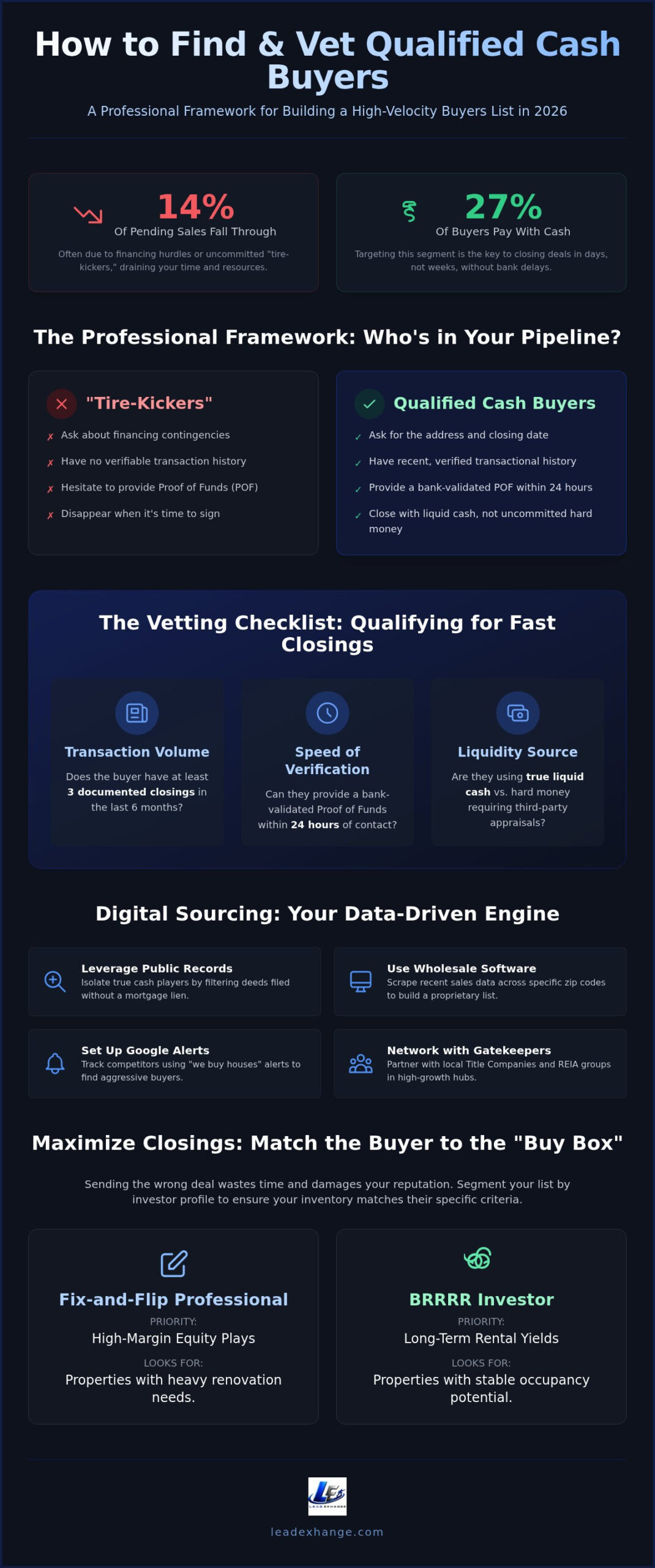
Nearly 14% of pending home sales in the U.S. fell through in early 2026, often due to financing hurdles or uncommitted buyers. If you’re a wholesaler, you know the frustration of “tire-kickers” who disappear when it’s time to sign. You’ve likely spent hours on manual outreach only to find people with no real transactional history. It’s a drain on your most valuable asset: time. Mastering how to find cash buyers for wholesale deals isn’t about growing a massive email list of random names. It’s about targeting the 27% of the market that actually has the liquidity to close without bank delays.
You need a list that performs under pressure and closes in days, not weeks. This guide provides the exact framework for building a high-velocity buyers list using verified data and strategic segmentation. We’ll examine the 2026 professional checklist for vetting active fix-and-flip or buy-and-hold investors. You’ll learn how to automate your list-building and navigate new regulations, like the strict disclosure laws in Louisiana and Ohio, to ensure your contracts stay secure. This is your roadmap to a repeatable system that turns assignments into revenue faster than ever.
Key Takeaways
- Identify high-volume institutional buyers by prioritizing verified transactional history over vanity metrics and unverified email lists.
- Master how to find cash buyers for wholesale deals by leveraging public records to isolate recent deeds filed without mortgage liens.
- Partner with local title companies and REIA groups in high-growth hubs like Atlanta and Memphis to access the industry’s most active “gatekeepers.”
- Implement a professional vetting checklist to calculate a buyer’s “Close Ratio” and eliminate time-wasting tire-kickers from your pipeline.
- Scale your operations with automated systems that connect exclusive off-market inventory directly to verified, ready-to-close investors.
The Professional Framework: Defining a ‘Qualified’ Cash Buyer
Speed is the currency of wholesaling. If you spend weeks educating a “buyer” on the definition of real estate wholesaling, you aren’t running a business; you’re running a classroom. High-velocity wholesalers distinguish between “tire-kickers” and active institutional players immediately. Tire-kickers ask about financing contingencies. Professionals ask for the address and the closing date. They understand that a deal is won or lost based on the ability to perform, not the promise of future funds.
In 2026, verified transactional history is the only metric that matters. Social media screenshots and verbal promises are worthless in a high-stakes market. You need to see recent, recorded deeds where the buyer closed in their own name or entity without a mortgage lien. This data confirms they have the liquidity to perform when a deal hits their inbox. Learning how to find cash buyers for wholesale deals starts with filtering for those who have already proven they can execute. If they haven’t closed a deal in the last quarter, they aren’t a priority for your list.
Vetting for Real Capital
Capital verification must happen before you share sensitive deal details or proprietary contract information. A standard Proof of Funds (POF) isn’t a suggestion; it’s a prerequisite for access. Serious buyers expect this request. If a buyer hesitates to show liquidity, they’re likely a co-wholesaler trying to daisy-chain your deal. Demand a bank-validated statement dated within the last 30 days. Use this checklist to protect your contract:
- Transaction Volume: Does the buyer have at least three documented closings in the last six months?
- Speed of Verification: Can they provide a bank-validated Proof of Funds within 24 hours of contact?
- Liquidity Source: Are they using true liquid cash rather than uncommitted hard money that requires third-party appraisals?
Using hard money isn’t a deal-breaker, but it adds a layer of third-party approval that can slow down a 7-day close. Prioritize true cash for the tightest timelines. This ensures they have the dry powder to close before your inspection period expires, leaving no room for contract fall-throughs.
Identifying Your Ideal Investor Profile
Successful list-building requires understanding the “Buy Box.” This is the specific set of criteria an investor uses to pull the trigger. A fix-and-flip professional in Birmingham looks for high-margin equity plays with heavy renovation needs. Conversely, a BRRRR investor in Gulfport prioritizes long-term rental yields and stable occupancy over massive equity spreads. If you send a rental deal to a flipper, you’re wasting their time. It damages your reputation as a professional facilitator.
Institutional buyers and hedge funds offer massive scale, but they often demand deep discounts that squeeze your assignment fee. Local investors might pay more for the right asset but lack the volume to take every deal you find. Segment your list by these profiles to ensure your how to find cash buyers for wholesale deals strategy matches the specific inventory you source. Matching the right buyer to the right “Buy Box” is what closes deals in days, not weeks.
Digital Sourcing Checklist: Leveraging Online Tools and Data
Digital sourcing transforms a slow, manual search into a data-driven engine. In a market where 27% of buyers pay with cash, you cannot afford to guess where the capital is flowing. High-performance wholesalers use public records to filter for deeds filed without a mortgage. This simple filter isolates the true liquid players from those reliant on bank approvals. You can further refine this by using wholesale real estate software to scrape recent sales data across specific zip codes. Learning how to find cash buyers for wholesale deals through automation allows you to build a proprietary list that your competitors haven’t touched yet.
Implementing diverse strategies for finding cash buyers ensures your pipeline never runs dry. Set up Google Alerts for “cash for houses” or “we buy houses” in your target markets. This tracks your competitors and identifies the most aggressive buyers in real-time. If a competitor is spending heavily on SEO or PPC, they likely have a massive appetite for deals. Reach out to them. They are often your best end-buyers because they already have the infrastructure to close quickly.
Mining Public Records and Tax Assessor Data
The tax assessor’s office is a goldmine for those who know what to look for. Focus your search on residential properties owned by “Corporations” or “LLCs.” These entities are rarely primary residences; they are investment vehicles. Identify “Absentee Owners” who hold high equity in high-demand neighborhoods. These individuals often have the capital to expand their portfolios quickly. Track “Notice of Default” filings as well. This reveals who is actively buying distressed assets before they hit the open market. This proactive approach is essential for anyone mastering how to find cash buyers for wholesale deals in 2026.
Social Media and Digital Community Tactics
Social platforms are networking tools, not just broadcasting channels. Use Facebook Groups to post “Value-First” content. If you lack a contract, post an ethical “Ghost Deal,” which is a summary of a hypothetical deal based on real market data, to gauge interest and collect buyer criteria. On LinkedIn, connect with real estate attorneys and title companies. These professionals are the gatekeepers of transactional data and can introduce you to their most active clients. Reddit’s r/WholesaleRealestate is another venue to find regional partners who can co-wholesale or provide localized buyer insights. If you want to skip the manual scraping, consider using off-market lead platforms to connect with verified investors immediately.
Local Market Networking: Building Presence in High-Growth Hubs
Digital tools provide the data, but local relationships provide the speed. In high-growth hubs like Atlanta, Memphis, and Gulfport, the most active investors aren’t always looking at public lists. They are in the field. Attending Real Estate Investor Association (REIA) meetings puts you in the same room as the capital. Don’t just hand out business cards. Listen for the buyers who discuss specific zip codes or renovation budgets. These are your high-volume targets. If you want to master how to find cash buyers for wholesale deals, you must go where the money congregates.
Title companies and hard money lenders are your most valuable strategic allies. Title companies act as gatekeepers for transactional data. They know exactly who is closing cash deals every week. Hard money lenders are equally vital. They fund the very investors you are looking for. If a lender knows you have a consistent pipeline of off-market deals, they’ll gladly introduce you to their top-tier borrowers to ensure their capital stays deployed. It’s a symbiotic relationship that accelerates your closing times.
The ‘For Rent’ method remains a staple for a reason. Call the numbers on rental listings in your target neighborhoods. Most of these callers are landlords looking to expand their inventory. They already understand the local market and have the infrastructure to manage more properties. This direct approach bypasses the noise of social media and connects you with verified property owners immediately. It’s one of the most pragmatic ways to build a list of buyers who are ready to perform.
Strategic Partnerships with Local Gatekeepers
Real estate attorneys in your target markets are essential for navigating local regulations and identifying frequent closers. They see the contracts before anyone else. Property managers are another untapped resource. They know which owners are looking to expand their local portfolios and which are looking to exit. Finally, talk to local contractors. They know who is currently doing the most flips in the neighborhood. If a contractor is busy, their employer is an active buyer with capital to spend. These relationships turn you into a high-performance facilitator.
The ‘Boots on the Ground’ Checklist
Success in wholesaling requires a physical presence. Use this checklist to dominate your local market and refine how to find cash buyers for wholesale deals through grit and strategic networking:
- Courthouse Auctions: Visit the courthouse steps during foreclosure auctions to meet buyers with ready cash.
- Strategic Signage: Place “We Buy Houses” signs in high-traffic areas. Track the calls from other investors who are scouting the same territory.
- Wholesaler Coffee: Host a monthly meetup to trade buyer contacts with non-competing peers. This expands your reach without increasing your marketing spend.
Building a local presence ensures you aren’t just another name in an inbox. It establishes you as a boots-on-the-ground expert who knows where the deals are. This reputation attracts the kind of elite buyers who close in days, not weeks.
The Vetting Checklist: Qualifying Buyers for Fast Closings
Vetting is the filter that separates predictable profit from wasted effort. A professional wholesaler uses a standardized Buyer Intake Form to gather operational data before a deal ever crosses a buyer’s desk. You need to know their exact “Buy Box” to avoid spamming their inbox with irrelevant inventory. This process protects your reputation and ensures your contracts close on time. Mastering how to find cash buyers for wholesale deals requires identifying those who perform under pressure and have the infrastructure to move quickly.
Verify their Close Ratio immediately. Ask how many contracts they signed last month versus how many actually funded. In early 2026, nearly 14% of pending home sales in the U.S. fell through, often due to buyer instability or financing hurdles. You cannot risk your assignment on someone who over-promises. Speed is non-negotiable. An elite cash buyer must be able to inspect a property and provide a firm commitment within 48 hours. If they demand a 10-day inspection period, they aren’t a true cash buyer; they’re a liability.
The 5-Minute Buyer Interview
Efficiency in vetting saves hours of follow-up. Use these targeted questions to expose “daisy-chain” wholesalers and unverified beginners. This is the ultimate verification step in learning how to find cash buyers for wholesale deals. If a buyer cannot provide specific answers, move them to your low-priority list.
- “What was the address of the last property you bought for cash?” Use public records to verify this claim. If they can’t name one, they lack transactional history.
- “What is your maximum renovation budget per project?” This reveals if they handle cosmetic flips or full structural gut-rehabs.
- “Do you require a formal inspection period for every deal?” True cash buyers often waive this or complete it within 24 to 48 hours.
Segmenting Your List for Maximum Conversion
A massive list is useless if it isn’t organized by performance. Segment your contacts into three tiers to ensure your best deals reach the most reliable capital first. This hierarchy creates a sense of exclusivity and rewards your most consistent partners.
- A-List: Proven closers with immediate liquid cash. They buy “as-is” and close in 7 days or less. Send your highest-margin deals here first.
- B-List: New investors or those using hard money lenders. They are reliable but require third-party approvals or appraisals that can slow the process.
- C-List: Out-of-state investors or niche buyers specializing in luxury or commercial assets. They may pay a premium but often move slower due to travel or specialized underwriting.
Your vetting process should prioritize buyers who have their own in-house contractors or the experience to estimate repairs on the fly. By focusing on the A-List, you minimize the risk of contract fall-throughs and maximize your assignment fees. This disciplined approach is what separates professional wholesalers from hobbyists.
Lead Exchange: Automating the Buyer-Deal Connection
Building a buyers list is only half the battle. The most efficient way to solve how to find cash buyers for wholesale deals is to secure the inventory they cannot find anywhere else. Professional investors don’t just buy houses; they buy margins. When you control high-quality off-market real estate leads, the buyers will find you. Lead Exchange acts as the catalyst, providing the exclusive data required to dominate your local market and attract elite capital. This platform shifts your focus from chasing people to managing high-value opportunities.
The marketplace has evolved beyond static lists. Today, a single “perfect” deal can make your entire existing buyer network irrelevant by attracting new, high-volume institutional players. By using the Lead Exchange platform, you gain the ability to find the exact deals that fit the most aggressive “Buy Boxes” in the country. This ensures your contracts are assigned in days, keeping your capital and your momentum moving forward. You stop being a solicitor and start being a high-performance facilitator.
Sourcing High-Margin Deals to Build Leverage
Professional buyers follow the deals, not the wholesalers. If you secure a property at 65% of ARV in a high-demand zip code, you hold the leverage. Lead Exchange provides access to exclusive off-market data, allowing you to stay ahead of the MLS and traditional public record scrapers. This exclusivity forces buyers to compete for your contracts, often leading to higher assignment fees. Lead Exchange simplifies the search phase for wholesalers by centralizing distressed property data into a high-velocity dashboard. You gain the clarity needed to identify which assets will move fastest in your specific market.
Scaling Your Wholesaling Engine
Transitioning from manual list-building to a SaaS-driven pipeline is the only way to scale in 2026. The Starter Plan is designed for those building their first 50-person buyer network in a single hub. It provides the foundation for consistent deal flow without the overhead of a large team. For wholesalers ready to dominate multiple markets like Jackson or Gulfport, the Growth Plan offers the volume and automation necessary to manage a multi-state operation. It’s built for those who value speed and reliability over manual processes.
Integrate Lead Exchange data directly with your CRM to trigger automated buyer alerts the moment a new deal matches their criteria. This removes the delay between contract signing and property disposition. You aren’t just learning how to find cash buyers for wholesale deals; you’re building an automated engine that qualifies deals and alerts capital simultaneously. This streamlined approach minimizes friction and maximizes your bottom line.
Dominate Your Market with a High-Velocity Buyers List
Building a robust investment pipeline requires more than just a large contact list. It demands verified transactional history and a disciplined vetting process to ensure your contracts close in days. You’ve learned that the most effective strategy for how to find cash buyers for wholesale deals involves a dual approach. You must leverage digital automation to identify liquid players and build strategic alliances with local gatekeepers like title companies and hard money lenders.
Success in 2026 hinges on your ability to secure exclusive inventory that institutional players cannot ignore. Lead Exchange provides professional lead data in high-growth hubs like Memphis, Atlanta, and Detroit. Whether you’re utilizing the Starter plan to build your foundation or the Growth plan to scale across multiple states, the platform ensures you stay ahead of the competition. Focus on high-margin deals, and the elite buyers will follow.
Take control of your deal flow today. With a repeatable system for vetting and sourcing, you’re positioned to turn every contract into a fast, reliable closing.
Frequently Asked Questions
How do I find cash buyers for wholesale deals with no money?
Use free digital networking and public data. Scan Facebook groups for active investors or call “For Rent” signs to find local landlords. You can also attend local REIA meetings to network directly with capital providers. These methods require sweat equity rather than a marketing budget. It’s about direct outreach to individuals who already own property in your target area.
What is the fastest way to build a real estate buyers list?
Leverage automated data platforms to scrape recent cash transactions. Filtering for deeds filed without a mortgage is the most efficient path. This identifies active investors who have closed deals in the last 90 days. Using a platform like Lead Exchange accelerates this by connecting you with verified professionals in high-growth markets. It turns manual research into a streamlined pipeline.
How do I verify if a cash buyer is actually a wholesaler?
Request a specific address of a property they closed in their own name or LLC. Wholesalers who “daisy-chain” deals will struggle to provide recorded deeds where they were the end-buyer. Check the county recorder’s office to confirm the transaction was a true purchase rather than a contract assignment. This step ensures you are dealing with the actual capital provider.
Can I find cash buyers on the MLS?
Yes, you can identify them by looking for “Sold” listings with “Cash” as the financing type. Real estate agents often represent these buyers and can act as gatekeepers. Building relationships with agents who close multiple cash deals per month is a proven strategy for how to find cash buyers for wholesale deals without manual scraping.
What should I ask a cash buyer before sending them a deal?
Ask for their specific “Buy Box” and a bank-validated Proof of Funds. You need to know their target zip codes, minimum ROI, and renovation capacity. Confirming their decision-making timeline is also critical. A true professional should be able to inspect and commit within 48 hours of receiving the deal details. This is the most effective way to manage how to find cash buyers for wholesale deals.
Is it better to have a large buyers list or a small one?
A small list of verified, high-volume closers is superior to a large list of unvetted names. Quality beats quantity in disposition. Focus on 10 to 20 “A-List” buyers who have the liquidity and experience to close without inspection hurdles. This minimizes the risk of your contracts falling through and protects your assignment fee from unreliable tire-kickers.
How do I use public records to find cash buyers in my city?
Access the county tax assessor’s website and search for properties with different “Owner” and “Mailing” addresses. This identifies absentee owners. Filter these results for corporate entities like LLCs or Inc. These owners are likely investors who purchased the asset with cash to build a rental or flip portfolio. It’s a reliable way to find localized capital.
What happens if my cash buyer backs out of a wholesale deal?
You risk losing your earnest money deposit and damaging your reputation with the seller. If this happens, immediately reach out to your backup buyers to find a replacement. This is why vetting for a high “Close Ratio” is essential before signing an assignment contract. Having a tiered list ensures you have options when a primary buyer fails to perform.
Disclaimer
The opinions and information shared on this website are for educational purposes only. Results from real estate investing and lead generation vary, and no specific outcome or profit is guaranteed