The national average assignment fee for real estate wholesalers reached $13,000 in 2026, yet many investors still struggle to close a single profitable transaction. While the income potential for advanced operators can exceed seven figures, the “spray and pray” marketing tactics of the past are failing in a market defined by 6.67% interest rates. You’ve likely noticed that competition for on-market properties is at an all-time high, leaving you fighting for thin margins on the MLS. It’s a common frustration to feel stuck between aggressive competitors and confusing new disclosure regulations in states like Ohio and Connecticut.
We’ll show you how to master the mechanics of professional wholesaling and identify high-margin, off-market deals in today’s competitive landscape. This guide moves past the basics to position you as a high-performance facilitator who prioritizes data over guesswork. You’ll gain a clear understanding of the modern wholesale deal flow, learn how to secure reliable sources for off-market leads, and discover how to scale your investment volume without traditional market limitations. It’s time to stop acting as a middleman and start operating as a strategic ally in the investment sector.
Key Takeaways
- Identify how real estate wholesalers operate as strategic facilitators to secure off-market properties before they hit the competitive public market.
- Master the mechanics of the transaction lifecycle to move deals efficiently from initial contract to profitable assignment.
- Evaluate property leads using the 70% Rule to ensure every deal maintains a high-margin professional standard.
- Leverage the “as-is” cash model to provide rapid exit solutions for sellers that traditional brokerage services cannot match.
- Scale your investment engine by replacing manual lead hunting with automated, high-quality off-market data subscriptions.
What Are Real Estate Wholesalers? Defining the Industry’s Deal-Makers
Professional real estate wholesalers are the strategic facilitators of the modern property market. They don’t just find houses; they secure off-market properties under contract to create value where others see obstacles. Their primary goal is simple: bridge the gap between motivated sellers who need a fast exit and cash-ready investors seeking high-margin inventory. By identifying distressed assets and locking them in, they provide a vital service that keeps the investment engine running.
Understanding What is Wholesaling in a real estate context requires a shift in perspective. You aren’t selling bricks and mortar. Instead, a wholesaler is a contract rights distributor for equitable interest. This distinction is critical for legal compliance and professional standing. While a “bird-dog” merely points toward a potential lead for a small finder’s fee, professional real estate wholesalers take control of the transaction through a legally binding purchase agreement. They hold the rights to the deal, which they then assign to an end buyer for a fee.
The Role of the Wholesaler in the Investment Ecosystem
Wholesalers function as essential liquidity providers. They step in when homeowners face distressed situations, such as foreclosure or probate, offering a streamlined alternative to the traditional MLS. This speed creates a steady pipeline of “fix-and-flip” or “buy-and-hold” inventory for institutional and private investors. Success in this role demands deep local intelligence. In high-growth hubs like Atlanta and Memphis, wholesalers who understand specific neighborhood dynamics identify margins that automated algorithms often miss. They act as the boots-on-the-ground scouts for larger investment firms.
Wholesaling vs. Flipping: Key Operational Differences
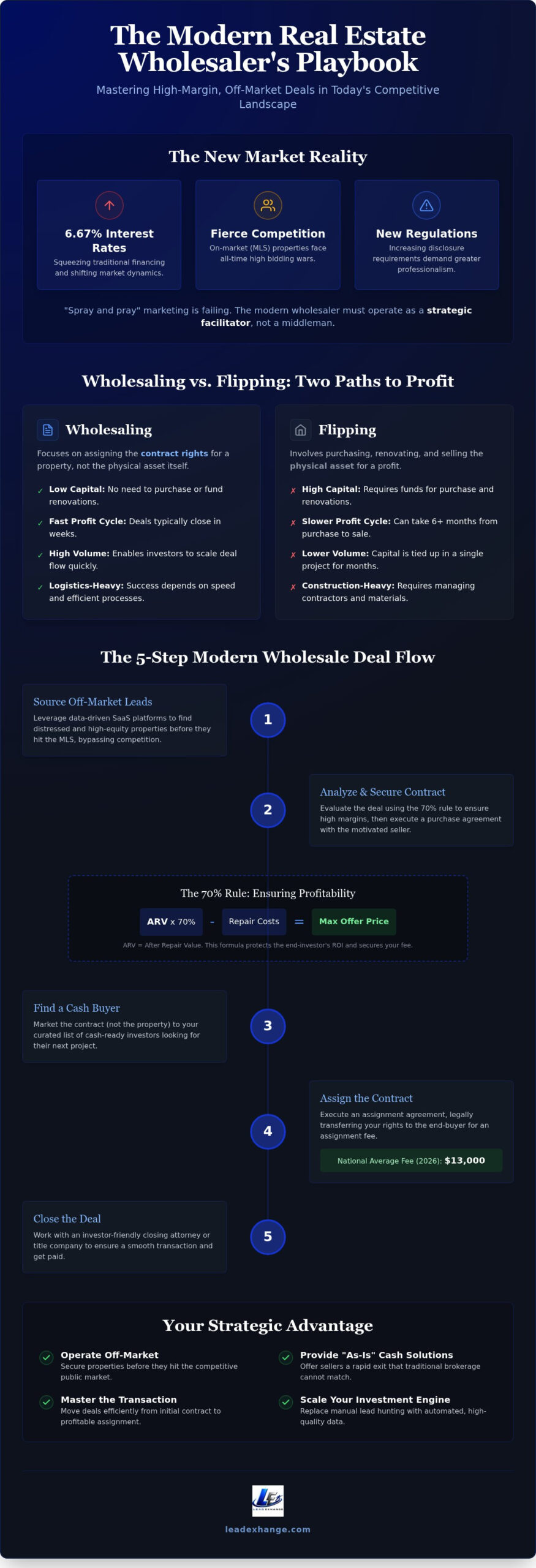
The fundamental difference between these strategies lies in the focus of the investment. Wholesalers focus on the contract. Flippers focus on the physical asset. Because you aren’t funding a full renovation or managing contractors, the capital requirements are significantly lower. This makes wholesaling a high-performance entry point for investors looking to scale volume quickly without tying up hundreds of thousands in a single project.
Profit cycles also vary significantly. A flip might take six months of construction and marketing to realize a return. A wholesale deal can move from contract to close in weeks. It’s a logistics-heavy operation that prioritizes speed and deal flow over construction management. To maintain this momentum, many professionals use the Starter or Growth plans from Lead Exchange to automate their lead sourcing and eliminate the friction of manual hunting.
The Mechanics of Wholesaling: How Deals Move from Contract to Close
Real estate wholesalers operate at the intersection of speed and precision. The transaction lifecycle begins with identifying a motivated seller whose property issues outweigh their desire for a retail price. Without a motivated profile, the “spread”—the gap between your contracted purchase price and the investor’s buy-in—evaporates. Success requires professional confidence to secure the contract and the technical expertise to navigate state regulations on wholesaling, which increasingly demand transparency and specific disclosures as of 2026.
Step 1: Sourcing Off-Market Real Estate Leads
Manual tactics like “driving for dollars” are no longer sufficient for high-volume operations. Professional wholesalers have transitioned to data-driven SaaS platforms to identify distressed or high-equity properties before they reach the public market. By focusing on exclusive data, you bypass the saturated competition found on the MLS. High-performance investors use curated platforms like off-market deal subscriptions to filter for high-margin opportunities in markets like Atlanta and Memphis where deal volume remains high.
Step 2: Executing the Assignment of Contract
The assignment clause is the engine of the wholesale deal. It allows you to transfer your equitable interest in the property to an end-buyer for an assignment fee. In 2026, the national average assignment fee is approximately $13,000, though mid-price markets often see fees reaching $18,000. To maintain investor ROI, you must calculate this fee based on a clear After Repair Value (ARV). Always partner with investor-friendly closing attorneys who understand the latest disclosure requirements in states like Ohio, where 12-point bold font disclosures are now mandatory for every wholesale transaction.
Step 3: The Double Closing Alternative
When a deal carries an exceptionally high profit margin, a double closing offers a strategic advantage. This method involves two separate transactions: the A-to-B purchase from the seller and the B-to-C sale to the investor. While it requires transactional funding, it protects your privacy and ensures transparency by keeping your specific profit margin confidential from both parties. This approach is standard for advanced real estate wholesalers who prioritize exclusivity and high-stakes deal protection. It ensures that both the seller and the buyer receive a clean, professional experience without the friction of fee negotiation.
Wholesalers vs. Real Estate Agents: Understanding the Value Proposition
Real estate agents optimize for the highest possible sales price through broad market exposure. Professional real estate wholesalers optimize for speed and certainty. While an agent lists a property on the MLS and waits for a retail buyer, a wholesaler secures the property and assigns it to a cash investor immediately. This “as-is” cash model removes the traditional friction of the residential market. Prioritizing a rapid exit is why many sellers choose wholesalers over the long, uncertain process of open houses and retail negotiations.
Wholesalers act as specialized problem-solvers for properties that don’t fit the retail mold. They handle complex title issues, structural damage, or inherited properties that would fail a standard bank appraisal. By bypassing inspections and appraisals, wholesalers provide a definitive solution for homeowners who cannot afford the time or capital for repairs. This directness eliminates the risk of a deal falling through due to financing contingencies or unfavorable inspection reports.
Speed vs. Market Exposure
Broad market exposure often leads to higher offers, but it comes at the cost of time. In 2026, the average time to close a retail sale remains significantly longer than a wholesale assignment. For serious investors, “off-market” status is a premium feature. It ensures they aren’t competing in a bidding war on the MLS. High-performance operators use the Growth plan from Lead Exchange to access exclusive, fast-track opportunities in high-growth markets like Birmingham and Memphis. This data-driven approach allows wholesalers to present a firm offer within hours, not days. Broad exposure is a liability when a seller needs liquidity immediately.
Fee Structures and Net Proceeds
The traditional brokerage model relies on a 6% commission plus closing costs. While this seems straightforward, the hidden costs for a seller are often substantial. Retail buyers frequently demand repairs, price concessions after inspections, and seller-paid closing costs. When you factor in monthly holding fees, insurance, and taxes during the listing period, the net proceeds from a retail sale can drop below a cash wholesale offer.
Wholesalers offer a “no-nonsense” partnership. There are no commissions. There are no contingencies for financing. The offer you present is the amount the seller considers against their current liabilities. This transparency positions the wholesaler as a strategic ally rather than a middleman. It provides the seller with a clean break and the investor with a high-margin asset. By removing the 6% commission and the repair budget from the equation, you create a win-win scenario that traditional agents simply cannot facilitate.
Identifying and Sourcing High-Margin Wholesale Opportunities
Professional evaluation of leads separates high-performance operators from hobbyists. In 2026, real estate wholesalers must apply rigorous mathematical frameworks to filter out noise and protect their margins. The standard benchmark remains the 70% Rule. This formula dictates that your maximum allowable offer (MAO) should not exceed 70% of the After Repair Value (ARV) minus estimated repair costs. While simple, it ensures a built-in margin that protects both your assignment fee and the end investor’s ROI. Applying this rule consistently prevents you from overpaying for properties with hidden structural liabilities or inflated market expectations.
The Anatomy of a Profitable Wholesale Lead
Properties with significant “deferred maintenance” offer the most leverage. You’re looking for physical distress that disqualifies a home from traditional financing. Target high-equity owners who prioritize a definitive, fast exit over top-dollar pricing. Location is equally critical. Class “B” and “C” neighborhoods in cities like Birmingham, Charlotte, and Jackson often yield better spreads than luxury markets. These areas have higher demand for rental inventory and entry-level flips. Identifying these pockets requires a focus on neighborhoods where the median home price allows for a substantial renovation budget while staying under the retail ceiling.
Key identifiers for high-margin leads include:
- Properties in probate or inherited estates.
- Homes with visible structural distress or code violations.
- Owners with high equity but low liquidity.
- Properties that have been vacant for more than 60 days.
For a deeper dive into these strategies, consult our guide on Off-Market Real Estate Leads.
Leveraging Local Market Data
Atlanta and Memphis continue to be wholesaling hotspots due to high investor activity and consistent deal volume. Success here depends on accurate ARV analysis. You must use recent neighborhood comps specifically those sold within the last 90 days to determine what a property is worth in its fully renovated state. Don’t rely on Zestimates or broad market averages. Professional real estate wholesalers use a Wholesale Real Estate Calculator to vet deals instantly. This precision allows you to present offers with confidence and move to the contract phase without hesitation.
In 2026, speed is a byproduct of better data. When you know the numbers are solid, you can close the gap between a lead and a signed contract in a fraction of the time it takes your competitors. Moving quickly with a firm, data-backed offer builds trust with motivated sellers who are often overwhelmed by their property’s condition.
Scaling Your Investment Engine with Professional Lead Data
Scaling a high-volume operation requires a transition from manual deal hunting to automated systems. Professional real estate wholesalers can’t afford the time drain of cold-calling or driving for dollars. These legacy tactics lack the consistency needed to maintain a predictable pipeline. By shifting to a lead subscription model, you remove the friction of sourcing and focus exclusively on closing. This transition represents the shift from being a solo operator to running a high-performance investment engine.
Reliability is the currency of the 2026 market. When your sourcing is automated, your professional confidence increases because you aren’t desperate for the next lead. You have the luxury of being selective, choosing only the highest-margin off-market investment deals. This stability allows you to build a reputation as a reliable partner for cash buyers who demand a steady stream of inventory. Market dominance isn’t about working harder; it’s about deploying better data more efficiently.
Replacing the Hustle with SaaS Efficiency
Marketing overhead is often the largest expense for a growing firm. Direct mail campaigns and skip-tracing services require significant capital and offer no guarantee of a return. Curated, off-market data provides a definitive competitive advantage by delivering vetted leads directly to your dashboard. The cost-benefit analysis is clear: a subscription to professional data is cheaper and more effective than managing a fragmented marketing stack.
Our Starter plan provides the essential tools for new wholesalers to secure their first few assignments without heavy risk. For high-volume firms, the Growth plan offers the scale needed to dominate multiple territories simultaneously. To understand the technology driving these results, review our Wholesale Real Estate Software guide. Using the right platform turns lead generation from a variable hurdle into a constant asset.
Next Steps: Joining the Lead Exchange Network
Expanding your reach into new territories requires a strategic ally who understands local nuances. Whether you’re targeting high-equity opportunities in Detroit, distressed assets in Cleveland, or emerging markets in Gulfport, exclusive data access is your bridge to success. You don’t need a massive team to scale. You need a reliable source of truth that identifies motivated sellers before your competitors even know the property exists.
Joining a professional network simplifies the complex acquisition process. It allows you to operate with the agility of a local expert in any market you choose. This streamlined approach to information delivery ensures you stay ahead of regulatory changes and market shifts. Focus on the bottom line and let professional data handle the hunting.
Accelerate Your Acquisition Engine
The landscape for real estate wholesalers has shifted toward a high-performance logistics model where data is the primary leverage. Success in 2026 isn’t built on manual outreach. It’s built on the ability to identify high-margin, off-market deals before the competition even notices. By mastering the 70% rule and navigating the evolving regulatory environment with professional transparency, you position yourself as a strategic ally rather than a middleman.
Lead Exchange removes the friction of manual sourcing by providing exclusive off-market data across high-growth markets. Our scalable Starter and Growth plans offer a direct connection between motivated sellers and professional investors. You don’t need to struggle with thin margins on the MLS when you have the right acquisition engine. It’s time to replace the hustle with a streamlined, SaaS-driven strategy that prioritizes your bottom line.
Start operating with the precision and speed that the modern market demands. Your next high-margin deal is ready for capture.
Professional Wholesaling FAQ
Is wholesaling real estate legal in all states in 2026?
Wholesaling remains legal in all 50 states, but compliance requirements vary by jurisdiction. In 2026, states like Ohio and Connecticut have implemented strict disclosure and registration rules for every transaction. You are selling the equitable interest in a contract rather than the property itself. Always consult local regulations to ensure your contracts include mandatory 12-point bold disclosures where required. Legal transparency is the standard for professional real estate wholesalers operating in high-growth markets.
How much money do real estate wholesalers make per deal?
The national average assignment fee for a wholesale deal is approximately $13,000 as of July 2026. This figure fluctuates based on the specific market median. In mid-price regions, fees typically range between $8,000 and $18,000 per transaction. High-performance investors in markets like Atlanta or Charlotte often see higher spreads by targeting deeply distressed assets. Your profit depends on the “spread” between the contracted purchase price and the end investor’s final buy-in price.
Do I need a real estate license to be a wholesaler?
Most states don’t require a real estate license to wholesale if you are selling your equitable interest in a purchase contract. However, some jurisdictions like Oklahoma require a license to market properties you don’t own. Licensing can provide a competitive edge and ensures you stay within legal boundaries. Regardless of your license status, you must avoid acting as an unlicensed broker by marketing the physical property instead of the specific contract rights.
What is the difference between an assignment fee and a commission?
An assignment fee is the profit earned by selling the rights to a purchase contract to another buyer. It is a flat fee or spread determined by the deal’s margin. In contrast, a commission is a percentage-based fee paid to a licensed broker for representing a party in a transaction. Real estate wholesalers earn assignment fees through contract control, whereas agents earn commissions through traditional MLS brokerage services which we do not provide.
How do I find cash buyers for my wholesale deals?
Building a robust cash buyer list involves networking at local investor meetups and analyzing public records for recent cash transactions. Look for active flippers and landlords in markets like Memphis and Birmingham who have closed deals in the last 90 days. High-volume wholesalers also use professional platforms to connect their secured off-market investment deals with ready-to-close capital. Maintaining a curated list of reliable buyers ensures your assignments close quickly without any financing delays.
Can I wholesale properties that are listed on the MLS?
You can wholesale MLS-listed properties, but it is significantly more difficult than sourcing off-market deals. Listed properties are already exposed to the broad market, which typically eliminates the necessary margin for a wholesale spread. Most professional real estate wholesalers avoid the MLS to bypass bidding wars and agent commissions. Instead, they focus on exclusive lead sources to find motivated sellers before their properties ever reach the public retail market.
What happens if I cannot find a buyer for a wholesale contract?
If you cannot find a buyer before the closing date, you risk losing your earnest money deposit or defaulting on the contract. Professional wholesalers use inspection contingencies to provide a legal exit strategy if a deal isn’t viable. To avoid this outcome, ensure your numbers follow the 70% Rule and target high-demand areas like Detroit and Atlanta. Having a pre-vetted buyer list for specific zip codes reduces the risk of an unassigned contract.
How does Lead Exchange help wholesalers find motivated sellers?
Lead Exchange provides a curated platform of exclusive off-market property leads, removing the friction of manual sourcing. Our Starter and Growth subscription plans allow wholesalers to access distressed property data in high-growth markets like Gulfport and Cleveland. By delivering vetted leads directly to your dashboard, we act as a strategic ally in the acquisition process. This allows you to focus on executing contracts rather than cold-calling or managing expensive direct mail campaigns.
Disclaimer
The opinions and information shared on this website are for educational purposes only. Results from real estate investing and lead generation vary, and no specific outcome or profit is guaranteed