Driving for dollars is no longer a viable strategy for the professional investor looking to scale. In a market where 30.8% of homes are selling above asking price, relying on luck and manual searches is a recipe for stagnation. You need a faster, data-driven way to secure a wholesale house that actually offers a profitable margin.
It’s exhausting to compete in saturated markets where every “exclusive” deal you see has already been passed over by ten other buyers. You’ve probably noticed that many leads being marketed as wholesale are actually low-margin properties with unrealistic price tags. You deserve a system that cuts through the noise and delivers high-stakes opportunities directly to your desk.
This guide promises to transform your acquisition process. You’ll master the art of identifying, evaluating, and securing high-margin properties in a competitive off-market environment. We will examine the impact of new 2026 regulations in states like Ohio and Louisiana, define clear criteria for a true wholesale house, and show you how to access exclusive leads before the competition even knows they exist.
Key Takeaways
- Identify high-margin opportunities by distinguishing between physical and financial distress. Learn to spot the specific seller motivations that lead to a profitable wholesale house acquisition.
- Build a repeatable sourcing system by defining a precise buy box and aggregating off-market data. Stop wasting time on manual searches and start leveraging professional data streams.
- Master the 70% Rule to calculate your Maximum Allowable Offer with precision. Ensure every deal has enough spread for a successful assignment or flip.
- Scale your investment volume by automating lead generation with professional SaaS tools. Move faster than the competition by setting up real-time alerts for exclusive off-market deals.
What Defines a Wholesale House in the 2026 Market?
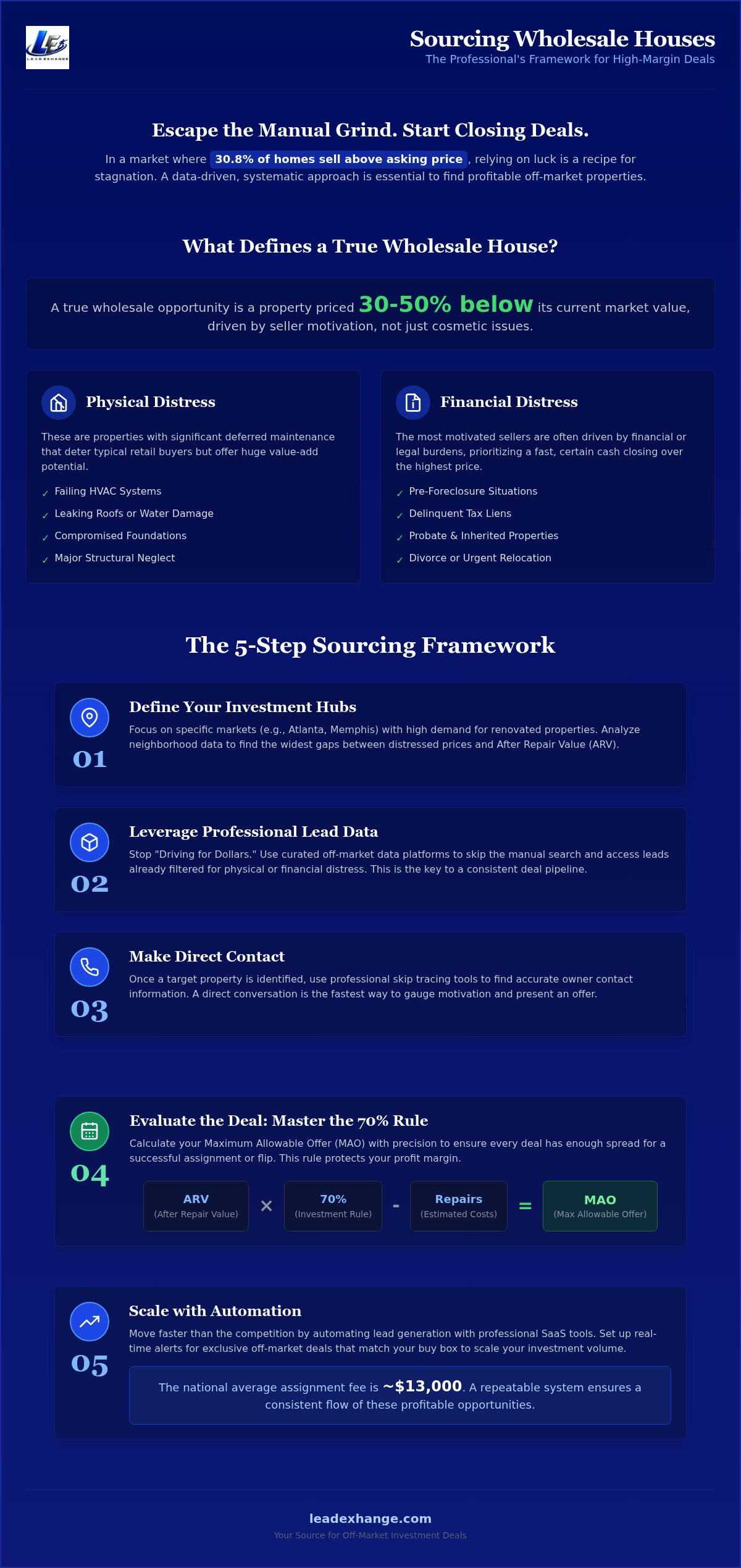
Professional investors distinguish between a standard listing and a true wholesale house by looking at the underlying distress. To understand the broader context of this business model, one should ask, What is Wholesaling? and how it applies to distressed assets. In the real estate sector, this means identifying properties priced 30-50% below their current market value. These aren’t just properties that need a coat of paint; they are assets where the seller is prioritized for speed and certainty over a top-dollar retail price.
The core of every deal is the spread. This is the financial distance between your acquisition cost and the property’s After Repair Value (ARV). In a recalibrating market where national home price growth has stabilized at 1.5%, your margin for error is slim. You need a significant gap to account for renovation costs, holding fees, and your own profit. Without this spread, you aren’t wholesaling; you’re just passing on a high-risk liability.
Physical Characteristics of Wholesale Assets
Successful acquisition often starts with identifying structural neglect or outdated systems. A wholesale house typically features major deferred maintenance, such as failing HVAC units, leaking roofs, or compromised foundations. These issues terrify retail buyers who rely on traditional mortgage lending, but they represent a massive value-add opportunity for the professional flipper or landlord. Visual distress is your best friend. The “ugly house” phenomenon allows you to secure a property at a steep discount because the average buyer cannot see past the aesthetic neglect.
A wholesale house is an asset with a high equity-to-effort ratio.
Financial Distress and Motivated Sellers
Physical decay is only half of the equation. Many of the best deals look perfect from the curb but are buried under financial distress. You must learn to identify pre-foreclosures, tax liens, and probate situations. These sellers aren’t looking for the highest bidder; they’re looking for a way out of a mounting financial or legal burden. They need a cash buyer who can close in days, not months.
These deals rarely appear on the traditional MLS. With 30.8% of homes currently selling above asking price, the MLS is a retail battleground. Sellers of wholesale assets avoid the public market because they can’t afford the time or cost of traditional brokerage services. Seller motivation is more important than the property’s condition. If the seller isn’t motivated by a specific problem, you won’t get the discount you need to make the numbers work. Off-market leads provide the only real advantage in high-competition zones.
The 5-Step Framework for Sourcing Wholesale Houses
Professional sourcing requires a repeatable system. You can’t rely on random discoveries or luck. You need a framework that filters out noise and highlights high-margin opportunities. Moving beyond manual search methods allows you to treat your investment business as a high-performance engine rather than a hobby. This process starts with a clear buy box and ends with a secured contract.
Step 1: Defining Your Investment Hubs
Focusing on specific markets like Atlanta or Memphis yields better results than casting a wide, shallow net. These cities consistently show high demand for renovated inventory and have robust ecosystems for off-market transactions. You must analyze neighborhood-level data for “flippability” scores, looking for areas where the gap between distressed prices and ARV is widest. Establish a strict minimum profit margin per deal. With the national average assignment fee sitting at approximately $13,000 in 2026, your target should reflect your specific overhead and scaling goals.
Step 2: Leveraging Lead Exchanges for Speed
Manual prospecting is a significant bottleneck. Driving for dollars takes weeks to produce a single viable wholesale house lead. Curated off-market data platforms allow you to skip the manual search and move straight to acquisition. There is a massive difference between “cold” lists and curated leads that have already been filtered for distress. You can access high-quality opportunities through Off-Market Real Estate Leads, which are designed for investors who value time and efficiency. If you want to maintain a consistent pipeline, consider subscribing to Off-Market Investment Deals to automate your lead flow.
Step 3: Direct Contact and Skip Tracing
Once you identify a target, you must find and contact the property owner directly. Professional skip tracing tools provide accurate phone numbers and mailing addresses, allowing you to bypass gatekeepers. Speed is the primary factor here; the first investor to reach a motivated seller often wins the deal.
Step 4: The Desktop Appraisal
Before leaving your office, run a preliminary “desktop” appraisal. Check the numbers against recent sales and estimated repair costs to ensure the deal meets your criteria. This step prevents you from wasting time on properties that don’t have enough spread to justify the effort.
Step 5: Securing the Contract
The final step is securing the contract with a clear assignment clause. This legal provision allows you to sell your interest in the contract to another buyer. You must remain compliant with evolving state wholesaling regulations, such as the new disclosure requirements in Ohio and Louisiana that took effect in 2026. Clear communication with the seller about your role as a wholesaler ensures a transparent and legal transaction.
Evaluating the Deal: Calculating the Max Allowable Offer (MAO)
Precision is the only thing that separates a professional investor from an amateur. In a recalibrating market where inventory is rising and buyers have more leverage, you can’t afford to guess. You need a formulaic approach to ensure every wholesale house you put under contract delivers a guaranteed margin for your end buyer. If the numbers don’t work, the deal doesn’t exist.
The 70% Rule remains the industry baseline. It assumes your end buyer needs a 30% margin to cover their profit, financing, and risk. With national home price growth sitting at a modest 1.5% as of mid-2026, overestimating the After Repair Value (ARV) is a fatal mistake. You must use conservative comparables from the last 90 days to stay realistic. Estimating repair costs without a contractor requires a standardized price-per-square-foot model based on the level of distress identified during your initial walkthrough.
The MAO Formula Breakdown
The math is simple but non-negotiable. Use this structure to protect your profit:
- MAO = (ARV x 0.70) – Estimated Repairs – Assignment Fee
- Adjust the 0.70 multiplier to 0.75 or 0.80 in high-velocity hubs like Charlotte or Birmingham where competition is fierce.
- Subtract all closing and holding costs to ensure your end buyer’s net profit remains attractive.
- Factor in the national average assignment fee of $13,000 to ensure your own effort is compensated.
The MAO is your walk-away price to ensure profitability.
Due Diligence Checklist
A signed contract is only the beginning of the transaction. You need a feasibility period, typically 7 to 14 days, to verify every assumption. Use this time to check for hidden municipal liens, title clouds, or utility arrears that could derail a quick closing. If the title isn’t clear, your “deal” is just a legal headache.
Identify your exit strategy before the feasibility period ends. Is this wholesale house best suited for a fix-and-flip professional or a long-term buy-and-hold landlord? Knowing your end buyer’s specific criteria allows you to tailor your pitch and secure a faster assignment. Speed is your greatest asset; the longer a deal sits on your desk, the more risk you carry.
Scaling Your Sourcing with Professional Lead Data
Manual prospecting is the primary barrier to professional scaling. If you spend your weekends driving for dollars, you are acting as a gig worker rather than a strategic investor. Scaling requires you to transition from manual discovery to automated lead intake. By integrating Wholesale Real Estate Software into your workflow, you can evaluate dozens of properties in the time it once took to visit one. Professional investors use these tools to sync off-market data directly with their CRM, allowing for instant lead scoring and automated follow-ups.
Starter vs. Growth: Choosing Your Tier
Choosing the right data tier depends on your current volume and future ambition. The Starter plan is the entry point for those looking to secure their first 1-2 deals per month. It provides the essential data needed to identify a profitable wholesale house without the overhead of a massive operation. This plan is perfect for building a foundation in a single market like Atlanta or Memphis before expanding your footprint.
The Growth plan is built for high-volume firms that treat real estate as a high-stakes business. It offers exclusive data access and the lead volume necessary to dominate multiple markets simultaneously. This tier allows you to manage high-velocity prospecting across several cities, ensuring your pipeline remains full even as specific local markets recalibrate. This is the definitive solution for moving from a solo operation to a multi-state investment firm.
Targeting the Right Markets in 2026
Market selection in 2026 requires a data-driven approach rather than following outdated trends. While some markets in the South and West are cooling, the Midwest and Northeast are showing stronger appreciation and resilience. Detroit and Cleveland remain top choices for high-yield wholesale house opportunities due to their low entry points and consistent demand from cash buyers. These cities allow for the high-margin spreads that make wholesaling profitable in a tighter economy.
Emerging opportunities in Gulfport and Jackson offer entry-level investors a way to build capital with less competition. You can use Lead Exchange to filter by specific geographic criteria, focusing your efforts on neighborhoods with the highest flippability scores. This precision ensures you aren’t wasting marketing dollars on areas where inventory is sitting too long or price growth has stalled.
Next Steps: Securing Your First Wholesale House Deal
Success in wholesaling is determined by the speed of your response. When a high-margin wholesale house hits your radar, you have minutes, not hours, to engage. Set up real-time lead alerts to ensure you are the first to contact a motivated seller. In a market where inventory remains tight at a 4.6-month supply, the first professional to provide a credible solution usually secures the contract. Don’t wait for the perfect moment; move as soon as the data confirms the spread.
You must build your cash buyers list before you even have a property under contract. A deal is only as good as your ability to exit. Identify active flippers and landlords in your target zip codes by searching for recent cash transactions. Having a pre-vetted list of buyers allows you to assign a wholesale house within 48 hours of acquisition. This rapid turnover minimizes your risk and keeps your capital moving toward the next opportunity.
Finalize your legal strategy early to avoid friction at the closing table. Decide if a specific deal warrants a simple assignment or a double closing. Double closings are often preferred for high-margin deals to keep your assignment fee private from both the seller and the end buyer. Ensure your contracts include the necessary 2026 disclosures required by new state regulations in Ohio, Louisiana, and Connecticut to avoid legal delays or contract cancellations.
Building Your Local Network
Scaling your operation requires a reliable local team. Partner with investor-friendly title companies that understand the nuances of assignment clauses and double closings. While digital sourcing provides the volume, local REIA meetings provide the relationships. Networking with other investors helps you gauge local demand and discover which neighborhoods are cooling in real-time. Maintaining a professional reputation with motivated sellers is your most valuable long-term asset. Treat every lead with respect, even if the numbers don’t work for a wholesale deal.
Launch Your Acquisition Engine
Take the guesswork out of sourcing with curated off-market data. You now have the framework to identify, evaluate, and secure high-margin deals with precision. Stop wasting time on manual methods that don’t scale. It’s time to move from the sidelines to the closing table and build a repeatable system for financial success. Start sourcing today and dominate your local market.
Dominate Your Local Market with Data-Driven Sourcing
You now have the blueprint to move from manual, low-yield prospecting to a professional acquisition engine. Success in 2026 requires more than just finding a distressed property; it demands a deep understanding of seller motivation and strict adherence to the 70% Rule. By automating your lead intake and focusing on high-velocity hubs like Memphis or Detroit, you bypass the saturated MLS and secure high-margin opportunities before the competition even knows they exist. Finding your next wholesale house is now a matter of systemization rather than luck.
Leveraging direct property acquisition expertise allows you to navigate shifting regulations and market recalibrations with professional confidence. Whether you use the Starter plan to secure your first deals or the Growth plan to dominate multiple states, the key is consistency. These systems provide the security and efficiency needed to scale your investment business to new heights while ensuring you only commit to deals with a verified spread. Exclusive access to off-market residential leads is the primary differentiator between a hobbyist and a high-performance investor.
The market is moving quickly, and those who leverage professional data will be the ones who thrive. Take control of your pipeline today and start closing deals with the precision of a seasoned professional.
Frequently Asked Questions
How do I find a wholesale house near me without a real estate license?
You can find properties by leveraging off-market data platforms or direct-to-seller marketing. Most states allow you to wholesale without a license as long as you sell your equitable interest in a contract rather than the property itself. Always check local regulations; for instance, Illinois requires a license for more than one deal per year. Professional data subscriptions allow you to bypass the traditional MLS battleground entirely.
What is the difference between a wholesale house and a foreclosure?
A wholesale house is a property under contract by an investor intended for assignment, whereas a foreclosure is a property the lender has seized due to non-payment. Wholesalers often target pre-foreclosures to help owners avoid the actual foreclosure process. Foreclosures are typically sold at auction or via the MLS, while wholesale deals are strictly off-market opportunities with higher potential margins.
Can I buy a wholesale house with a traditional mortgage?
No, traditional mortgages are rarely compatible with wholesale deals. Lenders usually require a 30 to 60 day closing period and property appraisals that distressed properties cannot pass. These transactions require cash or hard money loans because they prioritize speed and the property’s as-is condition. Most wholesalers only work with cash buyers who can close in under two weeks to meet the seller’s needs.
How much money do I need to start wholesaling houses in 2026?
You need enough capital to cover marketing costs and earnest money deposits. While you aren’t buying the house, you’ll need between $1,000 and $5,000 for skip tracing, lead subscriptions, and deposits. New 2026 laws in Louisiana mandate a minimum deposit of 1% of the purchase price to be held in escrow. Budgeting for professional data ensures you don’t waste funds on manual searches that yield low results.
Is wholesaling houses legal in states like Atlanta and Detroit?
Wholesaling is legal in Georgia and Michigan. It remains a standard practice in cities like Atlanta and Detroit, provided you follow state disclosure laws. You must clearly state that you’re the contractual buyer and are selling your interest in that contract. Avoid net listings and ensure you aren’t publicly marketing the property as a broker would. Compliance is the foundation of a scalable investment business.
What is an assignment fee and how much should I charge?
An assignment fee is the profit you earn for finding the deal and transferring the contract to an end buyer. You should charge a fee that fits within the 70% Rule, ensuring your buyer still has enough margin for their own profit. While the national average is approximately $13,000, fees can reach $22,000 in high-demand states like Georgia or North Carolina depending on the spread you secure.
How do I verify the ARV of a wholesale property?
Verify the After Repair Value by analyzing sold comparables from the last 90 days within a half-mile radius. Focus on properties with similar square footage and bedroom counts that have been fully renovated. Avoid relying on automated valuation models or retail-facing estimates; use actual closing data to ensure your numbers are grounded in reality. This precision protects your reputation with cash buyers and ensures your assignment remains profitable.
What happens if I can’t find a buyer for my wholesale contract?
If you can’t find a buyer, you may have to cancel the contract using your inspection or feasibility contingency. This usually results in the loss of your earnest money deposit if the contingency period has passed. To avoid this, build your buyers list before you secure the contract. Professional investors only put a wholesale house under contract when they’re certain of the local demand and their exit strategy.
Disclaimer
The opinions and information shared on this website are for educational purposes only. Results from real estate investing and lead generation vary, and no specific outcome or profit is guaranteed