Real estate investing doesn’t require a massive bank account or a perfect credit score. Most people believe you need six figures to enter the market, but that assumption is simply a barrier to entry for the uninformed. If you’ve been searching for what is wholesale real estate, you’re looking for a high-speed marketing strategy rather than a traditional property purchase. It’s a way to capitalize on the 34% of single-family homes currently being snatched up by investors without ever taking title yourself.
You’re likely concerned about 6.69% mortgage rates and the fear of getting stuck with a bad deal or legal complications. We understand that managing new 2026 regulations like Ohio’s Senate Bill 155 feels daunting. This guide changes that. You’ll master the fundamentals of wholesaling to generate an average assignment fee of $13,000 per transaction. We’ll cover the legal mechanism of contract assignment, provide a clear roadmap for your first deal, and show you exactly where to find the exclusive off-market leads that drive high-margin results.
Key Takeaways
- Define exactly what is wholesale real estate by focusing on the legal assignment of contracts rather than property ownership.
- Master the core math behind every deal by calculating After Repair Value (ARV) and Maximum Allowable Offer (MAO) to protect your margins.
- Navigate the 2026 regulatory landscape with professional disclosure strategies that mitigate risk and ensure legal compliance.
- Identify why wholesaling offers higher velocity and lower capital requirements compared to traditional house flipping.
- Transition from manual sourcing to a scalable model using Lead Exchange to access exclusive, high-margin off-market property data.
What is Wholesale Real Estate? Defining the Strategy for 2026
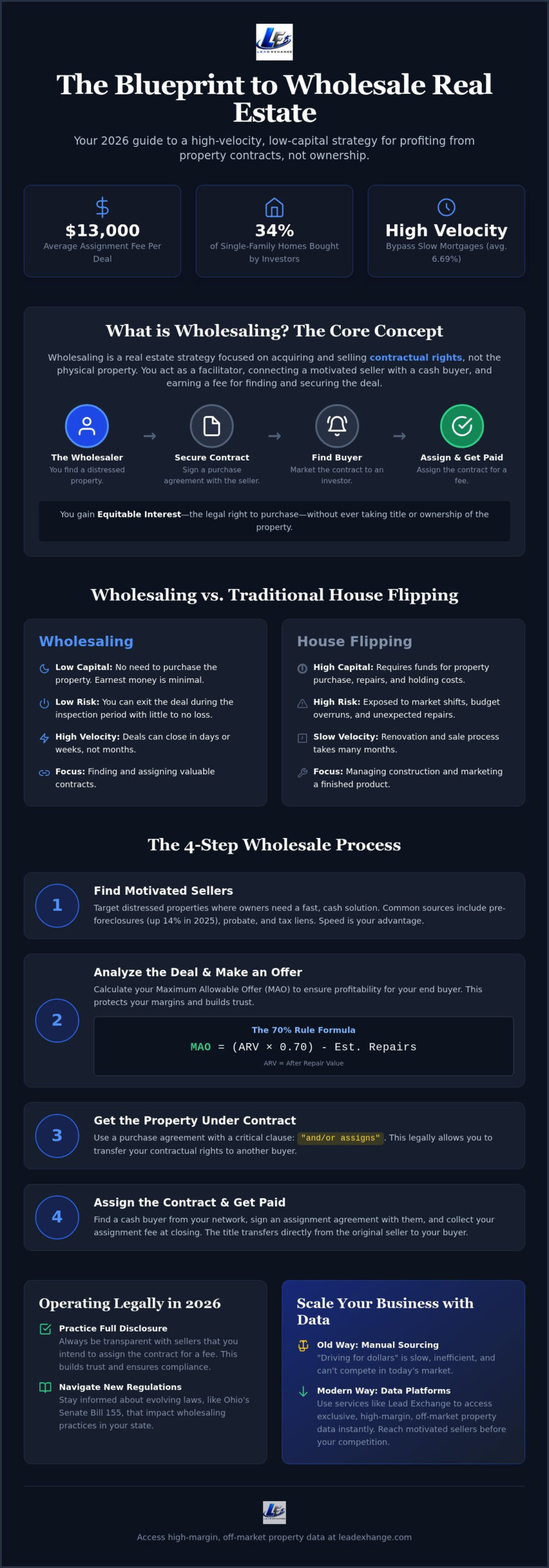
Wholesaling is a strategic maneuver, not a property purchase. To understand what is wholesale real estate, you must view it as the acquisition and sale of contractual rights. You secure a distressed property at a discount, then assign that contract to a cash buyer for an assignment fee. You never take title. You never apply for a mortgage. It’s a high-velocity model built on the principle of arbitrage.
In the 2026 market, liquidity is king. Investors prioritize this model because it bypasses the average 6.69% mortgage rates currently impacting traditional acquisitions. By focusing on the “spread”, which is the gap between your contracted price and the investor’s purchase price, you generate rapid capital growth with minimal risk. Understanding What is Wholesaling in a broader commercial context reveals that this is a proven method used across multiple industries to move assets efficiently. For those defining what is wholesale real estate for their own portfolios, the answer lies in the ability to find and control off-market value.
The Concept of Equitable Interest
When you sign a purchase agreement with a seller, you don’t own the bricks and mortar. You own the contract. This grants you equitable interest, a legal standing that allows you to market the property to an end buyer. It’s the distinction between owning a title and owning a contractual right. This mechanism allows for the transfer of the right to buy without the wholesaler ever appearing in the chain of title.
Equitable interest is the legal foundation of wholesaling, granting the wholesaler a right to the property’s value before the title transfer occurs.
The Role of the Professional Wholesaler
Professional wholesalers act as high-performance facilitators. You aren’t just a middleman; you’re a matchmaker solving two distinct problems simultaneously. For the seller, you provide a guaranteed exit from a distressed situation. For the cash buyer, you provide a pre-vetted, high-margin opportunity they wouldn’t find on the MLS.
Successful operators in 2026 distance themselves from amateurs by focusing on transparency and data. They use precise analytics to ensure the deal works for the end buyer. This professionalism builds a buyers list of repeat investors who trust the wholesaler’s numbers. It’s a business of speed, reliability, and exclusive access to off-market inventory.
The Mechanics of the Deal: Assignment of Contract Step-by-Step
Successful execution requires a methodical approach. You don’t just “find a house.” You identify a financial or situational problem and provide a liquidity solution. Understanding what is wholesale real estate in a practical sense means mastering four specific phases: sourcing, analysis, negotiation, and disposition. Each stage must be handled with precision to ensure the deal remains profitable for the end investor.
Finding Motivated Sellers and Distressed Properties
Sourcing is the engine of your business. You target properties where the owner’s need for speed outweighs their desire for a full-market price. Common pain points include pre-foreclosure, probate, or burdensome tax liens. In 2025, U.S. foreclosure filings rose by 14%, creating a significant pool of motivated sellers who need an immediate exit.
Efficiency is the differentiator in 2026. Traditional “driving for dollars” is too slow to compete with modern data tools. Professionals now rely on off-market real estate leads to skip the manual search. Accessing exclusive data in competitive hubs like Atlanta or Memphis allows you to reach sellers before they hit the open market. This speed is essential when 34% of single-family homes are being purchased by investors.
Executing the Assignment Contract
Your contract is the legal vehicle for your profit. It must contain an “and/or assigns” clause to permit the transfer of equitable interest. Without this specific language, you can’t sell your right to buy. You also need a defined inspection period. This provides a safety net to verify your repair estimates and confirm your After Repair Value (ARV) before committing earnest money.
Professionalism requires transparency. High-level operators follow what to know about real estate wholesaling guidelines by disclosing their intent to assign the contract for a fee. Once the agreement is signed, you apply the “70% Rule” to determine your Maximum Allowable Offer (MAO). Multiply the ARV by 0.70 and subtract the estimated repair costs. If your contracted price is below this number, you have a deal that will attract cash buyers.
Finally, you move to disposition. You present the deal to your buyers list. When a buyer agrees, they sign an assignment of contract and pay a non-refundable deposit. Your profit, the assignment fee, is disbursed by the title company at the final closing. With the national average assignment fee reaching $13,000 in 2026, the potential for rapid capital growth is clear. To start scaling your volume, consider accessing curated deal flow through a dedicated platform.
Wholesaling vs. House Flipping: Analyzing Risk and Capital
Investors often ask what is wholesale real estate in comparison to traditional house flipping. The difference lies in the velocity of capital. Flipping is a capital-intensive project management business. It requires long timelines and heavy construction oversight. Wholesaling is a high-speed marketing and data business. You aren’t managing a job site; you’re managing a pipeline. One strategy builds long-term equity, while the other generates immediate cash flow through contract assignments.
Capital Requirements and Entry Barriers
Entry barriers for house flipping are steep. You need significant financing, construction expertise, and the ability to carry holding costs for months. Wholesaling flips the script. Your primary expense is your marketing budget. Instead of a 20% down payment, you’re investing in data and lead acquisition. This makes the strategy accessible to “Starter” level investors who want to learn the market without taking on massive debt.
Wholesaling requires a different set of resources:
- Marketing Capital: Funds allocated for direct mail, skip tracing, or lead platforms.
- Earnest Money: Small deposits to secure your equitable interest in a property.
- Contract Knowledge: Mastery of assignment clauses and legal disclosures.
By avoiding the 30-year fixed-rate mortgage, which remains elevated at 6.69% in mid-2026, wholesalers remain agile in a shifting market.
Risk Mitigation Strategies
Risk profiles differ drastically between these two models. A flipper risks their entire credit score and capital on a single asset. If renovation costs spiral or the market dips, the loss is absolute. Wholesalers mitigate risk through the assignment mechanism. Your maximum exposure is usually limited to your earnest money deposit. In 2026, new regulations like Louisiana’s Act 807 mandate a 1% deposit, but this is still a fraction of the capital required for a full purchase.
To protect your interests, professional operators use wholesale real estate software to run precise comps and vet deals before signing. A robust buyer’s list acts as your definitive exit strategy. When you have five cash buyers ready for a distressed property in Memphis or Atlanta, your risk of a failed assignment drops to near zero. You’re simply the facilitator moving the asset to the person best equipped to renovate it.
Navigating Legalities and Identifying “The Catch” in 2026
Legality is the primary concern for those learning what is wholesale real estate. The short answer is yes, it’s legal. However, the regulatory environment in 2026 has shifted toward mandatory transparency. States are increasingly defining the line between selling a contract and brokering a property. Professionalism now requires more than just a signed agreement; it requires strict adherence to new disclosure mandates to avoid legal scrutiny.
Recent legislation highlights this trend. As of August 1, 2026, Louisiana’s Act 807 requires wholesalers to disclose their intent to assign and provides sellers a five-day cancellation window. Similarly, Ohio’s Senate Bill 155, effective March 2, 2026, mandates a separate written disclosure stating the wholesaler isn’t representing the seller. Failing to follow these rules doesn’t just risk the deal; it risks legal repercussions for unlicensed brokerage. To stay compliant, avoid “net listings” where you pocket everything above a fixed price. Instead, use a clear assignment fee or a double closing.
The Ethics of Wholesaling
The perceived “catch” in wholesaling is the discount. Critics argue it takes equity from homeowners, but this ignores the value of liquidity. Many sellers own distressed assets that can’t pass a traditional bank inspection or meet the requirements for a 6.69% mortgage. They can’t wait months for an MLS buyer or pay high commissions. Wholesalers provide an immediate exit for properties in probate or pre-foreclosure. An ethical wholesaler acts as a strategic partner for distressed homeowners by offering speed and certainty over top-market price.
2026 Regulatory Landscape
Distinguishing yourself from an unlicensed broker is critical. In cities like Detroit and Cleveland, local authorities are scrutinizing “public marketing” of properties you don’t own. If you market the house rather than the contract, you’re crossing into brokerage territory. Double closing is a common 2026 strategy to mitigate this. In a double closing, you purchase the property and immediately sell it to your end buyer. It costs more in closing fees but provides maximum privacy and legal protection.
Consulting with local real estate attorneys is non-negotiable. They ensure your contracts reflect specific city ordinances and state laws. High-growth markets like Atlanta have their own nuances regarding title transfer and escrow. Precision in your paperwork is what separates a sustainable business from a liability. For those still defining what is wholesale real estate in their local market, compliance is the foundation of longevity.
Scaling Your Wholesale Business with the Lead Exchange Platform
Scaling a business requires moving from the manual grind to a data-driven investment engine. While the fundamentals of what is wholesale real estate remain constant, your execution must evolve to maintain profitability in a competitive market. High-volume operators don’t spend their days manually searching for distressed properties. They use Lead Exchange to automate the discovery process in high-demand markets like Memphis, Jackson, and Gulfport. This shift allows you to focus on the $13,000 average assignment fee rather than the exhaustion of manual research.
The Starter plan is designed for the emerging investor. It focuses on providing the exact data points needed to secure that first contract without the overhead of a large marketing team. The Growth plan is for the established wholesaler. It targets higher volume and deeper market penetration in cities where investor competition is fierce. By leveraging this tiered approach, you align your overhead with your current deal flow while maintaining a clear path toward expansion.
Leveraging Exclusive Off-Market Data
Public leads are saturated before you even see them. By the time a property hits a public list, dozens of competitors have already made offers, driving the price up and the spread down. Lead Exchange identifies properties suitable for wholesaling before they reach the open market. This exclusive access is the only way to preserve the profit margins essential for a successful assignment in 2026.
First-mover advantage is critical when 34% of single-family homes are being purchased by investors. You need to reach the seller before the “spray-and-pray” marketers arrive. Lead Exchange provides curated off-market data that focuses on high-margin distressed properties. This precision targeting ensures that your marketing budget is spent on leads with a higher probability of conversion, maximizing your return on investment.
Implementing a High-Velocity Workflow
Automation is the differentiator between a side hustle and a professional enterprise. When you understand what is wholesale real estate at a high level, you realize it is a game of numbers and speed. The Lead Exchange Starter plan provides the foundational leads necessary for your first deal by automating the “top of the funnel” activities. This frees your time to focus on negotiation and closing, which are the highest-value tasks in your business.
Integrating lead data with your CRM allows for rapid outreach. In a market where foreclosure filings rose by 14% in 2025, the ability to respond to a motivated seller instantly is a massive competitive edge. Professionals don’t wait for leads to get cold. They use automated systems to ensure they are the first person a distressed homeowner speaks with. This high-velocity workflow is how you move from closing one deal a year to closing multiple deals every month.
Take Command of the 2026 Real Estate Market
Mastering the assignment of contract and navigating new state-specific disclosures are the dual pillars of professional success. You’ve learned that wholesaling isn’t about buying property; it’s about controlling equitable interest and moving with speed. Success in high-competition hubs like Memphis, Atlanta, and Detroit requires more than manual effort. Professional-grade data is your only competitive edge in a market where 34% of single-family homes are purchased by investors. Now that you understand what is wholesale real estate, the focus shifts from education to execution.
Lead Exchange provides the foundational leads necessary to scale your volume. Whether you’re using the Starter plan to secure your first deal or the Growth plan to dominate a market, the goal is high-velocity profit. You now have the roadmap to generate an average assignment fee of $13,000 without the risks of traditional flipping or the burden of elevated mortgage rates. Your professional-grade investment engine is ready for deployment.
The 2026 market rewards the prepared and the decisive. Secure your first exclusive lead today and start building a sustainable, scalable wholesale business.
Professional Wholesaling: Frequently Asked Questions
Is wholesale real estate legal in the United States in 2026?
Wholesaling remains legal in 2026, provided you comply with state-specific disclosure mandates. New regulations like Louisiana’s Act 807 and Ohio’s Senate Bill 155 require clear intent to assign and specific deposit minimums. As long as you’re selling your contractual interest rather than the property itself, the practice is a standard part of the real estate market. Always consult a local attorney to ensure your paperwork matches current regional statutes.
Do I need a real estate license to start wholesaling?
In most states, you don’t need a license to sell your equitable interest in a contract. However, some jurisdictions like Illinois and Oklahoma have enacted stricter rules regarding the number of deals you can close without a license. Licensing provides a layer of protection and allows for easier marketing, but the core strategy of what is wholesale real estate relies on contract law rather than brokerage law.
How much money do I need to start wholesaling real estate?
You can start with less than $1,000, primarily allocated to earnest money deposits and marketing data. Unlike house flipping, you aren’t paying for down payments or renovation costs. Your main investment is the cost of sourcing off-market leads and skip tracing. Using a structured platform allows you to focus your limited capital on high-probability distressed properties rather than broad, ineffective marketing campaigns.
What is the average assignment fee for a wholesale deal?
The national average assignment fee in 2026 is approximately $13,000. This figure fluctuates based on the market, with fees in high-growth states like Georgia or North Carolina often reaching $22,000. Your profit is the “spread” between your contracted price with the seller and the final price paid by your cash buyer. High-velocity wholesalers aim for a 40% to 50% profit margin on their business operations.
Can I wholesale a house that is listed on the MLS?
Wholesaling MLS listings is possible but challenging because agents and sellers expect market-rate offers. Distressed properties on the MLS already have high visibility, which shrinks your potential spread. Most professionals avoid the MLS in favor of off-market leads. It’s difficult to secure the deep discounts required to attract cash buyers when a property is exposed to the entire public market and 34% of active investors.
What happens if I can’t find a buyer for my wholesale contract?
If you can’t find a buyer, you must cancel the contract within your specified inspection period to avoid losing your earnest money. This is why a buyers list is critical before you sign an agreement. If the inspection period expires and you can’t perform, you risk forfeiting your deposit to the seller. Professional wholesalers always ensure their exit strategy is clear before the legal deadlines in the contract pass.
How do I find a cash buyers list for my wholesale deals?
You build a buyers list by networking at local investment clubs, searching public records for recent cash transactions, or using data platforms that track active investors. Focus on finding fix-and-flip operators who need consistent inventory. High-quality data tools can identify which investors are currently buying in specific zip codes. A strong list of five to ten reliable buyers is often more valuable than a massive list of inactive leads.
What is the difference between wholesaling and a double closing?
Wholesaling typically refers to the assignment of a contract for a fee. A double closing involves two separate transactions where you actually buy the property and immediately sell it to your end buyer. Double closings are more expensive due to dual closing costs but offer higher privacy regarding your profit. Many investors use double closings to comply with specific state regulations that restrict the public marketing of assigned contracts.
Disclaimer
The opinions and information shared on this website are for educational purposes only. Results from real estate investing and lead generation vary, and no specific outcome or profit is guaranteed