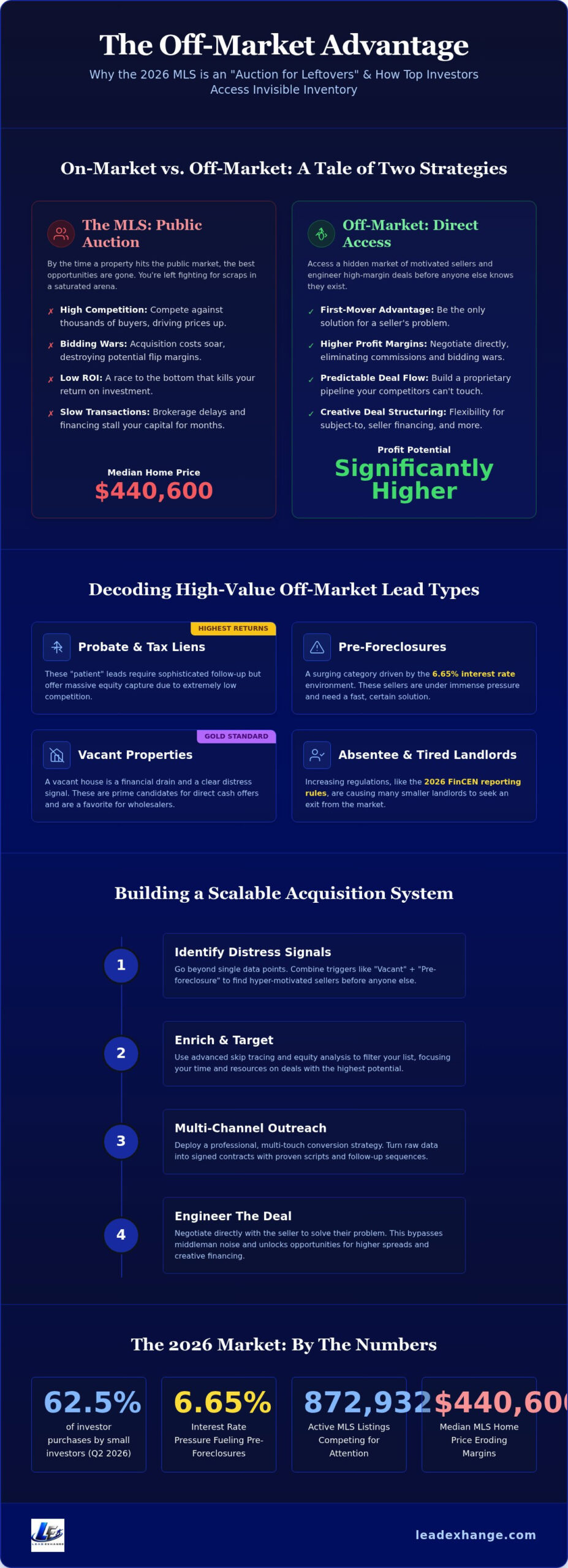
The MLS is an auction for leftovers. While active inventory reached 872,932 units this August, the “Great Lock-In” has drained the public market of high-margin opportunities. You’re likely tired of fighting for scraps against thousands of other buyers in a market where the median home price has hit $440,600. Success in 2026 requires a shift. You need to master the art of sourcing off-market real estate leads before they ever reach a public portal. This is the only way to escape the “invisible inventory” effect that keeps the best properties hidden from the masses.
You already know that the best deals aren’t found; they’re engineered through superior data and direct outreach. We’ll show you how to build a scalable acquisition system that bypasses the middleman and targets motivated sellers directly. This guide outlines the exact strategies used to generate predictable monthly deal flow and secure higher profit margins per transaction. We’ll cover everything from navigating the new FinCEN reporting rules for all-cash LLC purchases to leveraging high-performance lead marketplaces. You’re about to build a proprietary pipeline that your competitors simply cannot touch.
Key Takeaways
- Understand why the 2026 MLS is an “auction for leftovers” and how to secure high-margin deals by accessing invisible inventory.
- Identify high-intent distress signals like tax liens and probate to target properties with the highest potential for equity-rich returns.
- Master a multi-channel conversion strategy to turn raw off-market real estate leads into signed contracts using professional scripts and skip tracing.
- Scale your acquisition process by transitioning from manual outreach to high-volume systems found in the Starter and Growth tiers.
- Leverage proprietary, curated databases to bypass middleman noise and establish a predictable, monthly deal flow for your investment business.
Why the MLS is Failing Professional Investors in 2026
The MLS is no longer a viable source for high-margin acquisitions; it’s a public auction for leftovers. By the time a property appears on a national portal, the potential for a significant spread has likely evaporated. In 2026, the “Auction Effect” has reached a breaking point. Public listings are immediately flooded with offers from retail buyers, institutional funds, and amateur flippers. This saturation drives acquisition prices toward the ceiling and leaves professional investors with scraps. If you’re relying on the same data as everyone else, you’re competing on price rather than value. It’s a race to the bottom that kills your ROI.
Timing is the most critical variable in real estate. There’s a massive difference between a “listed” property and a “motivated” seller. A listed property represents a seller testing the market for the highest possible price. A motivated seller is someone looking for a fast, certain solution to a specific problem. Waiting for that motivation to manifest as an MLS listing is a strategic failure. Professional wholesalers have realized that chasing traditional listings offers a declining ROI. They’re pivoting entirely to proprietary systems to find off-market real estate leads before the rest of the market even knows they exist.
The Hidden Costs of Public Market Competition
Bidding wars don’t just increase the purchase price. They destroy your flip margins and force you to compromise on your buy-box criteria. When you buy on the public market, you’re also fighting the psychological barrier of digital valuations. Homeowners see inflated estimates online and refuse to acknowledge the reality of their property’s condition or the cost of repairs. Beyond the price, the time-to-close delays inherent in traditional brokerage transactions can stall your capital for months. Every extra day in escrow is a day your money isn’t working on the next deal. Efficiency is the primary casualty of the public market.
Off-Market Leads: The Only Path to Predictable Spreads
Securing off-market real estate leads is the only way to maintain a predictable monthly deal flow. Direct-to-seller negotiation eliminates the middleman noise and the brokerage commissions that eat into your profits. This approach often involves targeting For Sale By Owner (FSBO) properties or distressed owners who need a rapid exit. You’re looking for properties that need significant work before they’re market-ready. By engaging these sellers before they hire an agent, you establish a first-mover advantage. You aren’t just one of twenty offers; you’re the strategic ally providing a direct cash solution. This direct access allows you to engineer deals with spreads that public listings simply cannot match.
Decoding High-Value Off-Market Lead Types
Not all leads are created equal. High-performance acquisition teams categorize off-market real estate leads by the intensity of the seller’s “why.” In the current 2026 climate, pre-foreclosure leads are surging as the 6.65% interest rate environment puts pressure on variable-rate debt. However, the highest returns often come from probate and tax lien leads. These are “patient” leads. They require a sophisticated follow-up sequence, but the lack of retail competition allows for massive equity captures. When you target these niches, you’re competing on your ability to solve a problem rather than just your offer price.
Absentee owners and tired landlords represent another high-yield segment. With increasing regulatory hurdles and the March 2026 FinCEN reporting rules for all-cash LLC transactions, many smaller landlords are seeking an exit. Vacant property data remains the gold standard for wholesalers. A vacant house is a liability for the owner. It is a drain on resources and a prime candidate for a direct cash offer. In Q2 2026, small investors accounted for over 62.5% of investor purchases, proving that those who master these specific data sets can outmaneuver larger institutional players. Investors who want a deeper breakdown of how to source and convert these opportunities should review this professional guide to off-market homes for sale before building their outreach campaigns.
Identifying Real Motivation Beyond the Data
Raw data only tells half the story. To find hyper-motivated sellers, you must use multi-point distress triggers. A property that is both vacant and in pre-foreclosure is a high-priority target. Equity analysis is your second filter. While equity-rich leads offer the cleanest spreads, don’t ignore low-equity properties. These are prime candidates for creative financing or subject-to deals. One of the primary advantages of off-market real estate is the flexibility to structure these complex deals without the interference of a listing agent. You can engineering a win-win scenario that a traditional MLS listing would never allow.
The Psychology of the Distressed Seller
Successful acquisition is as much about psychology as it is about data. When dealing with probate or divorce, your approach must be professional and direct. You aren’t just a buyer; you’re a facilitator. Sellers in these positions are often overwhelmed by the logistics of a traditional sale. They value speed and certainty over a slightly higher price point. Position yourself as a problem solver. By offering a streamlined closing process and removing the need for repairs, you build the trust necessary to close. High-margin deals are won through transparency and the ability to execute quickly. For investors looking to automate this discovery process, utilizing a curated lead database can remove the guesswork from your daily outreach.
Raw data is inert without a high-performance conversion engine. Once you have identified high-intent off-market real estate leads, your focus must shift from discovery to surgical execution. Success in 2026 demands a sophisticated multi-channel approach. Relying on a single outreach method is a strategy for failure. You need to integrate professional skip tracing with a coordinated sequence of direct mail and SMS touchpoints. This multi-front strategy creates a surround-sound effect that builds brand familiarity before you even initiate a voice call.
Your initial contact scripts must avoid tired “cash buyer” clichés. Sellers are increasingly wary of generic, low-effort solicitations. Instead, lead with the specific homeowner pain points identified during your initial data filtering. If a property is vacant, address the mounting liabilities of maintenance and security. If it is a probate lead, offer a streamlined exit that simplifies complex logistics for the heirs. Speed is your greatest competitive advantage in converting off-market real estate leads into signed contracts. The 24-hour rule is non-negotiable. If you fail to respond to an inquiry within a single business day, you’ve likely lost the deal to a more agile operator. Rapid movement signals professional competence and financial readiness.
The Professional Follow-Up Framework
Persistence is the primary separator between amateur flippers and professional acquisition teams. Statistical analysis confirms that 80% of off-market deals close only after the 5th touchpoint. Most independent investors abandon the lead after the second attempt. To scale, you must automate your CRM to trigger multi-channel follow-ups without manual intervention. This ensures no motivated seller falls through the cracks while you focus on high-level negotiations. Balancing this persistence with professional, direct communication protects your brand reputation. You want to be positioned as a persistent solution to their problem, not a persistent nuisance in their inbox.
Due Diligence on the Fly
You cannot afford to wait for formal appraisals in a competitive environment. Professional investors must calculate After Repair Value (ARV) and estimate repair costs in real-time. In the 2026 labor market, fluctuating material costs and contractor premiums must be factored into every spread. Use your proprietary data to justify your cash offer to skeptical homeowners. When a seller pushes back, presenting local market trends and specific property deficiencies turns a “low” offer into a pragmatic, logical solution. This data-driven transparency bridges the gap between emotional expectations and the reality of your exit strategy.
Building a Scalable Lead Acquisition System
Manual methods like “driving for dollars” are fundamentally unscalable. They rely on your physical presence and finite time. To reach elite levels in 2026, you must replace sweat equity with data equity. High-volume wholesalers don’t wander neighborhoods; they dominate digital pipelines. Scaling requires a shift in focus toward your Cost Per Acquisition (CPA). By calculating exactly what you spend on off-market real estate leads versus the revenue generated per contract, you turn real estate into a predictable math problem. Once your CPA is stable, you can confidently increase your data spend to multiply your deal flow.
As your volume grows, your role must shift from lead generator to lead closer. This is the point where most solo investors hit a ceiling. Hiring your first acquisitions manager is a critical milestone. This hire should happen when your lead flow exceeds your ability to follow up within the mandatory 24-hour window. By delegating the initial negotiation and contract signing, you free yourself to focus on high-level strategy and disposition. A scalable system isn’t just about more data; it’s about building a machine that operates without your constant intervention. Investors seeking a comprehensive framework for sourcing off market properties for sale through proprietary data networks will find the strategic blueprint essential before scaling their acquisition teams.
Choosing the Right Subscription Tier
Efficiency starts with selecting the tier that matches your current operational capacity. The Starter plan is the entry point for individual investors or small teams targeting one to two deals per month. It provides the essential data needed to establish a consistent baseline without overwhelming your resources. The Growth tier is engineered for established teams ready to dominate their local market. It offers the high-volume data required to support multiple acquisitions managers and aggressive marketing campaigns. Evaluating ROI is simple. If a single deal yields a significant spread, the monthly subscription fee becomes a negligible cost of doing business.
Integrating Lead Data into Your Workflow
Speed and organization are the pillars of a scalable system. Your proprietary leads should sync directly with your existing marketing stack to trigger outreach sequences immediately. Use automated skip tracing to instantly find contact information for owners of vacant properties. This removes the manual research bottleneck that slows down most wholesalers. Setting up “Lead Alerts” ensures you’re the first to know when a property meeting your specific criteria enters the database. This first-mover advantage is what separates high-performance firms from those fighting for scraps. Pairing your lead data with the right wholesale real estate software ensures your outreach sequences trigger automatically and your pipeline never stalls. To begin building your high-volume pipeline, choose the subscription plan that fits your growth goals.
The Lead Exchange Advantage: Exclusive Off-Market Access
Public data has become a commodity. In a market where every amateur has access to basic property filters, proprietary data is your only remaining competitive advantage. Lead Exchange provides a specialized filter that separates generic property records from high-intent off-market real estate leads. We don’t just aggregate data; we curate opportunities specifically for the high-margin requirements of investors, wholesalers, and flippers. While traditional agents focus on market-ready listings, our systems identify the distress signals that precede a public sale. This allows you to engage sellers when they are most receptive to a direct cash solution.
Our proprietary database is built to identify “true” off-market opportunities. These are properties that haven’t been touched by the retail market or exhausted by thousands of cold calls from low-tier lead lists. By focusing on residential real estate investment, we remove the “middleman” noise that typically inflates acquisition costs. We streamline the entire journey from lead discovery to the final contract. This efficiency is vital in 2026, where speed to lead determines who secures the spread and who loses out to institutional competition. Lead Exchange acts as your strategic ally, providing the high-level data you need to maintain a dominant market position.
Our Results-Oriented Approach
Success in real estate acquisition requires professional confidence and reliable data. We provide direct-to-seller information that bypasses the friction of the public market. This approach allows you to build a business based on predictable results rather than market luck. Top wholesalers trust Lead Exchange because we remove the traditional obstacles to acquisition, such as outdated contact info and low-intent data. Our focus is on providing actionable intelligence that leads directly to signed contracts and high-margin off-market real estate leads. We empower you to spend less time sorting through spreadsheets and more time closing deals.
Next Steps: Securing Your Exclusive Territory
The path to a scalable acquisition system starts with choosing the right data volume for your goals. If you are testing local market dynamics or aiming for one to two deals per month, the Starter plan provides the perfect entry point. It offers a curated selection of leads designed to establish your baseline deal flow. For teams ready to implement national-level strategies or high-volume wholesaling, the Growth tier delivers the necessary scale. Both plans are engineered to integrate seamlessly with your workflow, ensuring you remain the first mover in your target sectors. Don’t wait for the MLS to deliver scraps. Secure your access to exclusive off-market leads today at leadexchange.com and start engineering your own high-margin deals.
Dominate the 2026 Market with Proprietary Data
The era of finding high-margin deals on the public MLS is over. To maintain a predictable deal flow in 2026, you must pivot to a data-driven acquisition strategy. Success requires identifying distress signals early and engaging sellers before they enter the retail market. By mastering specific conversion frameworks and automating your follow-up, you transform your operation from a manual hustle into a scalable investment machine. You’ve seen the value of targeting equity-rich leads and the necessity of rapid execution.
Lead Exchange is your no-nonsense professional partner in this high-stakes environment. We provide the off-market real estate leads you need to bypass middleman noise and secure higher spreads. With tiered plans like Starter and Growth, our proprietary database supports your business at every stage of expansion. It’s time to stop fighting for scraps and start engineering your own opportunities. Take control of your acquisition pipeline and build the portfolio you deserve. Start sourcing exclusive off-market deals with Lead Exchange today and outpace the competition.
Frequently Asked Questions
What exactly are off-market real estate leads?
Off-market real estate leads are properties available for purchase that aren’t listed on the Multiple Listing Service (MLS) or public real estate portals. These opportunities are identified through proprietary data signals such as pre-foreclosure status, tax liens, or probate filings. Accessing these leads allows you to negotiate directly with homeowners, bypassing the bidding wars and high competition common in the retail market.
How often is the Lead Exchange database updated?
Our database is updated continuously to ensure you’re working with the most current distress signals and property information. We prioritize data freshness to give our users a first-mover advantage in high-demand residential sectors. By filtering out stale records, we enable your team to focus their outreach efforts on homeowners who have an immediate need for a cash solution.
Is wholesaling real estate legal in all states in 2026?
Wholesaling remains legal in 2026, though it’s subject to increasingly strict state-specific regulations and disclosure requirements. For instance, Washington state law RCW 61.40.010 now requires an appraisal contingency for unsolicited offers on unlisted properties under certain conditions. You must ensure your contracts and marketing methods comply with the most recent local laws and the 2026 NAR Code of Ethics regarding compensation disclosure.
What is the difference between the Starter and Growth plans?
The Starter plan is designed for individual investors or small teams targeting one to two deals per month. It provides the essential data needed to establish a consistent acquisition pipeline. The Growth plan is engineered for established firms requiring a higher volume of off-market real estate leads to support multiple acquisitions managers and aggressive, multi-market marketing strategies.
How do I know if a property lead is truly ‘motivated’?
Motivation is confirmed by analyzing multi-point distress triggers, such as a property being both vacant and facing a tax lien. A truly motivated seller is someone who values the speed, certainty, and convenience of a direct sale over the potentially higher price of a long-term market listing. Our curated data identifies these “why” factors so you can lead your outreach with a specific solution to the homeowner’s problem.
Can I use Lead Exchange for both flipping and buy-and-hold strategies?
Yes, our data is optimized for any residential investment strategy that relies on high-margin acquisitions. Whether you’re seeking deep-discount properties for a fix-and-flip or equity-rich homes to add to a long-term rental portfolio, these leads provide the spreads necessary for success. Eliminating brokerage fees and retail competition makes off-market real estate leads ideal for any investor focused on maximizing their ROI.
Do I need a real estate license to use these leads for wholesaling?
You don’t need a license to access our database, but whether you need one to wholesale depends on your state’s specific “activity” definitions. In 2026, more jurisdictions are requiring licenses for those who publicly market equitable interest in multiple contracts. It’s vital to consult with local legal counsel to determine if your specific volume and method of operation require a real estate license in your target market.
What is the typical ROI for a Lead Exchange subscription?
ROI is typically achieved with your first successful contract. Because off-market deals often trade at a significant discount to current MLS values, the spread on a single transaction usually exceeds the cost of a subscription by a substantial margin. Your total return depends on your team’s ability to follow the 24-hour response rule and maintain a professional follow-up sequence through at least five touchpoints.
Disclaimer
The opinions and information shared on this website are for educational purposes only. Results from real estate investing and lead generation vary, and no specific outcome or profit is guaranteed