While most investors fight for scraps on the MLS, over 10% of home sales are now happening entirely behind closed doors. Public market margins are shrinking as bidding wars drive prices beyond logic. Relying on manual lead generation is a slow path to stagnant growth in a market that demands speed and precision. Finding quality off-market homes for sale requires a shift from traditional searching to strategic acquisition.
You deserve a proprietary stream of motivated sellers that protects your spreads on every wholesale and flip deal. This guide provides the blueprint to secure high-margin real estate opportunities before they ever reach the public eye. We focus on results; showing you how to automate lead sourcing and eliminate the friction of over-saturated listings. You’ll learn how to move from chasing leads to closing exclusive contracts.
We’ll analyze the impact of the March 2026 FinCEN reporting rules on all-cash transactions and discuss navigating the current 6.65% interest rate climate. You will learn to leverage data-driven PropTech to identify exclusive deals with surgical accuracy. This is the professional standard for scaling your portfolio and securing a competitive advantage in a stabilizing market.
Key Takeaways
- Master the shadow inventory concept to access properties sold entirely outside of traditional MLS channels.
- Protect your profit margins by eliminating public market competition through direct, one-on-one seller negotiations.
- Deploy high-volume sourcing strategies to identify off-market homes for sale before they attract institutional attention.
- Conduct professional-grade due diligence by verifying property liens and ownership through specialized data streams.
- Scale your investment volume using automated lead generation tools tailored for wholesalers and house flippers.
Understanding Off-Market Homes for Sale: Beyond the MLS
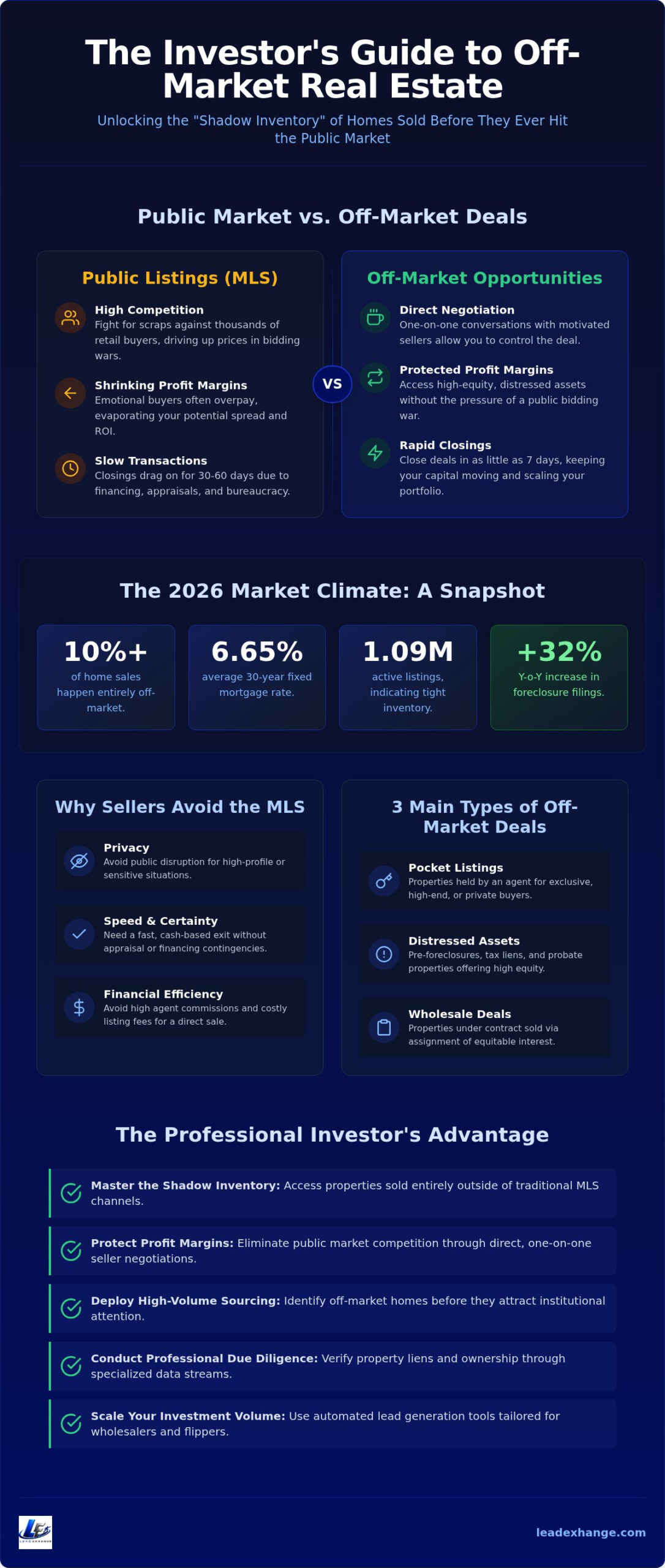
Off-market homes are properties sold outside the public eye. They never touch the Multiple Listing Service (MLS). This “shadow inventory” represents a massive portion of the real estate market that retail buyers never see. For professional investors, this is where the real work happens. Public markets are often over-saturated and low-margin. Off-market deals allow for direct negotiation and higher spreads. You aren’t competing with thousands of people; you’re solving a specific problem for a seller.
The 2026 housing market is in a cooling phase. With mortgage rates hovering around 6.65% for a 30-year fixed loan, many buyers are sidelined. However, inventory remains tight at roughly 1.09 million active listings. This creates a bottleneck in the public sector. Finding off-market homes for sale is no longer a luxury; it’s a survival strategy for serious investors. You can’t rely on retail listing alerts when competition is this fierce. You need exclusive access to properties before they hit the open market and trigger a bidding war.
The Three Main Types of Off-Market Deals
Investors usually target three specific categories of non-public inventory. Each offers unique advantages for different exit strategies. A Pocket listing is a property held by an agent for exclusive buyers. These aren’t advertised to the general public and often involve high-end or sensitive assets. Distressed assets include pre-foreclosures, tax liens, and probate properties. Foreclosure filings saw a 32% year-over-year increase in early 2026, creating a surge in these high-equity opportunities. Finally, wholesale houses for sale involve properties already under contract by other investors, sold via equitable interest through an assignment of contract.
Why Sellers Choose to Stay Off-Market
Sellers often have pragmatic reasons for avoiding the MLS. It isn’t always about the highest price; it’s often about the easiest process. Privacy is a major factor. High-profile sellers or those in sensitive situations don’t want strangers wandering through their homes. Speed and certainty also drive these decisions. Many off-market sellers need a fast, cash-based exit. They don’t want to wait for buyer financing or appraisal contingencies that might fall through. Financial efficiency is the final piece. Selling off-market can help owners avoid high agent commissions and the cost of traditional listing fees, providing a direct path to a closing without the public theatre of a retail sale.
Why Investors Prioritize Off-Market Real Estate Over Public Listings
Public listings are a battleground for retail buyers. Professional investors avoid the noise. The primary reason is control. When you source off-market homes for sale, you eliminate the friction of multiple-offer situations. One-on-one negotiations allow you to focus on the seller’s specific pain points rather than just the purchase price. This direct access often results in lower acquisition costs and cleaner contracts. You aren’t just a number in an inbox; you are a solution provider.
Speed defines success in high-stakes investing. Traditional MLS transactions often drag on for 30 to 60 days due to bank approvals and bureaucratic delays. Off-market deals can close in as little as seven days. This rapid turnaround is essential for wholesalers and flippers who need to keep capital moving. By removing the middleman, you customize closing dates and contingencies to fit your specific timeline. It’s a more efficient way to operate.
The Financial Advantage: Spreads and ROI
Profit margins on the MLS are under constant pressure. Retail buyers, driven by emotion, frequently overpay for properties. Off-market deals offer significantly higher equity potential because they often involve distressed assets or motivated sellers. These properties provide the renovation upside required for a successful “Buy, Rehab, Rent, Refinance” (BRRRR) strategy. Using targeted investor strategies for off-market properties allows you to find these gems before they are polished for the public market. You reduce your marketing overhead by focusing on high-intent lead lists rather than broad, expensive campaigns. This precision increases your overall return on investment.
Bypassing the Bidding War
The “highest and best” offer request is the enemy of profit. In high-demand markets, public listings trigger bidding wars that evaporate your spread. Professional investors prioritize building direct rapport with sellers. This human connection often secures a deal even if a higher offer exists elsewhere. Sellers value certainty and simplicity. By avoiding retail platforms, you stay away from the traps of public sentiment and inflated valuations. You can access high-margin deals by focusing on data-driven sourcing instead of public auctions. This strategy ensures you only enter deals where the numbers actually work. It’s about protecting your bottom line from the volatility of the retail market.
Top Strategies for Sourcing Off-Market Inventory in 2026
Scaling a real estate portfolio in 2026 requires more than just local connections. It demands a systematic approach to data. Finding off-market homes for sale is now a competition of technology rather than shoe leather. Successful investors use proprietary lead databases to bypass the public market entirely. These platforms aggregate distressed signals, such as the 32% increase in foreclosure filings recorded in January 2026, to identify opportunities before they become public knowledge. You need a pipeline that moves as fast as the market does.
Direct-to-seller marketing remains a cornerstone of high-volume acquisition. However, it’s only effective when backed by precision data. Combining targeted mailers with digital outreach ensures your message reaches the right owner at the right time. Leveraging SaaS platforms allows you to automate this discovery process, freeing your time for negotiation rather than manual searching. This transition from manual labor to automated systems is the hallmark of a professional operation.
Data-Driven Sourcing vs. Manual Searching
Driving for dollars is an inefficient use of time in a modern market. It’s a low-yield strategy that can’t compete with predictive analytics. Modern systems analyze thousands of data points to pinpoint motivated sellers who are likely to trade at a discount. Skip tracing is the professional practice of cross-referencing public and private databases to identify the current contact information of elusive property owners. With over 92% of real estate companies now utilizing AI for data analytics, manual searching has become a liability. You need to leverage these tools to maintain your competitive edge.
Networking with Industry Insiders
Professional networking should focus on high-yield partnerships rather than casual groups. Probate and divorce attorneys are excellent sources for consistent lead flow. These professionals manage assets that must be liquidated quickly, often regardless of market fluctuations. Specialized wholesalers also provide a vital service by offering pre-vetted deals that fit your specific criteria. Building a repeatable pipeline of wholesale houses for sale at 60-70% of after-repair value is the most reliable way to sustain high-volume acquisition. In the high-end market, pocket listing agents remain essential. They control access to exclusive inventory that never reaches the public. Building these relationships ensures a steady stream of off-market homes for sale that meet your margin requirements. The new FinCEN reporting rules effective March 1, 2026, add a layer of due diligence to all-cash deals, making professional partnerships even more critical for compliance and speed.
Due Diligence: How to Evaluate Off-Market Deals
Buying off-market requires a forensic approach. You lack the safety net of a public listing’s disclosures. Verifying property ownership and lien status through public records is the first line of defense. Hidden encumbrances can evaporate your profit margins instantly. You must identify every stakeholder and debt obligation before signing a contract. This is especially true for wholesale assignments where you are stepping into another investor’s shoes. Accuracy is your only protection in this high-stakes environment.
Calculating the After Repair Value (ARV) is more complex without the convenience of MLS comparables. You need to rely on county recorder data and specialized investor software to find “sold” prices. Estimating renovation costs requires a standardized checklist to avoid expensive surprises. Professional investors don’t guess; they calculate. Protecting your spreads means building in a 10% to 15% contingency for unforeseen repairs. This disciplined evaluation separates high-performers from those who struggle to break even on off-market homes for sale.
The 5-Step Evaluation Framework
Success depends on a repeatable process. Start by confirming the seller’s motivation and timeline. A seller who needs to close in ten days offers different leverage than one who is simply testing the market. Conduct a preliminary title search early to uncover hidden encumbrances. Run your comparables using data from the last six months within a half-mile radius. Use these figures to calculate your Maximum Allowable Offer (MAO). This formula should account for the current 6.65% interest rate environment to ensure the deal remains profitable for the end buyer. Finally, secure the contract with clear terms regarding assignment rights and inspection periods.
Risk Mitigation in Off-Market Buying
Professional inspections are mandatory. Even in a fast-paced cash deal, you must know the structural integrity of the asset. Skipping this step is a gamble, not an investment. Clear title is non-negotiable. Always close through a reputable title company or real estate attorney. They provide the necessary insurance to protect your capital from future claims. Compliance is also a shifting target. Effective March 1, 2026, a new FinCEN reporting rule requires beneficial ownership information for all-cash residential purchases made through legal entities like LLCs and trusts. This adds a critical layer of due diligence to your closing process. You can scale your portfolio safely by using vetted data that simplifies this entire due diligence workflow.
Scaling Your Portfolio with Lead Exchange Exclusive Data
Speed to lead is the primary differentiator for professional investors in 2026. While retail buyers wait for public alerts, the Lead Exchange SaaS platform provides real-time access to high-intent opportunities. This system intercepts off-market homes for sale before they attract institutional attention or trigger public bidding wars. Our platform processes distressed property signals, such as the 32% year-over-year increase in foreclosure filings seen in early 2026, with surgical precision. You move from lead discovery to a closed contract with minimal friction and maximum efficiency. We provide the technical evaluation frameworks that competitors lack, ensuring every lead you pursue meets your Maximum Allowable Offer (MAO) criteria.
Starter vs. Growth: Which Subscription Fits Your Strategy?
We offer tiered solutions to match your specific operational scale. The Starter plan is engineered for individual flippers and emerging wholesalers who need a reliable stream of vetted leads without the overhead of a dedicated research team. It provides the foundational data required to secure high-margin Off-Market Investment Deals. The Growth plan is the standard for professional investment firms requiring high-volume data and advanced filtering capabilities. This tier maximizes your ROI by replacing manual, time-consuming lead generation with automated discovery. In a market where active listings have plateaued at 1.09 million homes, exclusive data is your most valuable asset. You don’t have time to waste on manual searches when institutional investors are retreating from the market, leaving 92% of the sector to agile, data-driven players.
The Lead Exchange Advantage
Accessing proprietary leads is the only sustainable way to protect your spreads as home values stabilize. Our data includes pre-foreclosures, probate properties, and tax liens that never reach public eyes. We simplify the Direct Cash Home Buying process by delivering the contact information and property metrics you need to bypass traditional obstacles. This streamlined workflow allows you to scale your acquisition volume without increasing your manual workload. With the new FinCEN reporting rule effective March 1, 2026, having a transparent, data-backed sourcing process is essential for compliance in all-cash transactions involving LLCs and trusts. It’s time to stop chasing leads and start closing them. Scale your acquisitions with the Lead Exchange Growth Plan to secure your competitive advantage and dominate the off-market homes for sale sector.
Dominate the Market with Data-Driven Acquisition
The 2026 real estate landscape rewards those who prioritize speed and exclusive access. You’ve seen why relying on public listings is a race to the bottom for your profit margins. By mastering the evaluation frameworks and sourcing strategies discussed, you can secure off-market homes for sale with confidence. Professional investing isn’t about working harder; it’s about leveraging superior data to eliminate competition. Success requires a shift from chasing leads to executing high-margin contracts through a systematic pipeline.
Lead Exchange provides the infrastructure you need to scale. Our proprietary lead database offers national coverage for US acquisitions, ensuring you never miss a distressed opportunity. Whether you’re an individual flipper or a high-volume firm, our tiered plans match your specific growth trajectory. Stop competing for retail scraps and start building real wealth through exclusive inventory. High-stakes success is within your reach when you have the right tools in your corner.
Access Exclusive Off-Market Leads Now
Expert Insights: Off-Market Real Estate FAQs
Are off-market homes for sale legal to buy?
Yes, buying off-market is entirely legal and represents a standard practice for professional investors. These are private transactions between a buyer and a seller that occur outside the public Multiple Listing Service. You must still comply with all federal regulations, including the FinCEN reporting rule effective March 1, 2026, which requires beneficial ownership information for all-cash purchases made through legal entities like LLCs.
How do I find off-market listings in 2026?
Leverage data-driven SaaS platforms to identify motivated sellers before they list publicly. The 2026 market moves too quickly for manual searching or “driving for dollars.” Systems that track distressed signals, such as the 32% increase in foreclosure filings recorded in early 2026, provide the speed and precision necessary to secure off-market homes for sale before your competition even knows they exist.
What are the risks of buying a house off-market?
The primary risks include hidden title encumbrances and structural defects that aren’t publicly disclosed. Since these properties don’t undergo the standard MLS vetting process, you’re responsible for your own forensic due diligence. It’s essential to hire professional inspectors and close through a reputable title company to ensure you receive a clear title and a sound investment asset.
Do I need a real estate agent to buy an off-market property?
You don’t need an agent to buy off-market, but you must handle the technical details of the transaction yourself. Most professional investors work directly with sellers or through wholesalers to keep costs low and negotiations direct. However, it’s critical to use a real estate attorney or a specialized title company to manage the contract and ensure the closing is legally compliant.
How much cheaper are off-market homes compared to the MLS?
Discounts typically range from 10% to 30% below retail market value depending on the seller’s specific motivation. You aren’t paying for the convenience of a polished public listing or the overhead of high agent commissions. Sellers are often willing to trade equity for a fast, cash-based closing and the removal of traditional inspection or appraisal contingencies.
What is the difference between a pocket listing and a wholesale deal?
A pocket listing is a property an agent keeps off the MLS to show exclusively to their private network of buyers. A wholesale deal involves an investor who has secured a property under contract and is selling their equitable interest to you for a fee. Both are reliable methods for finding off-market homes for sale with high equity potential.
How do I verify the value of a house if it is not on public listing sites?
Use county recorder data and professional investor software to analyze actual “sold” prices in the immediate area. Consumer-facing valuation tools are often inaccurate for distressed or unlisted properties that haven’t been on the market recently. Pulling recent comparables from the last six months ensures your After Repair Value (ARV) calculations reflect current market stabilization trends accurately.
Can I use a mortgage to buy an off-market home?
It’s possible, but traditional financing is often too slow for these high-speed transactions. Most off-market sellers prioritize certainty and speed, favoring cash or hard money offers that can close in days. Additionally, many off market properties for sale don’t meet the strict habitability requirements of conventional lenders, making cash the more effective tool for professional acquisition.
Disclaimer
The opinions and information shared on this website are for educational purposes only. Results from real estate investing and lead generation vary, and no specific outcome or profit is guaranteed