The MLS has become a graveyard for real estate profit. While retail buyers fight over scraps and drive up prices, elite investors have already moved on to a more lucrative arena. Finding high-quality off market properties for sale requires you to step outside the public eye and into proprietary data networks. You’re likely tired of wasting hours on dead-end leads or losing deals to aggressive retail buyers who don’t care about margins. It’s a frustrating cycle that stalls your growth and kills your momentum.
We agree that the current market landscape demands a more strategic approach, especially as new federal regulations like the 21st Century ROAD to Housing Act shift the competitive balance. This guide provides the blueprint to bypass the noise and access high-margin deals using professional lead databases. You’ll discover how to automate your sourcing and build a consistent stream of distressed property leads that your competitors never see. We will preview the specific tools and tactics needed to secure a higher ROI per deal and scale your investment business with surgical precision.
Key Takeaways
- Identify high-intent distressed lead categories, including pre-foreclosure and probate, to secure deals before they reach the public market.
- Transition from manual labor to systematic sourcing to access exclusive off market properties for sale with minimal overhead.
- Eliminate the ‘Retail Trap’ by bypassing competitive bidding wars that typically erode investor ROI on the MLS.
- Implement professional due diligence and rigorous title searches to mitigate risks associated with distressed asset acquisitions.
- Scale your portfolio efficiently by leveraging proprietary data platforms to automate your lead generation and deal flow.
Why the MLS is a Deal Graveyard for Real Estate Investors in 2026
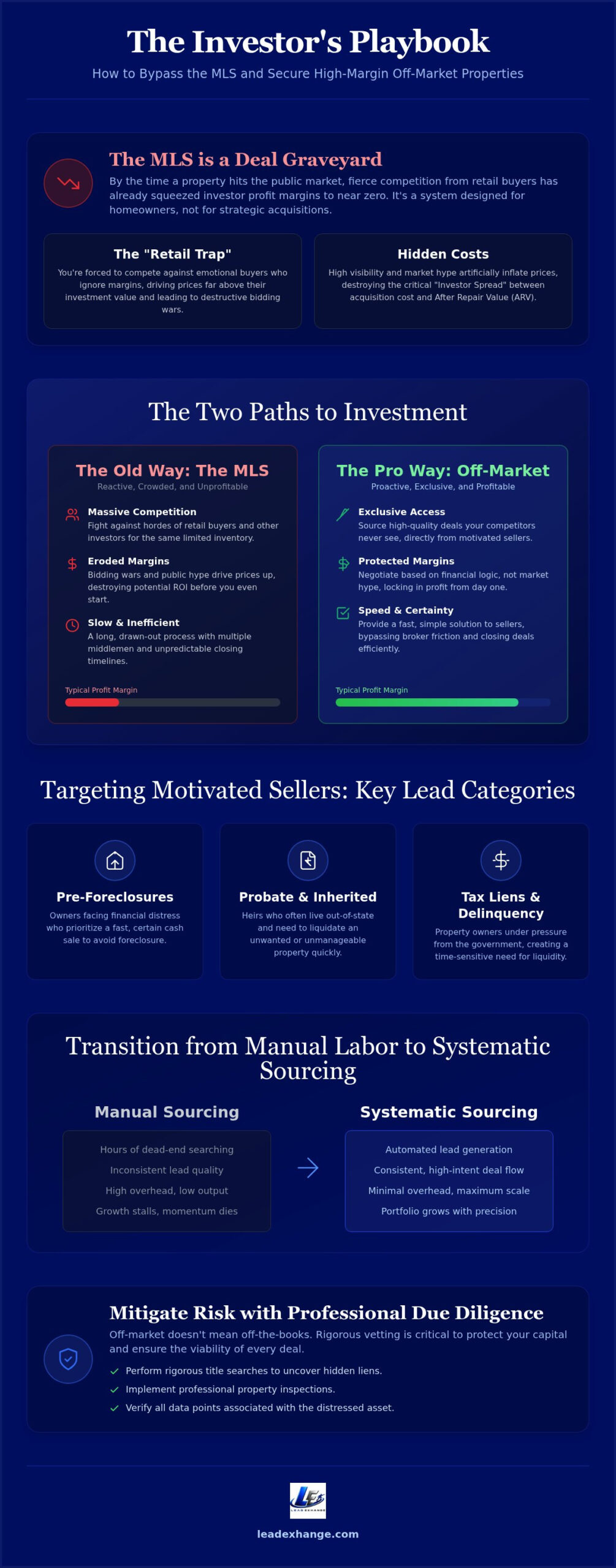
The Multiple Listing Service (MLS) is no longer the primary engine for investment growth. It’s a crowded marketplace designed for retail buyers, not professional acquisition strategies. In the current market, the MLS functions as a graveyard for profit. By the time a property hits the public feed, the margins have already been squeezed by high visibility and retail competition. Off-market properties are residential assets sold entirely outside this public system. They represent the only way to secure high-yield deals in a landscape where traditional inventory remains historically tight.
The “Retail Trap” is the biggest threat to your ROI. When you bid on public listings, you compete against families who prioritize emotional attachment over net operating income. These buyers don’t care about your flip margins or rental caps; they just want a home. This emotional bidding drives prices to levels that destroy professional spreadsheets. In 2026, while inventory levels have risen 20% above last year’s lows, the demand for quality assets still outstrips supply. This makes proprietary data more valuable than it has ever been. Finding off market properties for sale allows you to negotiate directly with motivated sellers. You remove the middleman, eliminate the bidding war, and lock in a price based on raw financial logic.
Off-Market vs. Pocket Listings: Knowing the Difference
Distinguishing between these two categories is vital for your bottom line. Pocket listings are properties held exclusively within a broker’s private network. While they offer more privacy than the MLS, they aren’t truly off-market. You’re still dealing with agent commissions and broker-controlled access. True off-market deals are direct-to-seller. These leads offer deeper discounts because they lack the friction of brokerage fees and public scrutiny. This strategy is similar to purchasing off-plan property; you’re securing the asset before it’s fully exposed to the general market. True exclusivity requires sourcing leads that no one else has seen yet.
The Hidden Costs of Public Real Estate Listings
Public listings carry financial burdens that don’t appear on the closing statement. Time-on-market is a primary factor. High visibility triggers a “herd mentality” that artificially inflates the price. Retail buyers often ignore structural issues or deferred maintenance because they’re caught in the heat of a bidding war. This behavior destroys the “Investor Spread,” which is the critical gap between your acquisition cost and the After Repair Value (ARV). When you source off market properties for sale, you protect this spread. You acquire assets based on distress factors, such as probate or tax liens, rather than market hype. This ensures your profit is built into the purchase price from day one.
The Mechanics of Sourcing Off-Market Properties for Sale
Successful acquisition isn’t a matter of luck; it’s a matter of infrastructure. While amateur investors wait for listings to appear on public sites, professionals use data science to identify off market properties for sale before the owner even considers a Realtor. This proactive approach relies on targeting specific “Distressed Lead” categories. Pre-foreclosures, probates, and tax liens represent high-intent opportunities where the seller’s priority is a fast exit rather than a top-market price. Understanding off-market investments requires a shift from browsing to hunting. You aren’t looking for a house; you’re looking for a problem you can solve with liquidity.
The Direct-to-Seller marketing funnel is the engine of this strategy. It bypasses the noise of the public market by reaching owners at the exact moment their motivation peaks. In 2026, speed-to-lead has become the most critical metric for success. With institutional investors facing new restrictions under the ROAD to Housing Act, individual investors have a unique window to act. You need to be the first person to offer a solution. If you’re second, you’re irrelevant. Predictive analytics now allow you to spot these trends months in advance, giving you a strategic head start over the rest of the market when looking for off market properties for sale.
Targeting Motivated Sellers: The Professional Approach
Motivated sellers value certainty and speed over everything else. They’re often dealing with inherited properties they can’t maintain, urgent relocations, or mounting financial distress. These pain points create a psychological state where a traditional 30-day closing is a liability. Cash offers are your primary weapon here. They remove the friction of bank appraisals and inspection contingencies that often kill MLS deals. By providing a guaranteed, fast closing, you offer a service that retail buyers simply can’t match. This direct negotiation allows you to secure deep discounts while solving the seller’s immediate crisis.
The Evolution of Real Estate Lead Generation
The industry has moved far beyond the manual era of “driving for dollars.” While knocking on doors still works for some, it’s an inefficient use of your most valuable asset: time. Modern SaaS platforms have democratized access to institutional-grade data. You can now filter entire zip codes for high-equity, distressed owners in seconds. A curated lead is a high-intent seller profile vetted for accuracy and motivation. This automation transforms your business from a manual search into a systematic acquisition machine. If you want to scale without the labor-intensive grind, you should explore curated lead databases that do the heavy lifting for you.
Proprietary Databases vs. Manual Sourcing: A Performance Comparison
Manual sourcing is a high-friction grind. It relies on brute force: cold calling, door knocking, and “driving for dollars” to find off market properties for sale. This active approach is limited by your physical energy and the hours in your day. Systematic sourcing, powered by SaaS platforms, shifts the burden from your calendar to a database. It allows you to filter thousands of records in seconds, identifying high-intent sellers based on real-time distress signals. You don’t have to hunt for the needle when the system hands you the haystack’s most valuable assets.
The hidden labor costs of manual work often go uncalculated. If you spend twenty hours a week chasing dead leads, you’re losing thousands in potential deal-making time. This creates a hard ceiling on your growth. You can’t scale a business that requires your physical presence at every front door. Professional platforms like Lead Exchange provide the competitive edge needed in 2026 by delivering high-margin opportunities directly to your dashboard. This removes the manual bottleneck and allows you to focus on closing deals rather than finding them. High-volume wholesalers who want to maximize their pipeline should review the complete breakdown of wholesale houses for sale and 2026 off-market sourcing strategies to understand how top operators are structuring their deal flow this year.
The ROI of SaaS Subscription Plans for Investors
A monthly subscription fee isn’t an expense; it’s a replacement for a bloated marketing budget. Traditional direct mail campaigns often cost thousands per month with no guarantee of a response. In contrast, proprietary database access provides immediate targets at a fraction of the cost-per-lead. New investors can utilize the Starter plan to secure their first few deals without massive overhead. Established firms use the Growth plan to fuel high-volume operations, ensuring a consistent pipeline of off market properties for sale. You pay for the precision, not the volume of mailers sent.
Data Accuracy and Lead Freshness
Stale data is the silent killer of investment ROI. Free forums or low-cost public lists are often cluttered with properties already under contract or sellers who have already resolved their distress. Professional lead exchanges use a rigorous vetting process to ensure exclusivity and accuracy. This prevents you from wasting resources on “dead” leads. Verified data ensures that every contact you make is with a seller who actually needs a solution. This maximizes your conversion rate and protects your most valuable asset: your time. You aren’t just buying data; you’re buying a vetted path to a high-margin closing.
Professional Due Diligence: 7 Red Flags When Buying Off-Market
Speed is essential, but negligence is fatal. Securing off market properties for sale requires a specialized vetting framework that differs from traditional retail transactions. Because these deals often involve distressed situations, the risk profile is higher. You aren’t just buying a building; you’re inheriting the owner’s legal and financial history. Professional due diligence ensures you capitalize on the opportunity without walking into a liability trap.
Title searches are non-negotiable in this sector. Distressed assets frequently carry hidden baggage like mechanic’s liens, unpaid property taxes, or secondary mortgages. If you don’t clear the title before closing, these debts become your problem. You also need to verify seller motivation with surgical precision. Ask direct questions about their timeline and specific needs. This allows you to confirm they are truly motivated without revealing how much you’re willing to pay. Keep your leverage intact while ensuring the deal is legitimate.
Calculating the “Spread” is the final hurdle. The purchase price is merely the first number in a complex equation. You must account for holding costs, repair estimates, and closing fees to determine the actual ROI. Professional investors focus on the After Repair Value (ARV) minus a safety margin. If the numbers don’t support a high-margin exit, walk away. Investors operating in competitive markets can use an Off-Market Property Calculator to reverse-engineer their maximum allowable offer and validate the spread before committing to any deal. Rehab investors in particular should use a dedicated Fix and Flip Calculator to analyze Atlanta rehab deals and ensure every line item from holding costs to repair estimates is accounted for before making an offer. To ensure you’re only analyzing high-quality opportunities, you can access vetted off-market leads that have already undergone initial screening.
The Essential Off-Market Checklist
Efficiency requires a standardized process. Follow these three steps to validate any private deal quickly:
- Step 1: Verify ownership and lien status immediately. Use a title company or professional database to confirm the person selling the property actually has the legal right to do so.
- Step 2: Conduct a rapid physical or virtual inspection. Focus on major structural issues, roofing, and HVAC systems. These are the deal killers that can instantly evaporate your projected profit.
- Step 3: Compare the deal against recent off-market comps. Don’t use MLS list prices as your benchmark. Look at what other investors are actually paying for similar off market properties for sale in that specific neighborhood.
Identifying Red Flags in Private Deals
Protect your capital by recognizing these critical warning signs early in the negotiation:
- Unclear title or undisclosed heirs: Missing relatives or probate disputes can freeze your capital indefinitely.
- Refusal of inspections: If you can’t see the property, assume it has catastrophic structural defects.
- Urgent wire requests: Pressure to send money before receiving a signed contract is a hallmark of a scam.
- Unverifiable ownership: If the seller’s name doesn’t match the tax records, stop the deal immediately.
- Inconsistent stories: Changing explanations for why the property is being sold suggest hidden legal or structural trouble.
- Unrealistic price points: A deal that is significantly below the local investor average often masks a major liability.
- Pressure to bypass escrow: Always use a neutral third party for the exchange of funds and documents to prevent fraud.
Scaling Your Portfolio with Lead Exchange Proprietary Data
Lead Exchange functions as the definitive catalyst for your financial success. It bridges the gap between manual searching and professional acquisition. By utilizing a streamlined, data-driven process, you stop acting as a researcher and start operating as an acquirer. This platform removes the traditional obstacles that stall most investors. You no longer have to spend your days filtering through low-margin public listings or chasing unvetted leads. Instead, you focus entirely on the bottom line: closing deals and growing your net worth.
Transitioning from a hobbyist to a professional acquirer requires a repeatable system. You cannot scale a business based on luck or manual effort. Lead Exchange provides the infrastructure needed to find off market properties for sale with surgical precision. This systematic approach ensures your pipeline remains full regardless of broader market fluctuations. It allows you to move with the speed and confidence of an elite investor. You spend your time negotiating contracts rather than scraping data, which is the only way to achieve high-volume growth in the 2026 real estate landscape.
Choosing the Right Subscription Tier
Your choice of plan should mirror your immediate business objectives. The Starter plan is built for investors looking to secure their first one or two deals per month. It provides the essential access needed to break into the off-market sector without excessive overhead. For those running high-volume wholesaling operations, the Growth plan is the professional standard. It delivers the lead volume necessary to fuel a multi-deal monthly pipeline. Both tiers eliminate the need for cold calling or manual data scraping, allowing you to bypass the friction of traditional lead generation.
Getting Started with Exclusive Leads
System setup is the first step toward automation. Once you configure your profile, the platform delivers the most relevant investment deals directly to your dashboard based on your specific criteria. This ensures you only see off market properties for sale that fit your portfolio strategy. In this high-stakes environment, rapid response is your greatest competitive advantage. When a new lead hits your system, the window for a high-margin deal is open. Professionals who act with decisiveness and speed consistently outperform the rest of the market. To begin your transition into professional acquisition, access exclusive off-market real estate leads with Lead Exchange today.
Dominate Your Market with Data-Driven Acquisitions
Public listings have become a race to the bottom for professional margins. To thrive in the 2026 real estate landscape, you must pivot toward a systematic, data-first strategy. We’ve established that identifying distressed leads and maintaining rigorous due diligence creates a sustainable competitive advantage. You don’t need luck when you possess a vetted pipeline of high-intent sellers.
Professional success depends on the precision of the tools you use to find off market properties for sale. Moving from manual labor to automated sourcing protects your time and maximizes your ROI. Lead Exchange provides a results-oriented platform designed specifically for professional flippers and wholesalers who demand speed and accuracy.
Whether you’re securing your first deal or scaling a high-volume operation, our curated distressed property leads give you the edge. Our Starter and Growth plans allow you to customize your lead flow to match your specific business goals. Stop fighting for scraps on the MLS and start building a portfolio that lasts. Scale your acquisitions with Lead Exchange exclusive leads and secure your financial future today.
Frequently Asked Questions
What is the best way to find off-market properties for sale in 2026?
Utilizing a professional lead database is the most effective method in 2026. These platforms identify off market properties for sale by tracking distress signals like probate filings or tax liens. You gain a massive advantage by reaching sellers before they enter the public market. This approach eliminates the inefficiency of manual searching and places you directly in front of motivated owners who need a fast exit.
Are off-market homes cheaper than those on the MLS?
Off-market deals typically offer deeper discounts because they lack the “Retail Trap” found on the MLS. You aren’t competing with emotional families who drive up prices in bidding wars. Removing real estate agent commissions also preserves more equity for the transaction. This allows you to secure a wider profit margin, which is the foundation of any successful flip or wholesale operation.
How do wholesalers find off-market properties so fast?
Speed is the direct result of automation. High-volume wholesalers use SaaS platforms to receive real-time alerts when new off market properties for sale meet their specific criteria. They don’t waste time on manual data scraping or driving for dollars. By using predictive analytics, they identify motivation before the owner even lists. This “speed-to-lead” infrastructure ensures they are the first to present a cash solution. Investors who want to replicate this model can learn exactly how top operators are sourcing wholesale houses for sale at 60-70% of ARV in 2026 using exclusive data pipelines.
Is it safe to buy a house that isn’t listed with a realtor?
Buying without a realtor is safe if you utilize a professional title company and an escrow service. These third parties ensure the deed is clear and funds are handled securely. You don’t need an agent to facilitate the deal, but you must maintain a rigorous due diligence process. Professionals focus on legal protections rather than salesmanship to guarantee a secure and transparent transaction.
What are the risks of buying off-market real estate?
The primary risks include undisclosed property liens, title disputes, and hidden structural damage. Distressed properties often have a history of deferred maintenance that isn’t immediately visible. You must conduct a thorough title search to identify any secondary mortgages or tax debts. Physical inspections are equally vital to prevent unforeseen repair costs from eroding your profit spread. Vetting the lead source is your first line of defense.
Do I need a license to buy off-market investment properties?
You don’t need a real estate license to purchase investment properties for your own portfolio. Licensing is generally required only if you are representing other parties in a transaction for a commission. As a principal buyer, you have the legal right to negotiate directly with sellers. This freedom allows you to move faster and keep more of the deal’s profit for yourself.
How does a lead subscription service like Lead Exchange work?
Lead Exchange functions as a curated platform that delivers vetted distressed leads directly to your dashboard. You choose a subscription tier, such as Starter or Growth, based on your required deal volume. The system identifies motivated owners through proprietary data analysis and removes the need for manual cold calling. This direct-to-seller model simplifies the acquisition process, allowing you to focus on closing instead of searching.
Can I find off-market properties for sale on Zillow?
Zillow is primarily a public listing portal and is not a reliable source for true off-market deals. While you may find For Sale By Owner (FSBO) listings, these properties are still exposed to the general public and retail competition. True off market properties for sale remain hidden from these massive aggregators. Professional investors avoid public sites to escape the noise and focus on exclusive, private lead databases instead.
Disclaimer
The opinions and information shared on this website are for educational purposes only. Results from real estate investing and lead generation vary, and no specific outcome or profit is guaranteed