Most Memphis investors lose their best deals not because they lack capital, but because they lack speed. You’ve likely felt the frustration of spending hours on detailed underwriting only to realize the numbers don’t work. Worse yet is the nagging fear of overpaying for a rehab project that eventually swallows your profit. Using a 70% Rule Calculator allows you to instantly filter these bad deals and focus only on the properties that guarantee a return. In a market where median prices are shifting, guessing on your entry price is a recipe for disaster.
You need a high-speed filter to separate profitable opportunities from expensive mistakes. This guide shows you how to master the 70% rule to make a definitive go or no-go decision in under 60 seconds. You’ll gain total confidence in your Maximum Allowable Offer, ensuring you protect your margins even as labor and material costs remain elevated in 2026.
We’ll break down the exact formula for the Memphis landscape, explain when to adjust your percentages for local liquidity, and show you how to source the off-market leads that make these numbers work. It’s time to stop over-analyzing bad deals and start securing high-margin flips with professional precision.
Key Takeaways
- Protect your capital by mastering the foundational formula to calculate a Maximum Allowable Offer (MAO) on any distressed asset.
- Accelerate your deal flow using a 70% Rule Calculator to filter potential acquisitions and make definitive decisions in under 60 seconds.
- Maximize your margins by adjusting profit buffers to match the specific market velocity of Memphis or Atlanta.
- Secure high-yield opportunities by focusing on exclusive off-market leads that provide the necessary spread for the 70% rule.
- Ensure consistent profitability by learning the distinct calculation nuances required for wholesaling versus fix-and-flip exit strategies.
What is the 70% Rule in Real Estate Investing?
The 70% rule is the ultimate speed filter for distressed property acquisitions. It’s a foundational formula used by professional investors to determine the maximum purchase price for a property while maintaining a safe profit margin. By using a 70% Rule Calculator, you can instantly strip away the emotion of a deal and focus on the hard math that drives successful exits. It ensures you don’t overpay for a project that looks good on paper but fails in execution.
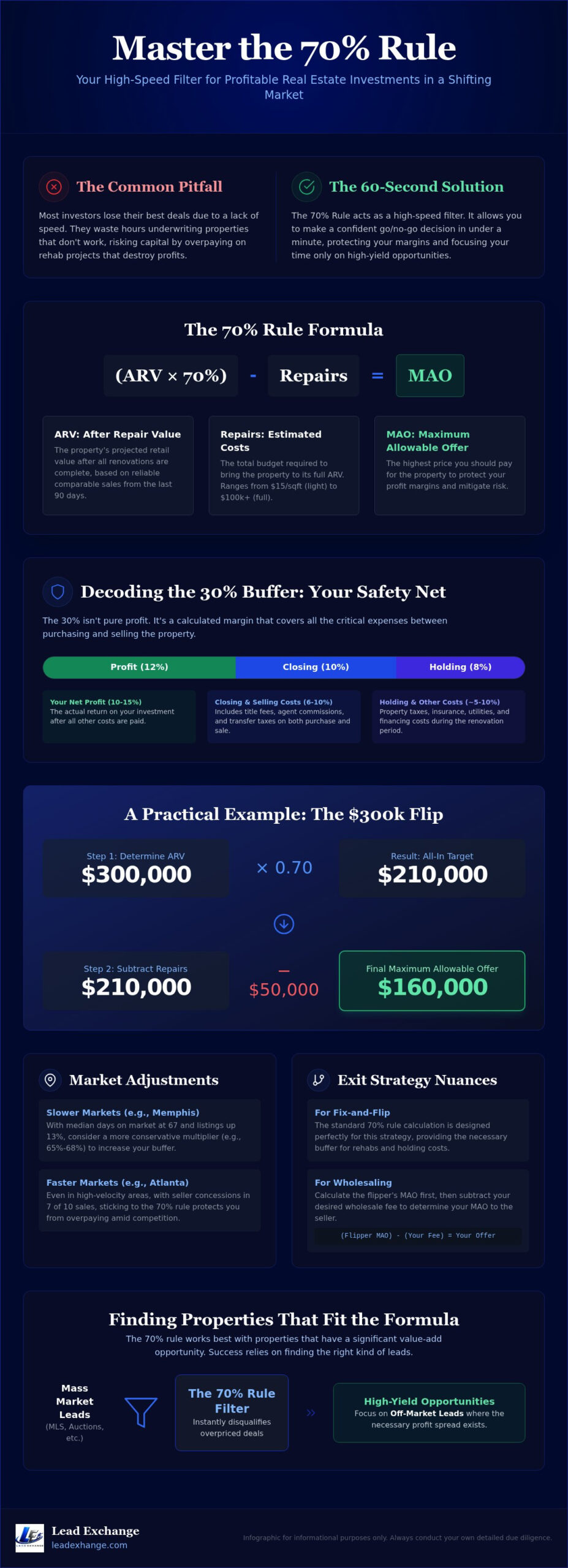
The formula is straightforward: (After Repair Value x 0.70) – Estimated Repair Costs = Maximum Allowable Offer (MAO).
In the volatile markets of 2026, this rule acts as a critical safety net. Memphis has seen active listings in Shelby County increase by 13% recently, while median days on market have climbed to 67 days. This shift toward a buyer’s market means you cannot afford to be wrong about your entry price. The 70% rule provides the necessary cushion to absorb longer holding times or unexpected seller concessions, which are now appearing in nearly 7 out of 10 sales in high-velocity areas like Atlanta.
It’s vital to distinguish between a quick screen and full underwriting. A 70% Rule Calculator is designed for the screening phase. It allows you to process dozens of potential leads in minutes. Once a property passes this initial filter, you move into detailed underwriting. This two-step process saves you hours of wasted effort on bad deals and keeps your focus on high-margin opportunities.
The Core Components: ARV and Repairs
After Repair Value (ARV) represents the property’s projected retail value once it’s fully renovated to neighborhood standards. This isn’t a guess. It’s based on reliable comparables from the last 90 days. Successful flipping depends on hitting this target accurately. If you overestimate the ARV, your entire profit margin disappears before you even swing a hammer.
Estimating repairs without a contractor’s quote requires localized data. In 2026, light home renovations typically range from $15 to $60 per square foot. A common mistake is basing an offer on the current as-is value rather than the future ARV. You must visualize the finished product to calculate the potential return correctly. Professionals use detailed photos or site walks to categorize the rehab as light, medium, or full to keep their estimates grounded in reality. For Atlanta investors who want to eliminate guesswork entirely, an ARV to MAO Calculator can translate your repair estimates and comparable data into a precise, defensible offer price.
Why 70%? Decoding the 30% Margin
The 30% gap isn’t just pure profit. It’s a calculated buffer for the expenses that often surprise novice investors. Closing costs on both the buy and sell side usually consume 6% to 10% of the ARV. You must also account for holding costs, including property taxes, insurance, and interest on financing. With 30-year fixed mortgage rates averaging 6.67% in August 2026, the cost of capital is a significant factor in your bottom line.
The remaining 10% to 15% serves as your profit buffer. This ensures a healthy net return on investment even if the market shifts during your renovation. Without this margin, a simple HVAC replacement costing $10,000 to $14,000 could turn a profitable flip into a financial loss.
Using the 70% Rule Calculator for Maximum ROI
High-velocity investing requires a repeatable process. You don’t have time to second-guess your offer when a deal hits your desk. Using a 70% Rule Calculator allows you to move from lead to offer with surgical precision. This workflow is designed to protect your equity before you even sign a contract. To maximize your ROI, follow these four precise steps.
- Step 1: Determine the ARV. Use reliable comparables (comps) from the last 90 days. With Memphis median days on market rising to 67 days in July 2026, using stale data from six months ago will lead to overpayment.
- Step 2: Estimate the Rehab Budget. Walk the property or use high-resolution photos to categorize the project. For light renovations in 2026, budget between $15 and $60 per square foot. If a full remodel is required, expect costs between $100,000 and $350,000 depending on the square footage.
- Step 3: Apply the 70% Multiplier. Multiply your ARV by 0.70. This establishes your total “all-in” cost ceiling, including the purchase and the renovation.
- Step 4: Find your MAO. Subtract the rehab budget from your all-in ceiling. This figure is your Maximum Allowable Offer.
A Practical Example: The $300k Flip
Imagine a Memphis property with a $300,000 ARV based on recent local sales. Applying the 0.70 multiplier gives you an all-in target of $210,000. If your detailed inspection reveals $50,000 in necessary repairs, your MAO is $160,000. This $140,000 spread must cover your profit, closing costs, and holding expenses. As this 70% Rule Explained resource suggests, sticking to this math ensures you remain profitable even if renovation costs escalate or market time increases beyond the current 67-day average.
When the Math Doesn’t Match the Market
You’ll often find sellers asking $180,000 for a property where your 70% Rule Calculator says $160,000. Don’t force the deal to fit your desires. If the numbers don’t work at 70%, you can use a more granular Real Estate Deal Analyzer to see if a 75% rule is viable for high-demand sub-markets. Use your calculation results as a negotiation tool; showing a seller the hard data on repair costs and current market days helps justify your offer. Finding properties that meet these strict criteria is easier when you source off-market investment deals directly.
Market Adjustments: Atlanta vs. Memphis Real Estate
Successful investors don’t treat the 70% rule as a static law. It’s a baseline. Market velocity and local liquidity dictate whether you should tighten or expand your profit buffer. In high-velocity markets like Atlanta or Charlotte, inventory remains tight as of August 2026. This competition often forces investors to use a 75% rule to secure deals. Conversely, in stable, cash-flow-heavy markets like Memphis or Birmingham, staying at a strict 65-70% rule protects you against slower appreciation. Using a 70% Rule Calculator as a flexible framework rather than a rigid cage is the key to scaling in different regions.
The 75% Rule for Hot Markets
Atlanta’s median home price sits around $420,000. Properties move fast, with median days on market between 55 and 58. Because the exit is quicker, some investors accept a thinner margin to remain competitive. However, stretching the formula to 75% increases the risk of over-leveraging. If the market dips during your four-month renovation, that 5% difference could be your entire profit. You should always use an Atlanta House Flip Profit Calculator to run sensitivity tests. This ensures the thinner margin still supports your net ROI after accounting for current 6.67% interest rates.
The 65% Rule for High-Risk Rehabs
When a property requires more than cosmetic updates, you need a larger safety margin. Major structural issues or foundation repairs are unpredictable. In Memphis, where the median days on market has climbed to 67, your holding costs accumulate faster than in high-velocity zones. Dropping your multiplier to 65% protects your capital in markets where price growth is modest. The Memphis Investor Guide provides specific insights into how local property taxes and insurance rates in the Mid-South impact your total soft costs. These expenses eat into your 30% margin faster than many realize.
Investors in cities like Detroit or Cleveland must also adjust for regional variables. High property tax rates relative to home value can consume a larger portion of your margin. Your exit strategy also matters. If you’re flipping for resale, you need the full 30% cushion. If you’re wholesaling to a landlord, they might accept a higher purchase price because their ROI is calculated over years of rental income. Regardless of the strategy, a 70% Rule Calculator provides the hard data needed to justify your offer to a seller.
Wholesaling vs. Flipping: Two Ways to Calculate
Flippers and wholesalers are two sides of the same coin, but their math differs by one critical variable. A flipper relies on a 70% Rule Calculator to protect their equity and time during a months-long renovation. They need every bit of that 30% margin to cover holding costs, 6.67% interest rates, and unexpected repairs like a $14,000 HVAC replacement. Wholesalers, however, must reverse-engineer this math to ensure the deal remains attractive to their end buyer while still securing their own profit.
Calculating the Wholesaler’s MAO
To be a successful wholesaler in Memphis or Atlanta, your offer must be lower than the flipper’s Maximum Allowable Offer. The formula changes slightly: (ARV x 0.70) – Repairs – Wholesale Fee = Your Max Offer to Seller. If you use a 70% Rule Calculator and find the flipper’s MAO is $160,000, your offer to the seller must be $150,000 if you want to secure a $10,000 assignment fee. For investors who want to eliminate guesswork on both sides of the transaction, a dedicated House Flipping MAO Calculator for Atlanta and Memphis can precisely model these spreads and protect your fee without sacrificing the deal.
The assignment fee is the bridge between your contract price and the investor’s purchase price.
Balancing this spread is an art. If you squeeze the seller too hard, you lose the deal. If you over-wholesale by taking a $30,000 fee on a thin deal, you kill your reputation. Memphis investors are a tight-knit group. Word spreads quickly if you’re shopping deals that don’t actually meet the 70% threshold after your fee is added. Your goal is to be a high-performance facilitator who leaves enough meat on the bone for the person doing the heavy lifting.
Reverse Engineering the Deal
You must know your cash buyer’s “buy box” before you even run the calculator. Some buyers in high-demand Atlanta sub-markets might accept a 75% rule, while Memphis buyers looking for rental portfolio additions might demand a stricter 65% rule to account for property taxes and slower appreciation. Transparency is your greatest asset. Present your 70% rule math to potential buyers with clear data on comps and repair estimates. This builds immediate trust and positions you as a professional partner rather than just another middleman.
Using Lead Exchange data allows you to find active buyers who are specifically hungry for 70% rule deals. You aren’t just selling a house; you’re selling a verified profit margin. When your math is sound and your fee is fair, your deals will close in hours, not weeks. Professionalism in your calculations ensures you remain a seasoned, no-nonsense partner in the local investment community.
Beyond the Math: Finding Properties that Fit the Formula
A 70% Rule Calculator is only as effective as the deal flow behind it. In 2026, finding properties that meet these strict criteria on the Multiple Listing Service (MLS) is nearly impossible. High competition from retail buyers and institutional hedge funds drives prices toward retail value, leaving zero margin for a 30% profit buffer. To consistently hit your Maximum Allowable Offer, you must bypass public channels and look where the competition isn’t.
Sourcing Distressed Properties for High Spreads
Success depends on identifying motivated sellers who prioritize speed and convenience over a top-dollar retail price. These are often owners of distressed assets who need a direct cash home buying solution to avoid the traditional listing process. Off-market real estate leads provide the exclusive access required to find these high-margin spreads before they reach the general public. Without this exclusivity, you’re forced to bid in auctions where the 70% rule is quickly abandoned by desperate buyers.
Managing this pipeline requires professional tools that scale with your ambition. By leveraging wholesale real estate software, you can automate lead tracking and ensure no potential 70% deal falls through the cracks. Lead Exchange streamlines this path by delivering targeted leads in Memphis and Atlanta directly to your dashboard. Whether you’re a new investor using the Starter tier to secure your first flip or a scaling operation utilizing the Growth tier to dominate the market, having a steady stream of off-market investment deals is the only way to keep your acquisition engine running at peak efficiency.
Taking Action: From Calculator to Closing
Precision matters when the stakes are high. Set your “buy box” filters on Lead Exchange to match the specific criteria your 70% Rule Calculator demands. This allows you to ignore the noise and focus solely on assets that fit your risk profile. In markets like Atlanta, where inventory remains tight, or Memphis, where days on market are climbing, a rapid response is your competitive advantage. When a deal hits your dashboard that fits the formula, you must be ready to execute without hesitation.
Stop wasting time underwriting bad deals from public databases. Access the exclusive inventory that makes the 70% rule a reality. Access exclusive off-market leads with Lead Exchange today.
Scale Your Acquisition Engine with Precision
Precision is the difference between a profitable exit and a costly mistake. You’ve mastered how a 70% Rule Calculator serves as your primary defense against overpaying in shifting markets. By adjusting your multipliers to match local liquidity in Memphis or Atlanta, you protect your capital from rising repair costs and extended holding times. Reliability in your math ensures you remain a seasoned partner in any investment circle.
The math only works when you have high-quality inventory to analyze. Public listings rarely provide the spreads required for a 30% profit buffer. To truly scale, you need exclusive access to motivated sellers who prioritize speed over retail pricing. Lead Exchange provides the infrastructure to bridge this gap. You gain access to exclusive off-market properties and streamlined lead data designed specifically for wholesalers and flippers.
Tiered subscription plans like Starter and Growth allow you to choose the pace of your expansion. It’s time to stop guessing on entry prices and start securing high-margin deals with professional confidence. Your next profitable flip is waiting.
Frequently Asked Questions
Does the 70% rule include closing costs?
Yes, the 30% margin is specifically designed to absorb these. Closing costs on both the buy and sell side typically range from 6% to 10% of the ARV. When you use a 70% Rule Calculator, you’re factoring in these expenses alongside holding costs and profit. This buffer ensures you don’t pay out of pocket for legal fees, title insurance, or commissions when you exit the project.
Is the 70% rule still relevant in 2026’s high-interest market?
It’s more relevant now than in lower-rate environments. With 30-year fixed mortgage rates averaging 6.67% in August 2026, the cost of capital is significant. The 30% cushion protects you from high interest payments during the renovation period. In a shifting market where median days on market in Memphis have reached 67 days, this safety margin prevents your profit from being erased by extended holding times.
Can I use the 70% rule for rental property acquisitions?
You can, but it’s often too restrictive for long-term holds. Rental investors typically focus on the BRRRR strategy, which often allows for an 80% or 85% all-in cost. Since you aren’t selling immediately, you don’t need to account for the 6% agent commission on the back end. However, using a 70% Rule Calculator for rentals provides an extra layer of equity that maximizes your cash flow.
What happens if my repair estimate is wrong?
Your profit margin absorbs the error. This is exactly why the 30% buffer exists. If an unexpected sewer line repair costs $5,000 or an HVAC replacement hits $14,000, your 10% to 15% net profit target might shrink, but you likely won’t lose money. To minimize this risk, always add a 10% contingency to your initial repair budget before running your final calculations to find your offer ceiling.
Should I use the 70% rule for new construction deals?
No, the 70% rule is specifically for distressed fix-and-flip properties. New construction requires a different underwriting model because the risk profile and timeline are longer. Build costs, permit fees, and land carry costs don’t follow the same ratios as a renovation project. For new builds, investors typically target a specific return on cost or internal rate of return rather than using a simplified percentage based on the final value.
How do I determine the ARV without access to the MLS?
You must rely on public records and third-party data platforms. Look for properties within a half-mile radius that have sold in the last 90 days. Focus on homes with similar square footage, bedroom counts, and finishes. While the MLS is the gold standard for real-time data, many professional investors use off-market lead platforms to view historical sales data and current market trends to estimate a property’s potential value.
Is a 75% or 80% rule ever acceptable for an experienced investor?
Yes, but only in high-velocity markets with high liquidity. In areas like Atlanta where inventory is extremely tight, investors might accept a 75% rule because they can sell the property in under 60 days. This reduces holding costs and risk. However, pushing to 80% leaves almost no room for error. Only seasoned professionals with reliable contractors and a guaranteed exit strategy should consider narrowing their profit margins to this degree.
How does the 70% rule differ from the MAO formula?
The 70% rule is the specific methodology used to reach the Maximum Allowable Offer (MAO). The MAO is the final dollar amount you can pay, while the 70% rule is the percentage-based filter that accounts for the 30% overhead and profit gap. Many investors use these terms interchangeably. It’s helpful to view the rule as the process and the MAO as the definitive ceiling for your negotiation with a seller. Investors who want a market-specific tool can use a House Flipping MAO Calculator built for Atlanta and Memphis to apply this framework with localized precision. For even greater precision in the Atlanta market specifically, the Atlanta ARV to MAO Calculator accounts for Georgia-specific closing costs and local renovation rates to sharpen your offer estimates.
Disclaimer
The opinions and information shared on this website are for educational purposes only. Results from real estate investing and lead generation vary, and no specific outcome or profit is guaranteed