Most Atlanta fix and flip investors don’t lose money because they picked the wrong house; they lose money because they used the wrong math. You know the stress of looking at a distressed property in the West End and wondering if your Fix and Flip Calculator is actually catching every hidden expense. Underestimating rehab costs or missing a few months of holding fees can turn a potential goldmine into a financial anchor. It’s frustrating to watch your profit evaporate because of a simple calculation error. You need a system that removes the emotion from the acquisition process.
This guide will help you master the math behind profitable property flips to secure high-margin deals. You’ll learn how to reach a definitive Go/No-Go decision on any Atlanta rehab project within minutes. We’ll break down the exact formulas for determining an accurate Maximum Allowable Offer (MAO) and building ROI projections that professional lenders actually respect. We’re moving past the guesswork and focusing on the hard data that drives investment success. By the end of this article, you’ll have the tools to analyze deals with the speed and confidence of an elite institutional buyer.
Key Takeaways
- Eliminate guesswork by using a professional Fix and Flip Calculator to act as a strategic risk-mitigation tool for every Atlanta acquisition.
- Master the After Repair Value (ARV) formula by utilizing “Sold” comps within a strict 0.5-mile radius to ensure your exit strategy is grounded in reality.
- Identify and account for hidden profit killers like lender points, property taxes, and insurance that can silently erode your margins during the rehab phase.
- Establish a firm Maximum Allowable Offer (MAO) using the 70% rule to create a definitive “Go/No-Go” decision point for any prospective deal.
- Scale your portfolio by pairing precise math with high-margin, off-market leads that provide the necessary spread for a successful flip.
The Fundamentals of Fix and Flip Math
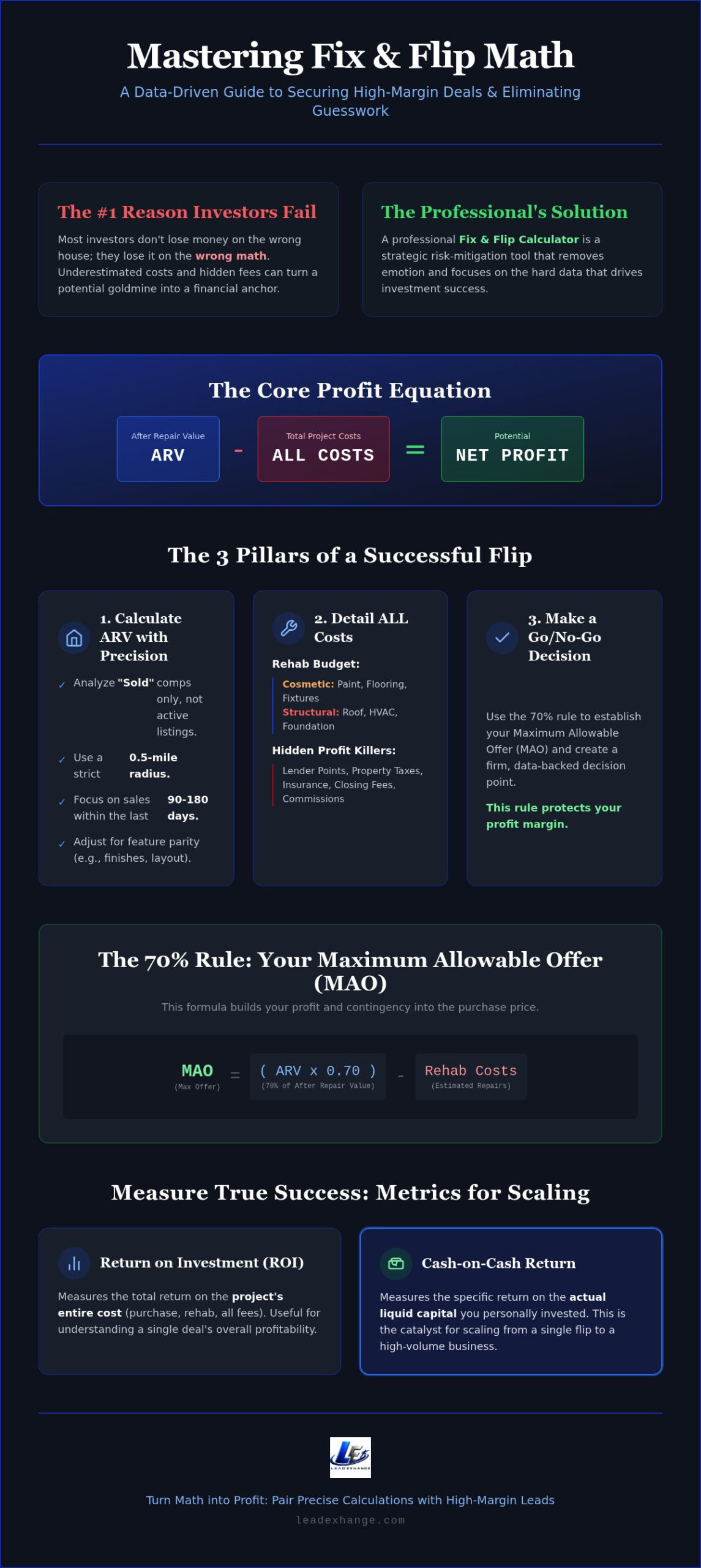
A professional Fix and Flip Calculator is more than a simple spreadsheet. It’s a strategic risk-mitigation tool designed to protect your capital from the volatile nature of high-stakes real estate. In the Atlanta market, where neighborhood borders define profit margins, “guessing” is a recipe for bankruptcy. Professional investors don’t rely on gut feelings or “back of the napkin” estimates. They rely on the three pillars of flip math: Acquisition, Renovation, and Disposition. By mastering these phases, you ensure every dollar spent contributes to the eventual exit. The spread is the critical gap between your total all-in costs and the property’s After Repair Value (ARV).
Why Precision Matters in 2026
Market volatility in 2026 requires a conservative approach to every deal. Precision isn’t optional when a 5% error in your ARV calculation can instantly erase a 20% profit margin. Investors who fail to account for shifting buyer preferences or interest rate fluctuations find themselves holding inventory they can’t move. Your Fix and Flip Calculator also serves as a resume for lenders. Private and hard money lenders require professional ROI projections before releasing funds. If your math is sloppy, your funding will vanish. Accuracy builds the trust needed to secure the capital that fuels your growth. High-performance investors use data to remove emotion from the acquisition, ensuring they only close on properties with a clear path to profit.
The Core Formula: ARV – All Costs = Profit
Success starts with one non-negotiable equation: ARV minus All Costs equals Profit. You must memorize this logic to evaluate deals on the fly. However, you must distinguish between gross and net figures. Gross profit is a vanity metric; net profit is the reality of what remains after you’ve paid taxes, closing fees, and commissions. Understanding the difference between ROI and Cash-on-Cash return is equally vital for scaling your portfolio.
- Return on Investment (ROI): This measures the total return on the project’s entire cost, including purchase and rehab.
- Cash-on-Cash Return: This measures the specific return on the actual liquid capital you personally invested into the deal.
Focusing on Cash-on-Cash return allows you to compare the efficiency of different deals. It’s the catalyst for moving from one single flip to a high-volume investment business. When you understand these metrics, you can leverage your capital more effectively and reduce the time your money is tied up in a single project.
Calculating After Repair Value (ARV) and Rehab Costs
After Repair Value (ARV) represents the estimated market value of a property once all renovations are complete. It’s the North Star of your investment strategy. If this number is inaccurate, every other calculation in your Fix and Flip Calculator will be flawed. To determine a reliable ARV, you must analyze “Sold” comparables within a strict 0.5-mile radius. Focus on properties that closed within the last 90 to 180 days to reflect current market conditions. Active listings are deceptive for valuation purposes. They represent a seller’s aspiration, whereas sold data represents the market’s reality. Relying on “Active” or “Pending” prices can lead you to overpay for a property, leaving no room for error when it’s time to sell.
Mastering the ARV in Local Markets
Specific neighborhood trends in Memphis and Atlanta dictate your exit price. You must adjust your comps based on feature parity to ensure you’re comparing similar assets. For example, if your target neighborhood expects quartz countertops and high-end tile, using comps with laminate or builder-grade finishes will skew your results. However, you must remain disciplined. The danger of over-improving for a specific ZIP code is real. Installing luxury finishes in a starter-home market won’t raise the appraisal ceiling, but it will certainly erode your profit. To find properties with enough spread to justify the right level of renovation, savvy investors frequently source off-market investment deals that bypass the competitive bidding wars of the MLS.
Building a Realistic Rehab Budget
A realistic rehab budget separates high-performance investors from those who lose their shirts. Categorize your costs into two distinct groups: Cosmetic and Structural. Cosmetic updates like paint, flooring, and landscaping are predictable. Structural issues involving the roof, HVAC systems, or foundation are the real profit killers. For quick initial estimates during the walkthrough, use the price per square foot method based on local averages for your intended finish level. This allows for rapid decision-making on the fly.
In 2026, labor shortages remain a significant hurdle for the construction industry. Skilled trades are in high demand, which drives up labor costs and extends renovation timelines. You must account for these delays in your holding cost projections. To mitigate this risk, always implement a 15% contingency rule for your rehab budget. This buffer is designed to cover “unseen” issues that only become visible after the demolition phase. If you don’t plan for the unexpected, you aren’t really planning for profit. Precision in your budget ensures that your Fix and Flip Calculator reflects the true cost of doing business in a competitive environment.
Financing, Holding, and Exit Costs: The Hidden Profit Killers
Many investors focus entirely on the “big” numbers while ignoring the friction that erodes their spread. Your Fix and Flip Calculator must account for every dollar that leaves your account between the initial acquisition and the final closing. Holding costs like property taxes, insurance, utilities, and HOA fees are constant drains on your capital. These aren’t one-time expenses. They’re recurring monthly obligations that accumulate every single day the property sits vacant. If you don’t track these with precision, your projected margins will vanish before you even list the property.
Financing costs represent another significant hurdle. If you’re utilizing hard money, you must factor in lender points paid at closing. These typically range from 1% to 3% of the total loan amount. Additionally, exit costs are often higher than beginners anticipate. You’ll typically lose 5% to 6% of the final sale price to Realtor commissions. In many competitive markets, you may also need to budget for seller concessions to cover a buyer’s closing costs. Ignoring these variables leads to a massive gap between your expected profit and the actual check you receive at the end of the deal.
The impact of time on your net profit is dramatic. A project with a 4-month timeline is significantly more profitable than one that stretches to 8 months, even if the renovation costs remain identical. Doubling your holding period means doubling your interest payments and carrying costs. This delay can easily slash your net profit by 25% or more. Speed isn’t just a goal; it’s a financial necessity in high-stakes flipping.
Hard Money vs. Cash: Impact on ROI
Cash offers maximum security because it eliminates debt service and monthly interest payments. However, hard money provides the leverage required to scale a portfolio. Using leverage increases your Return on Investment (ROI) by keeping your personal liquid capital available for the next deal. Lenders typically evaluate deals based on Loan to Cost (LTC) for the purchase and rehab, or Loan to Value (LTV) based on the projected ARV. When reviewing terms, prioritize interest-only payments. This structure keeps your monthly burn rate lower during the renovation phase, preserving your cash flow for unexpected site issues.
The Cost of Time: Why Speed is Profit
Every day you own the property, you’re paying for the privilege. For a typical $250,000 flip in markets like Detroit or Cleveland, your daily burn rate can exceed $50 when accounting for interest, insurance, and utilities. Sourcing off-market properties for sale accelerates your timeline by removing the friction of public bidding wars and long closing cycles. High carrying costs don’t just reduce your total profit; they drag down your annualized return. This makes your capital less efficient and slows your ability to reinvest in new opportunities. Elite investors prioritize acquisition speed as much as they prioritize the purchase price.
Applying the 70% Rule and Maximum Allowable Offer (MAO)
The Maximum Allowable Offer (MAO) is the absolute ceiling for any acquisition. It’s the point where a deal stops being an investment and starts being a liability. You must use a Fix and Flip Calculator to establish this number before you ever speak to a seller. Calculating your MAO requires a disciplined approach to ensure your margins remain protected regardless of market shifts. Follow these steps to find your limit:
- Step 1: Determine the ARV through the rigorous comp analysis discussed in previous sections.
- Step 2: Multiply that ARV by your “Investor Percentage,” which is typically 70% or 75%.
- Step 3: Subtract your total estimated rehab budget, including your 15% contingency.
- Step 4: Subtract your desired wholesale or assignment fee if you plan to flip the contract.
- Step 5: Arrive at the MAO. This is the highest price you can pay to maintain your target profit.
Sticking to this formula prevents “deal fever” from clouding your judgment. If the seller won’t meet your MAO, you walk away. It’s that simple. Successful investors don’t chase bad deals; they wait for the math to align with their goals.
When to Break the 70% Rule
The 70% rule isn’t a law; it’s a benchmark. High-demand markets like Atlanta often require more flexibility to remain competitive. In premium neighborhoods with high velocity, you might need to use a 75% or even 80% rule to secure an asset. Conversely, for lower-priced homes in markets like Birmingham, a “Fixed Profit” model often works better. In these scenarios, you subtract a specific dollar amount (e.g., $30,000) instead of a percentage to ensure the work justifies the return. You should also adjust your formula for wholetailing strategies. Since wholetailing involves minimal cosmetic repairs, you can afford a higher MAO because your risk and timeline are significantly reduced.
Using an MAO Calculator to Negotiate
Your math is your most powerful negotiation tool. When a seller asks why your offer is lower than they expected, show them the data. Walking a motivated seller through a professional Off-Market Property Calculator builds transparency and trust. It shifts the conversation from “I want to pay less” to “This is what the market and the renovation costs allow.” This objective approach often helps sellers realize that their “as-is” price expectations are unrealistic. Using a Fix and Flip Calculator to justify your offer positions you as a professional buyer rather than a low-baller. It provides a logical foundation for your price that is difficult for a rational seller to argue against.
Turning Math into Profit with Lead Exchange Exclusive Deals
A professional Fix and Flip Calculator is a diagnostic tool. It’s ultimately only as good as the data you feed it. You can master every formula in this guide, but if the deal itself lacks a sufficient spread, the math will only confirm a “No-Go” decision. To achieve the high-margin ROI projections required for success, you need access to inventory that hasn’t been picked over by the general public. Lead Exchange serves as the premier source for these high-margin, off-market leads. We provide the raw material your flip engine needs to generate consistent profit in competitive environments.
Our Starter and Growth plans are designed to give you a strategic advantage in markets like Atlanta and Memphis. By utilizing our exclusive data, you’re not just finding properties; you’re finding the specific opportunities that make the math work. Speed is the ultimate catalyst for financial success in real estate. The rapid data delivery provided by Lead Exchange allows you to identify and secure deals faster than your competition. This efficiency directly reduces your acquisition time and minimizes the holding costs that often eat into a flipper’s bottom line.
Sourcing Deals in Memphis, Atlanta, and Beyond
Exclusive data is the most valuable currency in the 2026 real estate market. Relying on traditional MLS listings often means entering bidding wars that thin your margins to the breaking point. Professional off-market real estate leads allow you to bypass these public auctions and negotiate directly with sellers. This direct access is how you secure the 30% to 40% spreads that institutional investors target. For those ready to scale their operation, the Growth plan provides the high-frequency data necessary to keep multiple projects in your pipeline simultaneously. Investors expanding into the Memphis market should also consider using a dedicated Memphis Rental Property Calculator to evaluate whether a flip candidate might generate stronger returns as a long-term hold instead.
Your Next Step: From Calculation to Acquisition
It’s time to stop analyzing from the sidelines and start acquiring assets with confidence. Mastery of the Fix and Flip Calculator ensures you won’t overpay, but Lead Exchange ensures you have a steady stream of targets to evaluate. You now have the formulas to protect your capital and the source to find your next deal. Access the same high-spread opportunities the pros use before they ever hit the open market. Don’t let bad math or a lack of inventory stall your progress. Join Lead Exchange today to find your next high-ROI flip and turn your professional calculations into tangible financial success.
Scale Your Atlanta Portfolio with Precision
Precision math is the only thing standing between a profitable exit and a total financial loss. You’ve learned how to isolate After Repair Value (ARV) from market noise and account for the hidden holding costs that erode net profit. By applying a disciplined Maximum Allowable Offer (MAO) through your Fix and Flip Calculator, you remove the emotional bias that leads to overpaying. But even the most accurate formula is useless without high-margin inventory. Success in 2026 requires a steady supply of distressed properties that haven’t been bid up on the open market.
We provide the pragmatic data serious investors need to scale their volume in high-growth areas like Atlanta and Memphis. Whether you choose the Starter or Growth plan, you’re gaining an elite partner that prioritizes your bottom line. Our exclusive off-market leads give you the necessary spread to ensure your projects remain viable despite labor shortages or market shifts. Don’t settle for guesswork; start acquiring properties with a clear, mathematical path to profit.
Your next high-ROI project is waiting for the right numbers and the right source.
Frequently Asked Questions
What is a good profit margin for a fix and flip deal?
Aim for a 15% to 20% net profit margin on the After Repair Value (ARV). While gross profit looks impressive on paper, your net margin accounts for all financing, holding, and closing costs. In competitive markets like Atlanta, some investors accept 10% to 12% for high-velocity deals. However, a thinner margin leaves little room for error if renovation costs spike or the market shifts during your holding period.
How do I calculate the After Repair Value (ARV) accurately?
Accuracy requires analyzing at least three “Sold” comparables within a 0.5-mile radius of the subject property. These comps must share similar square footage, bedroom counts, and finish levels. Focus on sales from the last 90 days to capture real-time market sentiment. Adjust your valuation based on specific features like a finished basement or a larger lot size. Don’t rely on active listings, as they don’t represent confirmed market value.
Does the 70% rule include closing costs and interest?
The standard 70% rule is a simplified benchmark that typically covers your desired profit and a buffer for costs. However, a professional Fix and Flip Calculator provides a much more granular view. Most seasoned investors treat the 70% as a starting point. They then subtract specific estimated closing costs, lender points, and monthly interest payments to reach a more precise Maximum Allowable Offer (MAO) that reflects their actual capital requirements.
What are the most common hidden costs in a house flip?
Hidden costs often include “soft costs” like permit fees, architectural drawings, and builder’s risk insurance. Many beginners also overlook utility costs, landscaping maintenance, and HOA dues that accumulate during the renovation. Structural surprises, such as outdated electrical panels or sewer line issues, can also derail a budget. Implementing a 15% contingency buffer is the most effective way to protect your spread from these inevitable but unpredictable expenses.
How much cash do I need to start a fix and flip project?
You typically need enough cash to cover a 10% to 20% down payment plus your initial closing costs and several months of interest payments. While hard money lenders can fund the majority of the purchase and rehab, they rarely cover 100% of the deal. You should also maintain a liquid reserve for the first few draws of the renovation before the lender reimburses those specific construction costs.
What is the difference between ROI and Cash-on-Cash return in flipping?
ROI measures the total profit relative to the total cost of the project, including debt. Cash-on-Cash return measures the profit relative only to the liquid capital you personally invested. If you use leverage, your Cash-on-Cash return is usually much higher than your ROI. This metric is critical for investors who want to scale quickly by using a Fix and Flip Calculator to compare how efficiently their cash is working across multiple deals.
How can I find off-market properties to flip in Atlanta or Memphis?
Finding high-margin deals requires moving beyond the MLS and utilizing exclusive data sources. Off-market investment deals are often found through direct-to-seller marketing or specialized lead platforms. These channels allow you to identify distressed properties before they reach the general public. By focusing on off-market inventory, you avoid bidding wars and secure the necessary spread to make your renovation math work in high-demand urban markets.
Is hard money better than using my own cash for a flip?
Hard money is better for investors who want to scale their volume and maximize leverage. While cash is safer and eliminates interest payments, it ties up a significant amount of liquidity in a single asset. Hard money allows you to control multiple properties simultaneously with the same amount of capital. The choice depends on your risk tolerance and whether your project’s projected profit can comfortably absorb the higher interest rates. Investors who plan to hold properties long-term in Memphis should use a professional Rental Property Calculator to determine whether a buy-and-hold strategy outperforms a traditional flip in that specific market.
Disclaimer
The opinions and information shared on this website are for educational purposes only. Results from real estate investing and lead generation vary, and no specific outcome or profit is guaranteed