Most Atlanta investors lose money before they even close because they’re applying retail math to wholesale opportunities. You need a professional Off-Market Property Calculator framework to avoid the common trap of overestimating your exit price. It’s a high-stakes environment where a single miscalculation on a non-MLS deal can turn a projected win into a significant financial burden.
You’ve likely felt the pressure of making a quick cash offer while worrying that an overlooked repair or a soft comparable sale will erode your margins. We understand that hesitation. This article promises to arm you with the precise formulas required to secure high-margin investment properties with absolute certainty. You’ll stop guessing and start executing with the speed of a seasoned pro.
We’ll break down a repeatable system for analyzing deals in minutes. You’ll learn how to reverse-engineer your maximum allowable offer and gain a clear understanding of the spread between purchase and exit prices. From accurate rehab cost shortcuts to finding comps for non-traditional deals, this is your roadmap to scaling an Atlanta portfolio with confidence.
Key Takeaways
- Determine your Maximum Allowable Offer (MAO) with precision using an Off-Market Property Calculator designed for non-MLS assets.
- Protect your investment margins by mastering the 70% Rule and After Repair Value (ARV) formulas without the need for traditional appraisals.
- Identify critical Atlanta-specific variables, such as local tax liens, that impact your final cash-to-close requirements.
- Use calculated data as a negotiation tool to build seller trust and secure contracts at prices that guarantee your profit spread.
- Scale your acquisition volume by pairing proven formulas with exclusive lead data from the Lead Exchange Starter and Growth plans.
What is an Off-Market Property Calculator and Why Do Investors Need One?
An Off-Market Property Calculator is a specialized analytical tool designed to determine the Maximum Allowable Offer (MAO) for real estate assets not listed on the Multiple Listing Service (MLS). Unlike retail tools, this calculator focuses on the spread between purchase price and potential profit. Investors need this precision because traditional MLS “comps” often fail to reflect the reality of distressed assets. Retail data tracks what families pay for move-in ready homes. It doesn’t account for the heavy lifting required in a professional investment deal.
Professional investors use this tool to mitigate the high risk associated with cash purchases. When you’re buying with limited inspection periods, the math is your only safety net. It allows you to filter through high volumes of data quickly. Top-tier investors often run 100 leads through their calculator just to find one deal that meets their margin requirements. This aggressive filtering ensures that capital is only deployed on assets with a high probability of success. It turns raw data into a tactical advantage.
The Difference Between Market Value and Investment Value
Relying on “Zestimates” or retail appraisals is a dangerous gamble for wholesalers and flippers. These figures represent what a retail buyer might pay after a property is perfect. Investment value is fundamentally different. It requires a mandatory “distressed discount” to account for risk, holding costs, and the specific work required to reach that retail peak. Presenting a data-backed offer to a motivated seller provides a massive psychological advantage. When you show the math behind your offer, you move the conversation from emotion to logic. This shift helps secure the contract at a price that protects your bottom line.
Key Components of a Professional Deal Analysis
Success depends on balancing current property condition against neighborhood potential. A house in ruins might be a goldmine if the surrounding area is appreciating rapidly. Your calculation must also account for the “Speed to Close” factor. Sellers often accept a lower price in exchange for a guaranteed, rapid exit. This speed is a currency in the off-market world. The Off-Market Premium is the cost of exclusivity. It represents the specific value of securing a deal before it hits the open market where bidding wars destroy margins. Without an Off-Market Property Calculator, you’re simply guessing in a market that doesn’t forgive mistakes.
The Core Formulas: ARV, MAO, and the 70% Rule
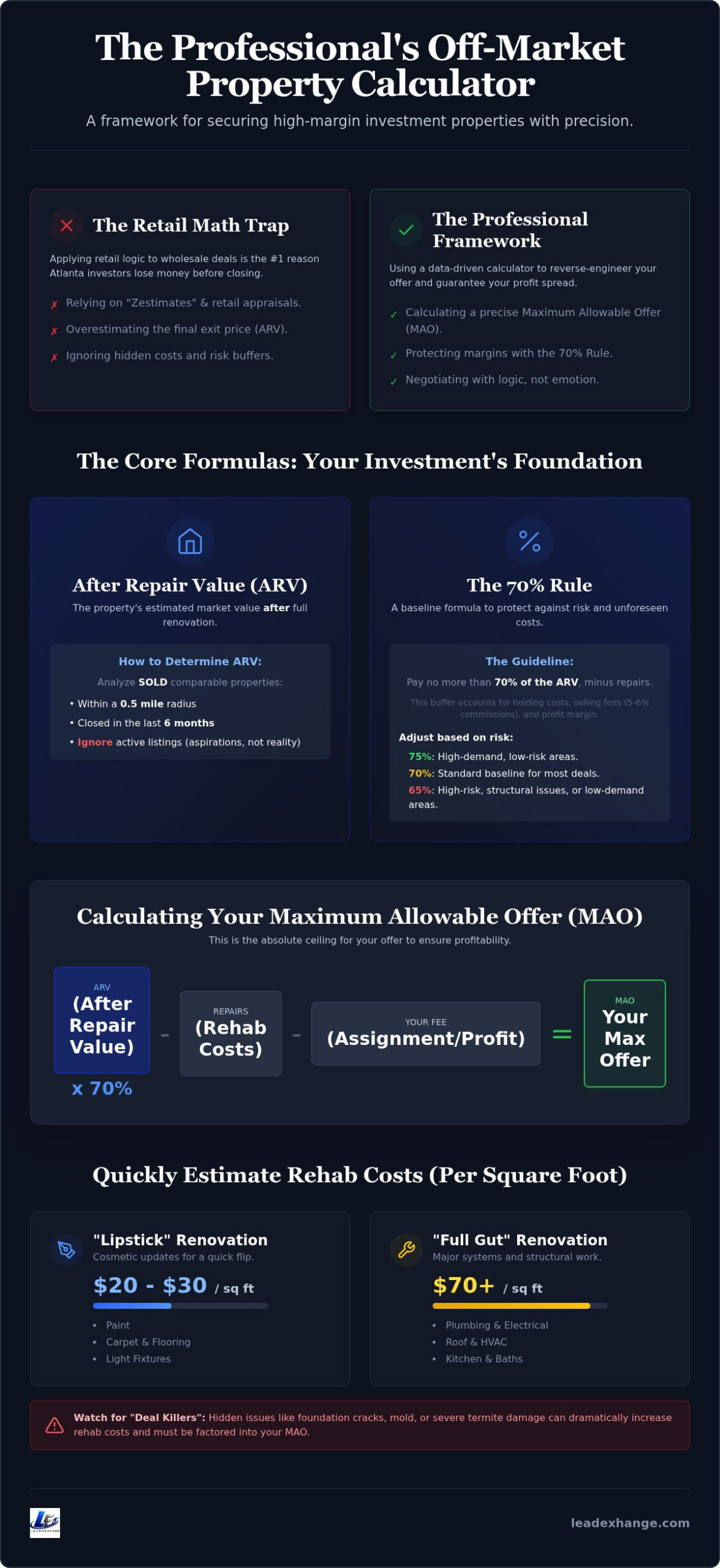
Precision in your initial analysis is the only way to protect your capital. The foundation of any professional Off-Market Property Calculator rests on two critical figures: After Repair Value (ARV) and Maximum Allowable Offer (MAO). ARV is your North Star. It represents the property’s value after it’s been fully renovated to meet current market standards. You determine this by analyzing “sold” comparables within a 0.5 mile radius that have closed within the last six months. Don’t look at active listings; they represent seller aspirations, not market reality.
The 70% Rule remains a vital baseline, even in the 2026 real estate market. This rule suggests you should never pay more than 70% of the ARV minus the cost of repairs. While some investors adjust this to 75% in hyper-competitive Atlanta neighborhoods, the 70% threshold accounts for the increased holding costs and higher interest rates typical of the current economic cycle. It builds in a safety buffer for selling costs, including the 5 to 6 percent lost to agent commissions and closing fees during the eventual exit.
Calculating the Maximum Allowable Offer (MAO)
The MAO is the absolute ceiling for your offer. To find it, use this specific formula: (ARV x 0.70) – Rehab Costs – Assignment Fee = MAO. Wholesalers often make the mistake of forgetting to deduct their own fee before presenting the number to a seller. If you need a $15,000 assignment fee to make the deal viable, that must come out of the offer price, not the flipper’s profit. Adjust your multiplier based on risk. For high-liquidity areas, 75% might work. For properties with structural issues or low demand, drop your multiplier to 65% to ensure the deal remains attractive to cash buyers.
Estimating Rehab Costs for Non-Contractors
Accurate rehab estimates are difficult without a construction background, but you can use square footage multipliers to stay within a safe range. A “Lipstick” renovation (paint, carpet, light fixtures) typically ranges from $20 to $30 per square foot. A “Full Gut” (plumbing, electrical, roof, and HVAC) can easily exceed $70 per square foot. Watch for hidden “deal killers” like foundation cracks or outdated knob-and-tube wiring that an untrained eye might miss. For the most reliable results, utilize the Atlanta Rehab Cost Calculator to align your math with current local labor and material prices. Investors who want to go deeper on rehab-specific deal analysis should also explore a dedicated Fix and Flip Calculator to catch every hidden expense before committing to a distressed Atlanta property.
Mastering these formulas is only half the battle. You also need a consistent stream of high-quality assets to analyze. You can access exclusive distressed leads that fit these specific profit models through a professional facilitator.
Local Market Variables: From Memphis to Atlanta
Geography dictates your profit margin. Real estate math isn’t universal; a formula that yields a profit in Birmingham can lead to a total loss in the Atlanta market. The effectiveness of your Off-Market Property Calculator depends entirely on the local variables you input. Property taxes and municipal liens are the primary deal killers that impact your final cash-to-close requirements. In distressed urban corridors, these hidden liabilities often exceed the property’s purchase price. You must validate calculator data with local boots on the ground to ensure your projections match the physical reality of the neighborhood.
Days on Market (DOM) is another critical local variable that many retail-focused tools ignore. In high-demand Atlanta zip codes, renovated properties might sell in under 14 days, which significantly reduces your holding costs. In slower markets, a 90-day hold can erode your margins through interest payments, insurance, and utilities. Professional investors adjust their risk multipliers based on these hyper-local trends. If the DOM in a specific zip code is rising, your Off-Market Property Calculator inputs should reflect a lower MAO to compensate for the added risk of a slow exit.
Navigating High-Yield Markets: Memphis and Detroit
Investors targeting Memphis or Detroit usually prioritize rental yields over quick flips. These markets offer high cash flow but come with complex challenges like back taxes and significant municipal water liens. when you analyze these “Buy and Hold” opportunities, you must account for higher vacancy rates and property management overhead. Utilizing the Memphis Rental Property Calculator is vital for long-term investors who need to see the true net operating income before committing capital to a distressed asset. It prevents the common mistake of overestimating cash flow in high-turnover neighborhoods where maintenance costs can be unpredictable.
High-Competition Markets: Atlanta and Charlotte
Atlanta and Charlotte represent the opposite end of the spectrum. These are high-velocity markets where rapid gentrification causes ARV projections to shift within months. In A-Class neighborhoods with high flip potential, you might need to adjust your MAO upward to 75% or even 80% to remain competitive against other cash buyers. However, this requires extreme precision to avoid over-leveraging. The Atlanta Wholesale Deal Calculator helps you navigate these bidding wars by providing a clear ceiling for your offers based on real-time neighborhood data. High competition demands faster execution, but speed never justifies ignoring the underlying math. Pairing this approach with a comprehensive Fix and Flip Calculator for Atlanta rehab deals ensures your ROI projections hold up under the scrutiny of professional lenders and cash buyers alike.
Strategic Execution: Turning Calculations into Contracts
Data alone doesn’t close deals. Your Off-Market Property Calculator is a tactical weapon in negotiations, but only if you know how to deploy the results. When a seller’s asking price exceeds your Maximum Allowable Offer (MAO), use your calculations to shift the conversation from price to cost. Presenting a professional breakdown of repairs and holding costs builds immediate credibility. It proves you’re a serious buyer with a logical basis for your offer, rather than just another investor hunting for a discount.
Moving from math to money requires a verified Proof of Funds. Sellers in the off-market space prioritize certainty over the highest price. If you can show the liquidity to back up your calculated offer, you’ll often win against higher, unverified bids. Once the contract is signed, these same metrics become your marketing engine. Use your calculator data to pitch to your cash buyer list. A deal package that includes a detailed ARV analysis and rehab estimate sells significantly faster than a vague property description with no supporting math.
The Wholesaler’s Pitch: Transparency vs. Strategy
Transparency is a high-performance negotiation tool. In many cases, showing the seller your detailed rehab estimate justifies a low offer that might otherwise seem insulting. This strategy works best with motivated sellers who are overwhelmed by the property’s physical condition. You’re not just offering cash; you’re offering a definitive solution to their problem. Ensure your wholesale real estate contract specifically reflects the risks identified during your analysis. This protects your interests and ensures you have the necessary contingencies in place before the earnest money becomes non-refundable.
Validating Your Data with Real-Time Leads
Static tools are only as good as the information you feed them. Most calculators fail because they rely on outdated or generic market averages that don’t apply to specific Atlanta neighborhoods. To secure high-margin deals, you must cross-reference your outputs with actual off-market sales data. This validation prevents the “Analysis Paralysis” that kills momentum in fast-paced investment cycles. Success requires exclusive lead data access to ensure your inputs reflect current reality. Without real-time fuel, even the most precise Off-Market Property Calculator is just a theoretical exercise.
Scaling with Lead Exchange: From Starter to Growth
A precise Off-Market Property Calculator is only effective when fed with high-quality, actionable data. Professional investors understand that math is the brain of the operation, but leads are the fuel. You cannot scale a real estate business by manually hunting for distressed assets while simultaneously trying to run complex deal analyses. Elite performers outsource their lead sourcing to professional facilitators. This shift allows you to focus exclusively on high-value activities: property inspections, contractor management, and contract negotiation. By combining professional math with exclusive off-market real estate leads, you create a streamlined engine for rapid wealth generation. It’s about working on the business, not in it.
The synergy between accurate formulas and exclusive data is what separates a hobbyist from a professional. Lead Exchange provides the infrastructure needed to turn your calculations into a repeatable profit cycle. You stop guessing where the next deal is coming from and start choosing which high-margin opportunity to close next. This level of predictability is essential for managing cash flow and securing private lending. When your Off-Market Property Calculator consistently shows a 20% or higher margin, your business becomes a magnet for capital and growth.
The Starter SaaS Subscription: For the Emerging Investor
The Starter plan is built for investors looking to secure their first five deals without the overhead of a full-scale marketing operation. It provides direct access to distressed properties in key US cities, including Atlanta, Memphis, and Detroit. Every lead is curated to ensure it fits the strict criteria of the 70% Rule. This targeted approach significantly lowers your cost per lead. It improves your overall ROI math by ensuring you don’t waste time on retail-priced assets that will never pass through your calculator with a viable profit margin. It’s the most efficient way to build your initial portfolio.
The Growth Plan: High-Volume Deal Flow
Scaling requires a shift from manual analysis to automated, high-volume deal flow. The Growth plan maximizes your calculator’s utility by providing a constant stream of opportunities. This tier is engineered for professional wholesalers and flippers who need a consistent pipeline to feed their teams. It offers exclusive data access that isn’t available to the retail market. Automation ensures your pipeline remains full at all times. This allows you to execute with the speed and decisiveness required to dominate competitive markets like Atlanta. You focus on the spread; Lead Exchange provides the volume.
Dominate the Atlanta Market with Data-Driven Acquisition
Mastering the Off-Market Property Calculator is the definitive line between a high-margin professional and an investor struggling with thin spreads. You now have the formulas to reverse-engineer profit from the exit price and the local insight to adjust for Atlanta’s unique market variables. Success in this sector isn’t about luck; it’s about the relentless application of precise math to exclusive opportunities. Relying on retail tools in a distressed market is a recipe for failure. You’ve learned how to protect your capital by accounting for rehab costs, assignment fees, and local tax liens before you ever sign a contract.
Transitioning from theory to execution requires a reliable source of distressed assets. Whether you’re utilizing Starter or Growth plans to scale your volume, Lead Exchange provides the exclusive Memphis and Atlanta lead data necessary to keep your pipeline moving. Our direct cash buying expertise ensures you’re working with vetted, non-MLS deals that meet your strict profit criteria. This synergy between professional analysis and premium leads is how you build a sustainable, scalable investment engine.
Stop guessing and start executing with the confidence of a market leader. Your next high-margin investment is waiting for the right offer.
Frequently Asked Questions
What is the 70% rule in off-market real estate investing?
The 70% rule is a risk-mitigation baseline stating you shouldn’t pay more than 70% of the After Repair Value minus rehab costs. This buffer covers holding costs, selling fees, and potential market shifts. While some aggressive Atlanta markets allow for 75%, sticking to 70% ensures a safer margin for cash buyers. It’s the standard input for any professional Off-Market Property Calculator setup to protect your capital.
How do I calculate ARV for a property that isn’t on the MLS?
You determine ARV by analyzing “sold” comparables within a 0.5-mile radius that share similar square footage and features. Focus on properties that closed within the last six months to ensure the data reflects current buyer demand. Don’t use active listings, as they represent seller expectations rather than actual market value. Accurate ARV is the foundation of your entire deal analysis and offer strategy in any distressed deal.
Can I use an off-market property calculator for rental properties?
Yes, but you must adjust the outputs to focus on Net Operating Income (NOI) and capitalization rates rather than a quick flip spread. A specialized Off-Market Property Calculator for rentals factors in monthly cash flow, vacancy rates, and property management fees. This ensures your purchase price aligns with your long-term yield requirements. It helps you avoid overpaying for assets that won’t meet your monthly revenue targets over time. Investors targeting the Memphis market specifically can use a dedicated Memphis Rental Property Calculator to accurately project net operating income and cash flow before committing capital.
What is a good assignment fee to factor into my wholesale calculator?
Assignment fees in high-velocity markets like Atlanta typically range from $10,000 to $25,000 per deal. Your specific fee should reflect the value you’ve created by sourcing an exclusive, high-margin asset. Always deduct this fee from your Maximum Allowable Offer (MAO) before presenting the number to the seller. This ensures your end buyer still has enough profit margin to make the deal attractive for their specific investment strategy.
How do I estimate rehab costs without visiting the property?
Use square footage multipliers based on detailed photos and seller disclosures to create a preliminary estimate. A “lipstick” renovation might cost $20 to $30 per square foot, while a full gut renovation can exceed $70 per square foot. Always build in a 10% to 15% contingency buffer for hidden issues like electrical or plumbing problems. This allows you to make rapid offers while maintaining a safety net for your investment margins.
Is an off-market property calculator accurate for the Atlanta market?
It’s highly accurate if you use hyper-local data inputs for specific zip codes and neighborhoods. Atlanta’s rapid gentrification means that broad city-wide averages will lead to inaccurate projections. You must account for local tax liens, neighborhood-specific appreciation rates, and current “Days on Market” for renovated homes. When fed with real-time lead data, these tools provide the precision needed to win in a competitive, fast-moving investment environment today.
What happens if my MAO is higher than the seller’s asking price?
This indicates a “home run” deal where the seller’s expectations are lower than your calculated maximum. In this scenario, you should move quickly to secure the contract at or near their asking price. Don’t over-negotiate a deal that already meets your profit criteria. Locking in the property immediately prevents other investors from outbidding you. Use your calculator results to confirm the deal’s strength and proceed directly to the closing process.
Do I need a real estate license to use an investment calculator?
No, you don’t need a license to use analytical tools or to purchase off-market properties as a principal. These calculators are designed for private investors, wholesalers, and flippers to evaluate the financial viability of a deal. However, you should always consult with local legal counsel to ensure your contracting and wholesaling activities comply with state-specific regulations. The tool itself is purely for financial analysis and strategic decision-making purposes.
Disclaimer
The opinions and information shared on this website are for educational purposes only. Results from real estate investing and lead generation vary, and no specific outcome or profit is guaranteed