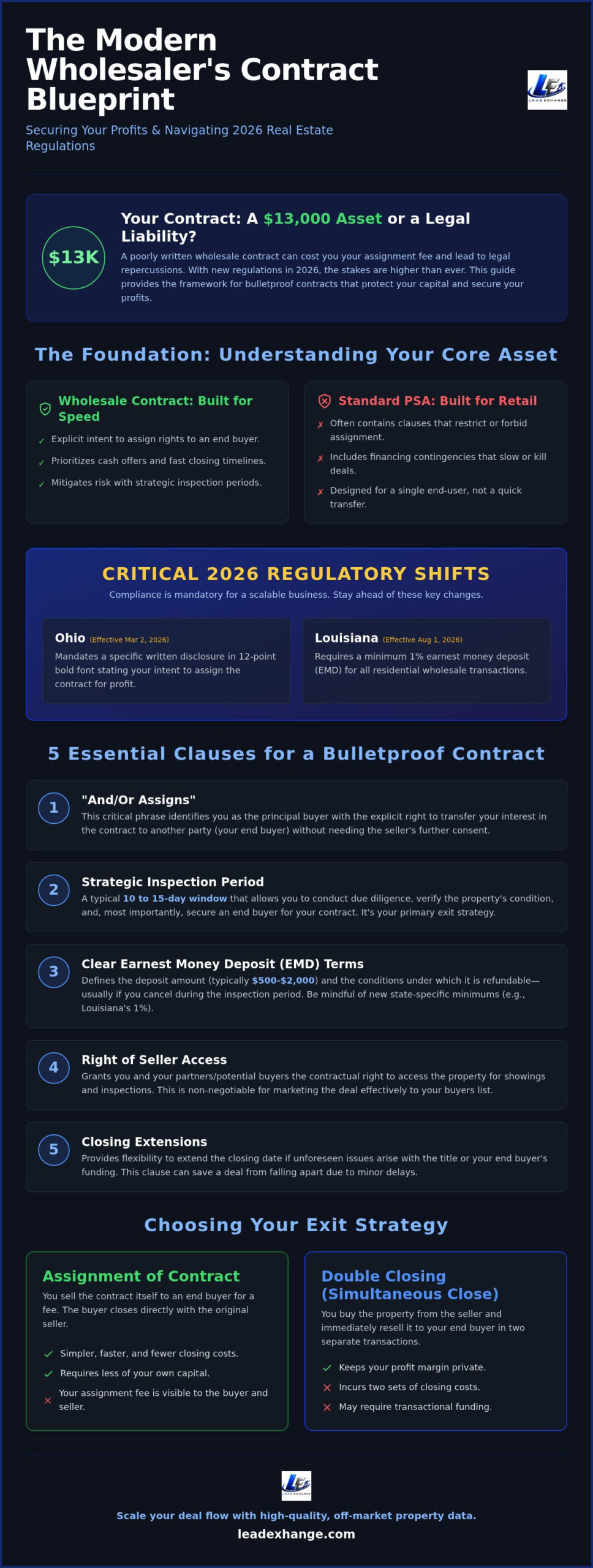
Your wholesale real estate contract isn’t just a simple purchase agreement. It is a marketable asset that determines whether you collect a $13,000 assignment fee or face legal repercussions for practicing brokerage without a license. In 2026, the stakes are higher than ever. New regulations in states like Ohio and Louisiana now mandate specific disclosures and escrow requirements that can kill a deal if ignored. You likely feel the constant pressure of protecting your earnest money while ensuring sellers don’t bypass you to work directly with your end buyer.
We understand that security and efficiency are the foundations of a scalable investment business. This guide provides the legal framework and professional roadmap you need to master the assignment process and execute deals with absolute confidence. You will gain the tools to secure your interests in high-velocity markets like Memphis and Atlanta without the traditional friction. Success in this market requires a combination of high-quality off-market leads and a contract that stands up to legal scrutiny.
We are going to break down the essential clauses every modern investor needs to stay protected. You will learn how to navigate the 2026 regulatory shifts and implement a bulletproof execution strategy. This article covers everything from assignment strategies to a professional contract template designed for rapid, secure closing.
Key Takeaways
- Secure your profit margins with a bulletproof wholesale real estate contract that includes the essential “And/Or Assigns” clause and mandatory 2026 disclosures.
- Determine whether to utilize a traditional contract assignment or a double closing to maximize efficiency and protect high-spread deal information.
- Protect your capital by mastering strategic inspection periods, ensuring you have a clear exit strategy for every off-market transaction.
- Streamline your deal flow in high-velocity markets like Memphis and Atlanta by sourcing motivated sellers through exclusive off-market property data.
- Scale your investment business with a professional execution roadmap that bridges the gap between identifying distressed properties and collecting assignment fees.
The Fundamentals of a Wholesale Real Estate Purchase Agreement
A wholesale real estate contract is a bilateral agreement where an investor agrees to purchase a property from a seller with the specific intent to assign that contract to an end buyer. It is the most critical asset you own. Without a properly structured contract, you have no deal to sell. While traditional Realtors use standardized Purchase and Sale Agreements (PSA) focused on a single buyer’s residence, your contract is built for speed and flexibility. You are a liquidity provider. You offer motivated sellers a fast exit that traditional listings cannot match. Standard Realtor-led PSAs often contain clauses that restrict assignment or require extensive financing contingencies that kill wholesale deals. Your contract removes these obstacles to ensure a seamless transfer of interest.
Wholesaling in real estate differs from retail commerce because you never intend to take long-term possession of the inventory. You are bridging the gap between a distressed asset and a cash-heavy investor. To do this effectively, your contract must be legally distinct from a standard brokerage agreement. The core value of this document lies in three areas:
- Intent to Assign: It explicitly states the buyer’s right to transfer interest to another party.
- Liquidity Focus: It prioritizes cash offers and aggressive closing timelines to solve seller problems.
- Risk Mitigation: It allows for a thorough inspection period without the heavy earnest money requirements of a retail purchase.
The Equitable Interest Concept
When both parties sign a wholesale real estate contract, you gain “equitable title” to the property. This is a crucial legal distinction. You don’t own the physical structure yet; you own the legal right to purchase it at a specific price. Wholesaling is the act of selling this interest to a third party for an assignment fee. By selling the contract rather than the house, you avoid the legal trap of brokering real estate without a license. You are a principal in the transaction, not an agent. This distinction is the foundation of a legal wholesaling business.
Wholesaling Legality in 2026
Compliance is the only way to scale in 2026. New regulations, such as Ohio’s Revised Code §5301.95 effective March 2, 2026, require wholesalers to provide a specific written disclosure in 12-point bold font. Louisiana followed suit on August 1, 2026, mandating a minimum 1% earnest money deposit for residential wholesale deals. In markets like Atlanta and Memphis, transparency is no longer optional. You must include “clear and conspicuous” language stating your intent to assign the deal for profit. High-quality leads from the Lead Exchange Starter and Growth plans make these negotiations easier. When you work with truly motivated sellers, they are more likely to accept these transparent terms in exchange for a guaranteed exit.
5 Essential Clauses Every Wholesale Contract Must Include
A wholesale real estate contract requires specific protective language to remain a marketable asset. Standard agreements often lack the flexibility needed to assign rights or exit a deal without penalty. You must understand what to know about real estate wholesaling before drafting these terms to ensure your interests are fully protected. Your contract must prioritize these five pillars to ensure you aren’t stuck with a property you can’t flip or an earnest money deposit (EMD) you can’t recover.
- “And/Or Assigns”: This identifies you as a principal who may transfer rights to a third party.
- Inspection Period: A 10 to 15-day window allows you to verify property condition and find an end buyer.
- EMD Terms: Typical deposits range from $500 to $2,000. However, be aware of 2026 regulations like Louisiana’s HB 468, which mandates a 1% minimum deposit.
- Seller Access: This grants you the contractual right to show the property to partners and potential buyers during the inspection period.
- Closing Extensions: Automatic 7 to 14-day extensions protect the deal if title issues arise or if the end buyer needs extra time for funding.
The Assignment Clause: Language for Flexibility
The purchaser field should always list your name or entity followed by “and/or assigns.” This simple addition signals your intent to the seller from the start. The assignment clause serves as the legal bridge between the wholesaler and the end buyer. While standard contracts are often rigid, this language provides the mobility required to scale your business. If you encounter “no-assignment” clauses in bank-owned or REO contracts, you must pivot to a double closing to protect your fee. Clarity here prevents sellers from claiming they were misled about who would actually be at the closing table.
Contingency and Escape Clauses
Structure your inspection period as an absolute right to cancel for any reason. This “Partner Approval” or “Due Diligence” contingency acts as your safety net. If your rehab estimates are too high or your cash buyer backs out, you can terminate the agreement and recover your EMD. You must ensure the contract explicitly states that the deposit is fully refundable if you cancel within the specified window. To find properties with enough margin to satisfy these contingencies, utilize vetted off-market leads that offer more room for negotiation. Balancing seller trust with investor protection is easier when the deal starts with a motivated lead and a transparent wholesale real estate contract.
Assignment of Contract vs. Double Closing: Choosing Your Exit
Your exit strategy is just as vital as the initial wholesale real estate contract. The method you choose to monetize your equitable interest determines your final profit and your level of privacy. In 2026, the national average assignment fee is approximately $13,000. For many deals, a simple assignment is the most efficient path. However, when spreads grow larger, or when dealing with institutional sellers, you must decide between a traditional assignment and a double closing.
Assignment involves selling your rights to the contract for a fee. It’s fast, requires no capital, and involves a single set of closing costs. The drawback is transparency. Your assignment fee is visible on the settlement statement. If you are making a $30,000 spread on a $100,000 house, the seller may feel slighted. Double closing solves this by creating two separate transactions. You buy from the seller (A-B) and sell to the buyer (B-C) on the same day. This keeps your profit margin confidential but requires you to pay closing costs twice.
When to Use an Assignment
Assignments are the engine of high-volume wholesaling. This method is best for spreads typically under $15,000. It works exceptionally well when you have established high transparency with the seller from the start. By streamlining the process using proven how to wholesale real estate tactics, you minimize friction and close deals faster. It’s the ideal choice for residential deals in markets like Memphis where speed is a competitive advantage.
The Mechanics of a Double Close
A double close requires more coordination. You’ll likely need transactional funding to bridge the gap between the A-B and B-C transactions. This funding is a specialized short-term loan that covers your purchase until the end buyer’s funds arrive. Many corporate or bank-owned sellers include “no-assignment” clauses in their agreements, making a double close mandatory. Title companies in cities like Detroit or Cleveland are highly experienced with these back-to-back transactions. They understand how to manage the flow of funds and deed recordings to ensure the wholesale real estate contract is executed legally and securely.
Step-by-Step: Executing and Assigning Your First Wholesale Deal
Execution is where your wholesale real estate contract transforms from a legal document into a tangible profit center. It begins with high-quality data and ends with a secured assignment fee. This step-by-step roadmap ensures you navigate the transition from sourcing to closing without losing your earnest money or your reputation. Success in 2026 requires a disciplined approach to every stage of the transaction.
The foundation of every successful deal is the lead source. You can’t negotiate a high-margin contract with a seller who isn’t motivated. Professionals use off-market real estate leads to target distressed properties before they hit the open market. This exclusivity allows you to offer a solution to the seller’s problem while securing a purchase price that leaves room for the national average assignment fee of $13,000.
Negotiation is about solving the seller’s problem while maintaining absolute transparency. Focus on the “net” number the seller will receive rather than just the purchase price. Once terms are aligned, execute the wholesale real estate contract with all required 2026 disclosures. This document protects your interest while you pivot to marketing. Present the deal to your cash buyer list with clear photos, repair estimates, and a firm closing date. When a buyer commits, execute the Assignment Agreement and collect your non-refundable fee to lock in the transaction.
Access high-margin off-market leads now.
Opening Escrow and Title Search
Send your executed PSA to an investor-friendly title company the moment it’s signed. You need a partner who understands the assignment process and doesn’t panic at the sight of an assignment fee. A preliminary title report is vital for wholesale success because it identifies clouds on title, such as tax liens or heirship issues, before you waste time marketing a dead deal. A clear title is the only way a wholesale fee gets paid.
Managing the Cash Buyer Relationship
Vetting your buyers is the difference between a payday and a collapsed deal. Never take a buyer’s word for their financial position. Always verify proof of funds before signing the assignment agreement. Secure the transaction by collecting a significant non-refundable deposit, often between $2,500 and $5,000. This financial commitment ensures the buyer is ready for a fast close in 14-21 days. If they won’t put skin in the game, they aren’t a real buyer. This protects your reputation with the seller and keeps the deal on track.
Scaling Your Deal Flow with Lead Exchange Off-Market Data
A bulletproof wholesale real estate contract is only as effective as the deal it secures. You can have the most sophisticated legal language in the industry, but without a consistent stream of distressed property data, your investment engine remains idle. Scaling a wholesaling operation in 2026 requires more than just knowing the law; it requires a strategic alliance with a high-performance data provider. Lead Exchange acts as this catalyst, delivering the off-market opportunities that allow you to put your legal framework into practice. By focusing on high-yield markets like Memphis, Jackson, and Birmingham, you ensure every contract you sign has the margin necessary to attract premium cash buyers.
Managing this pipeline from initial lead to final assignment requires precision. Utilizing wholesale real estate software allows you to track motivated sellers and maintain a clear execution roadmap. This integration ensures that your contract dates and inspection periods never slip through the cracks. It bridges the gap between raw data and a closed deal, turning a series of leads into a predictable revenue stream. Efficiency is the foundation of profitability in high-velocity residential markets.
The Starter Plan for New Wholesalers
For those just beginning their journey, the Starter plan provides the essential tools to secure your first few contracts. It focuses on residential deals with high flip potential, specifically curated to remove the friction of “tire-kicker” leads. Instead of wasting time on unmotivated sellers, you receive data on properties where the owner has a genuine need for a fast exit. This targeted approach allows you to practice executing your wholesale real estate contract on deals that have a high probability of closing. It’s the most efficient way to build momentum without the overhead of traditional marketing.
Scaling with the Growth Subscription
When you’re ready to transition from occasional deals to multi-deal monthly targets, the Growth subscription offers the necessary volume. This plan provides exclusive data access for highly competitive markets like Atlanta and Charlotte. These environments demand speed and accuracy. The Growth plan ensures you’re the first to identify distressed assets, giving you a significant advantage when negotiating terms. You can Access Lead Exchange Starter Plan to begin your 2026 acquisition strategy with confidence. This level of access transforms your business into an elite investment firm capable of dominating multiple markets simultaneously.
Secure Your Market Position in 2026
Mastering the legal framework of wholesaling is the difference between a thriving business and a costly liability. You’ve learned how specific clauses protect your earnest money and how to navigate the 2026 regulatory landscape. A bulletproof wholesale real estate contract is your primary defense against legal risks and lost deposits. It ensures you remain a principal in the transaction while maintaining the flexibility to assign your interest for a profit.
Success requires more than just a document. You need a consistent engine to drive high-margin opportunities into your pipeline. We provide exclusive access to residential leads in high-velocity markets like Memphis, Atlanta, and Detroit. Our Starter and Growth subscription tiers are designed to support you whether you’re securing your first deal or scaling to a multi-deal monthly target. These high-margin off-market property deals provide the spread you need to justify your fees and satisfy your cash buyers.
Take the lead in your market today. Professionalism and high-quality data will always be the fastest path to financial success. Secure your deals with confidence and build the investment engine you deserve.
Frequently Asked Questions
Is a wholesale real estate contract legal in all 50 states?
Wholesaling is legal in all 50 states, but specific disclosure and licensing requirements vary by jurisdiction. For example, Ohio’s March 2026 law requires a specific 12-point bold disclosure form. Louisiana’s August 2026 law mandates written intent and escrowed deposits. You aren’t selling the property; you’re selling the contract rights. Always verify local statutes in high-velocity markets like Atlanta or Detroit to ensure full compliance with evolving 2026 standards.
What is the “and/or assigns” clause in a real estate contract?
The “and/or assigns” clause identifies you as the primary buyer while granting you the legal right to transfer your interest to another party. It’s the core component of a wholesale real estate contract. Without this language, you may be forced to close on the property yourself. This clause signals your intent to the seller and allows for a seamless transition to your cash buyer at the closing table.
How much earnest money do I need for a wholesale deal?
Most wholesale deals require an earnest money deposit between $500 and $2,000 to show serious intent. However, state laws are changing these requirements. As of August 1, 2026, Louisiana law requires a minimum deposit of 1% of the purchase price. In most other markets, keeping the deposit low minimizes your financial risk if you can’t find a buyer during your due diligence period.
Can I wholesale a house listed on the MLS?
You can wholesale MLS properties, but it’s significantly more difficult than off-market deals. Most MLS listings use standard Realtor contracts that explicitly prohibit assignments. Banks and corporate sellers often include “no-assignment” addendums. To succeed with MLS properties, you’ll likely need to perform a double closing. This increases costs and complexity, making off-market leads a more efficient alternative for scaling.
What happens if I can’t find a buyer for my wholesale contract?
If you can’t find a buyer, you must use your inspection period contingency to cancel the agreement before it expires. This “escape hatch” allows you to terminate the contract and receive a full refund of your earnest money. If you miss this window, you risk losing your deposit or being sued for specific performance. Professional wholesalers prioritize high-quality off-market data to ensure they only contract deals with high buyer demand.
Do I need a real estate license to wholesale houses in 2026?
You generally don’t need a license if you act as a principal and sell your equitable interest in the property. However, some states like Illinois require a broker’s license for anyone wholesaling more than a specific number of deals per year. In 2026, the focus has shifted toward transparency. Proper disclosures and acting as a principal are the keys to staying within legal boundaries without a traditional real estate license.
How do I get paid my assignment fee?
Your assignment fee is typically paid by the title company or closing attorney once the transaction is finalized. The end buyer pays the assignment fee as part of their total acquisition cost. This amount is documented on the settlement statement, unless you choose a double closing to keep your profit private. The title company releases these funds to you the same day the seller receives their proceeds.
What is the difference between a PSA and an Assignment Agreement?
A Purchase and Sale Agreement (PSA) is the initial wholesale real estate contract between you and the seller. It establishes the price and terms for the property acquisition. An Assignment Agreement is a separate document between you and the end buyer. It transfers your rights under the PSA to that buyer in exchange for an assignment fee. You need both documents to complete a traditional wholesale transaction.
Disclaimer
The opinions and information shared on this website are for educational purposes only. Results from real estate investing and lead generation vary, and no specific outcome or profit is guaranteed