The most profitable wholesale houses for sale in 2026 are never actually “for sale” to the general public. They’re secured through exclusive data pipelines before a single listing hits the open market. You’ve likely felt the frustration of chasing leads only to find the ARV is inflated or the competition has already bid the price into the ground. It’s an exhausting cycle that drains your time and your capital. In a market where the average 30-year fixed mortgage rate sits at 6.79%, you can’t afford to waste resources on dead-end leads.
We agree that the current landscape is over-saturated with bad data and unrealistic seller expectations. This guide promises to show you how to identify, evaluate, and secure high-margin properties at 60-70% of their after-repair value. You’ll learn to build a repeatable sourcing pipeline that delivers vetted deals directly to your desk. We also preview the essential 2026 regulatory updates in states like Louisiana and Ohio, ensuring your contracts remain compliant while you scale your investment portfolio with precision and speed.
Key Takeaways
- Stop competing for crumbs on the MLS and discover why the most profitable deals are secured before they ever reach a public marketplace.
- Utilize a professional triage checklist to accurately evaluate wholesale houses for sale and avoid the fatal mistake of overestimating After Repair Value.
- Transition from time-intensive manual sourcing to high-efficiency private platforms that provide an unfair advantage in tight markets.
- Execute acquisitions with precision by mastering the “speed to lead” requirements essential for winning in high-demand cities like Atlanta and Memphis.
- Scale your investment volume through structured lead tiers that automate your pipeline and eliminate the friction of finding vetted, off-market opportunities.
The Reality of Wholesale Houses for Sale in 2026
Wholesale houses for sale are not your standard retail listings. They represent distressed assets secured under contract or purchased for immediate resale at deep discounts. This strategy, often referred to as real estate wholesaling, focuses on capturing the spread between a property’s current state and its potential value. In 2026, the Multiple Listing Service (MLS) has become the graveyard of investor profits. Institutional algorithms scan public listings in milliseconds; they leave human investors with overpriced scraps that don’t pencil out. Securing wholesale houses for sale requires moving into the off-market space where 30% margins are still achievable. Key markets like Detroit, Cleveland, and Memphis remain high-activity zones. These cities offer a consistent supply of distressed inventory that meets the criteria for high-margin flips or rental conversions.
Wholesale vs. Traditional Listings
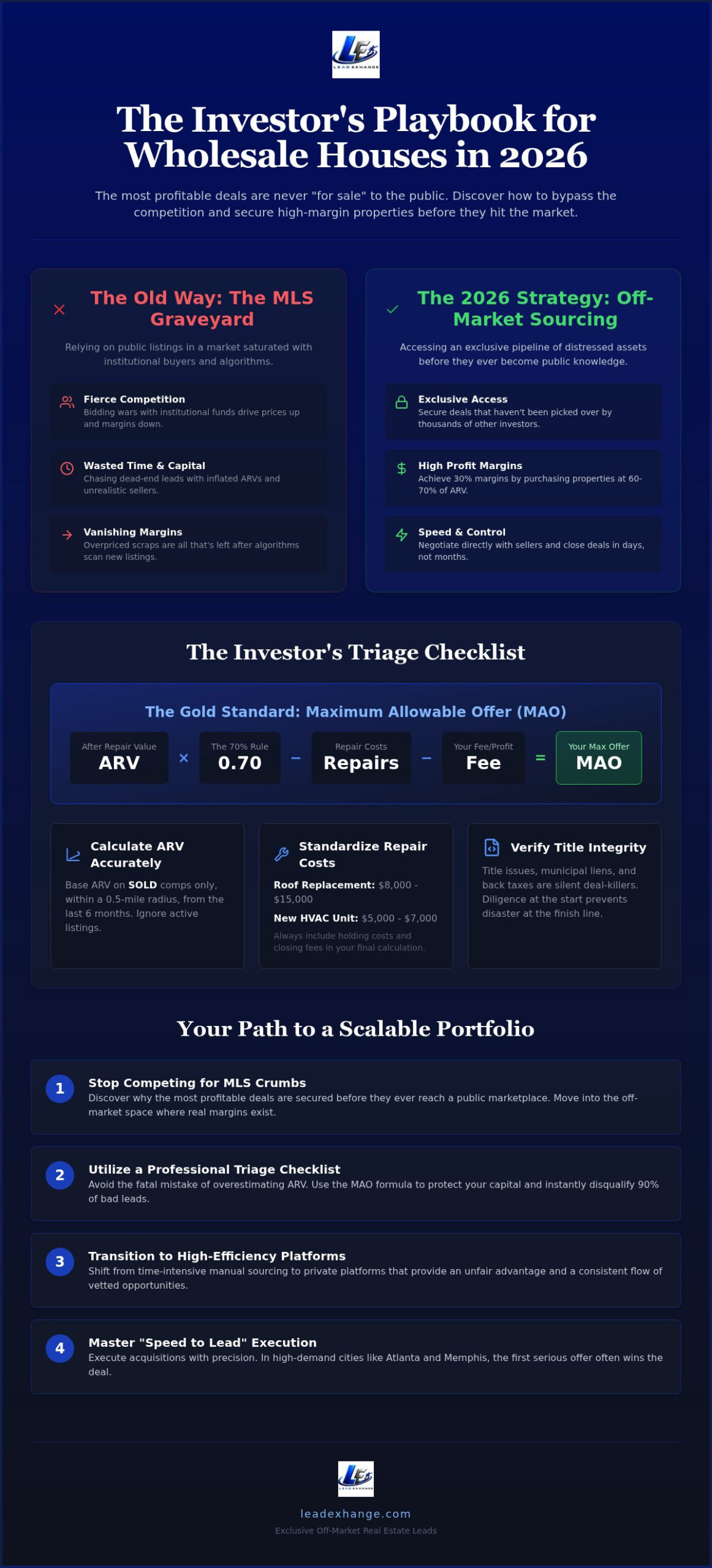
Traditional sales are slow and bureaucratic. Wholesale deals move with lethal speed; they often close in days rather than months to satisfy sellers who need immediate liquidity. You’re buying “as-is” properties that require significant repairs, structural updates, or cosmetic overhauls. In exchange for this risk, you get the gold standard of investment: the 70% rule. This formula dictates that your purchase price shouldn’t exceed 70% of the After Repair Value (ARV) minus repair costs. Traditional listings rarely accommodate this delta because sellers are looking for top-of-market retail prices. Wholesaling thrives on the pricing gap created by urgency and property condition, allowing you to secure equity on day one.
Why Investors are Moving Off-Market
Institutional buyers have choked public inventory. They have deeper pockets and lower yield requirements than independent investors. Professional flippers and landlords now rely on off-market real estate leads to bypass these bidding wars entirely. Finding wholesale houses for sale through private channels provides a buffer against the market volatility seen on public platforms. Negotiating directly with sellers allows you to dictate terms without agent interference, hidden fees, or inflated commissions. It’s the only way to maintain a repeatable pipeline in a high-interest environment where every dollar of margin counts. You aren’t just buying a house; you’re buying an exclusive opportunity that hasn’t been picked over by a thousand other sets of eyes. This exclusivity is the foundation of a scalable investment business in 2026.
Evaluating Wholesale Houses: The Investor’s Checklist
Profitable investing requires a ruthless triage process. You can’t afford to spend hours on every lead that crosses your desk. A professional framework allows you to disqualify 90% of opportunities instantly, leaving only the high-margin wholesale houses for sale. The most common mistake in this industry is overestimating the After Repair Value (ARV). In a high-interest rate environment where the average 30-year fixed mortgage rate sits at 6.79%, buyers are more selective and appraisal gaps are more frequent. Your ARV must reflect current market reality, not historical hope.
Use the Maximum Allowable Offer (MAO) formula to protect your capital. MAO equals (ARV multiplied by 0.70) minus repair costs and your desired fee. This 70% rule remains the gold standard because it provides a necessary safety net for unexpected structural issues. If you’re looking for pre-vetted deals that already meet these strict margin requirements, you might consider browsing off-market investment deals to save time on manual calculations. Local nuance is also mandatory. A “great deal” on paper in Birmingham or Gulfport can vanish if you don’t have “boots on the ground” to verify property conditions and neighborhood trends personally.
Calculating ARV and Repair Costs
Base your ARV on “sold” comps within a 0.5-mile radius from the last six months. Ignore active listings; they represent what sellers want, not what the market actually pays. You should develop a standardized repair budget for major systems to speed up your evaluation. For example, a standard roof replacement often ranges from $8,000 to $15,000, while a new HVAC unit typically costs between $5,000 and $7,000. Always include holding costs and closing fees in your final tally. These expenses can erode a $20,000 spread faster than you expect if they aren’t accounted for on day one.
Due Diligence and Title Integrity
Title issues kill deals at the finish line. In urban markets like Cleveland, municipal liens and back taxes are common hurdles that can stall a transaction for weeks. You must verify ownership and ensure a “clear” title before moving to the assignment phase. An assignment of contract is a legal mechanism to transfer purchase rights to an end buyer for a specified fee. This document must be ironclad to ensure your interest is protected and you get paid at closing. Don’t skip the due diligence phase; it’s the only thing standing between a profitable flip and a legal nightmare.
Top Sourcing Methods for Wholesale Properties
Sourcing is no longer a game of who has the loudest voice. It’s a game of who has the fastest data. Most investors treat the search for wholesale houses for sale as a static hunt for a list. Professional operators treat it as a dynamic, data-driven pipeline. You must choose between manual friction and automated efficiency. While manual methods allow for deep spreads, they often fail to scale because they rely on your personal bandwidth. If you’re ready to bypass the manual grind, you can access a curated list of off market properties for sale that are already vetted for margin and local demand.
Direct-to-Seller Marketing
Direct-to-seller methods like driving for dollars or cold calling yield the highest potential spreads. You’re catching the seller before any other investor. However, the cost of skip tracing and the high friction of direct mail campaigns can drain your marketing budget quickly. These methods have the lowest conversion rates because you’re dealing with raw, unvetted leads. You also have to manage the intense emotional aspects of distressed seller negotiations. It’s a high-effort strategy that requires a dedicated team or a massive time commitment. For many, the “sweat equity” required to find wholesale houses for sale this way isn’t sustainable for long-term growth.
Professional Lead Platforms (SaaS)
The modern investor relies on SaaS platforms to aggregate off-market homes for sale into a single, actionable dashboard. Lead Exchange provides this “unfair advantage” by delivering exclusive data directly to your inbox. This model allows you to get to the seller before the first direct mail flyer even arrives. It removes the guesswork from sourcing and lets you focus on closing rather than hunting. Subscription tiers make this scalability accessible to everyone:
- Starter Plan: Designed for new investors looking for low-friction entry into key markets.
- Growth Plan: Tailored for high-volume scaling with increased lead volume and deeper data insights.
Using a professional platform ensures your pipeline stays full without the burnout of manual cold calling. You’re paying for speed and precision. In competitive hubs like Atlanta or Memphis, that speed is the difference between a closed deal and a missed opportunity. Sourcing via SaaS moves your business from a reactive state to a proactive one. You stop chasing the market and start dictating your own deal flow.
Executing the Acquisition: From Lead to Closing
Identifying wholesale houses for sale is only the first half of the battle. Execution requires a clinical approach to paperwork and timelines. In hyper-competitive markets like Atlanta, “speed to lead” isn’t a suggestion; it’s a requirement for survival. If you hesitate for even six hours, an institutional buyer or a more aggressive wholesaler will likely snatch the deal. You need a pre-vetted network of investor-friendly title companies that understand the nuances of non-traditional transactions. These partners are essential because they know how to handle specific investor requirements that traditional retail title companies might find confusing or risky. They ensure the process remains fluid and legally sound while meeting tight deadlines.
Professional execution also involves choosing the right exit strategy before you even sign the contract. You’ll typically decide between an “Assignment of Contract” and a “Double Closing.” Assignments are cleaner and more cost-effective. They allow you to transfer your purchase rights to an end buyer for a simple assignment fee. Double closings are more discreet. They involve two separate transactions occurring back-to-back. This method is often preferred when your profit spread is significant, as it prevents the end buyer from seeing exactly how much you’re making on the deal. Choose the method that aligns with your specific margin and the level of transparency required to keep the transaction moving forward.
The Offer and Contract Phase
Craft a cash offer that solves the seller’s immediate problem. Motivated sellers usually prioritize certainty and speed over the highest possible price. Your contract must be concise but protective. Include a clear inspection period that allows for a final repair assessment before you’re fully committed. Ensure the “and/or assigns” language is present in the buyer field to maintain your flexibility. Once the seller signs, submit your earnest money to the title company immediately. This demonstrates professional intent and officially secures your position as the lead buyer for these wholesale houses for sale.
Closing Logistics and Funding
Review the HUD-1 or settlement statement meticulously before the closing date. You’re looking for any unexpected junk fees or clerical errors that could erode your bottom line. If you don’t want to use your own capital for the purchase, leverage transactional funding. This short-term financing covers the “A-to-B” side of a double closing for a few hours until the “B-to-C” funds from your end buyer arrive. Finally, perform a walkthrough 24 hours before the wire transfer. You must confirm the property condition hasn’t changed or been stripped of fixtures since your last visit. This final check protects you from inheriting new liabilities at the last minute.
Scale Your Portfolio with Lead Exchange Exclusive Leads
Lead Exchange acts as your primary strategic partner in high-velocity markets like Memphis and Charlotte. We eliminate the uncertainty of sourcing by providing a direct pipeline to exclusive inventory. You don’t just get data; you get an unfair advantage. Our platform bridges the gap between high-level opportunities and investors ready to capitalize on them. Whether you’re looking for your first flip or your fiftieth, our system streamlines the search for wholesale houses for sale. We focus on the bottom line so you can focus on the close.
Scaling requires different tools at different stages of your business. Our Starter plan offers a low-friction entry point for those beginning their journey. It provides access to vetted leads without the overhead of a full-scale marketing department. For professional wholesalers, the Growth tier delivers high-volume, exclusive data designed for rapid expansion. This isn’t a generic list. It’s a precision-engineered tool for aggressive portfolio growth. You get the volume you need to keep your renovation crews busy and your capital deployed.
We operate with a unique dual-service model that sets us apart from traditional lead providers. Lead Exchange is both a SaaS provider and a direct source of off-market inventory. We don’t just point you toward leads; we often vet and acquire distressed properties ourselves before making them available as off-market investment deals. This means you gain access to ready-to-close opportunities that have already passed our rigorous internal triage. You’re buying into a pipeline that has been scrubbed for quality and margin.
Data-Driven Advantage in 2026
Public marketplaces like HouseCashin often feature stale inventory that has already been picked over by thousands of users. In 2026, exclusivity is the only currency that matters. Our data-driven approach focuses on high-probability distressed assets in Detroit and Cleveland. We prioritize leads with motivated sellers who need to move fast. This focus allows our users to find wholesale houses for sale and move from initial lead to signed contract in as little as 48 hours. Speed is your greatest asset in a market that doesn’t wait for laggards. We give you the data to move first.
Your Next Step in Real Estate Investing
Waiting for a “perfect” MLS deal is a losing strategy. The public market is too crowded and the margins are too thin to support a scalable business. You need to integrate a consistent flow of private leads into your existing acquisition workflow to stay competitive. Lead Exchange provides the volume and quality necessary to outpace the competition. Stop reacting to the market and start controlling your deal flow with vetted, high-margin opportunities. The most successful investors in 2026 aren’t the ones working the hardest; they’re the ones with the best access.
Dominating the 2026 Off-Market Landscape
The 2026 real estate market doesn’t reward those who wait for public listings. Profitability now depends on your ability to bypass the over-saturated MLS and secure deals before they become common knowledge. You’ve learned how to apply the 70% rule with surgical precision and why “speed to lead” is the primary differentiator in high-stakes markets like Atlanta, Detroit, and Memphis.
Success requires a shift from manual hunting to data-driven acquisition. By focusing on exclusive off-market inventory, you protect your margins from bidding wars and institutional competition. Our specialized Starter and Growth plans provide the scalability needed to build a repeatable pipeline without burning out on dead-end leads. Identifying high-margin wholesale houses for sale is no longer a matter of luck; it’s a matter of having the right strategic partner to facilitate your progress.
Take control of your deal flow today. The most profitable opportunities are waiting for those bold enough to move first.
Frequently Asked Questions
What exactly are wholesale houses for sale?
Wholesale houses for sale are distressed assets secured by an investor at a deep discount for immediate resale to another buyer. These properties are typically not listed on the public market and require significant renovation. Investors secure them using the 70% rule to ensure enough margin exists for the end buyer to profit after repairs. They represent the primary inventory for flippers and landlords seeking high-equity positions.
How do I find wholesale properties without a real estate license?
You can find these properties by utilizing data-driven platforms or direct-to-seller marketing tactics like cold calling and driving for dollars. In most jurisdictions, you don’t need a real estate license to wholesale because you’re selling your equitable interest in a contract rather than the property itself. However, 2026 regulations in states like Ohio and Louisiana now require specific disclosures to remain compliant. Using a professional platform helps you navigate these legal nuances.
Is buying a wholesale house risky for new investors?
Risk is inherent in any distressed asset acquisition but it’s manageable through rigorous due diligence. The primary dangers involve overestimating the After Repair Value or underestimating renovation costs. New investors often fail because they rely on seller-provided data rather than independent comps. Success requires verifying every line item on your budget and ensuring the title is clear of municipal liens before you commit any earnest money to the transaction.
Why are wholesale houses sold for cash only?
Cash is the preferred medium because it guarantees the speed and certainty that motivated sellers require. Traditional lenders won’t finance properties with major structural issues, roof damage, or outdated systems. By removing the mortgage contingency, you become a more attractive buyer to someone facing foreclosure or probate. Cash transactions also allow for the 48-hour closing windows common in high-demand markets like Atlanta where competition for distressed inventory is fierce.
How much money do I need to start buying wholesale houses?
The capital required depends on your specific acquisition strategy. If you’re assigning a contract, you may only need a few thousand dollars for earnest money deposits and marketing. If you’re performing a double closing, you’ll need access to the full purchase price through transactional funding or private capital. Most professional wholesalers maintain a liquid reserve to secure wholesale houses for sale quickly when exclusive, high-margin opportunities arise in their target markets.
What are the best cities for finding wholesale real estate in 2026?
High-growth hubs with consistent distressed inventory remain the top targets for 2026. Cities like Memphis, Detroit, and Cleveland offer the best pricing deltas for investors seeking 30% plus margins. Atlanta and Charlotte also show high activity but require faster execution due to increased institutional competition. These markets have the necessary infrastructure of investor-friendly title companies and reliable contractor networks to support a scalable flipping business and rapid project turnover.
How does Lead Exchange differ from a traditional real estate site?
Lead Exchange provides exclusive, off-market data through a SaaS model rather than acting as a traditional brokerage. We connect you directly with high-probability leads in cities like Memphis and Detroit before they reach public platforms. Our Starter and Growth plans allow you to scale your lead volume based on your specific bandwidth. Unlike traditional sites, we also directly acquire and resell vetted deals to our subscribers to ensure a consistent flow of quality inventory.
Can I use a mortgage to buy a wholesale house?
Traditional mortgages are rarely compatible with wholesale transactions. Properties are usually in too poor of a condition to meet FHA or conventional lending standards. Furthermore, the speed required to secure wholesale houses for sale often exceeds the 30-day processing time of a bank. Professional investors use hard money, private capital, or transactional funding to bridge the gap between acquisition and the final exit or refinance once the property is stabilized.
Disclaimer
The opinions and information shared on this website are for educational purposes only. Results from real estate investing and lead generation vary, and no specific outcome or profit is guaranteed